The Government Attack on Public Health Research
I have been conducting transdisciplinary research on HIV/AIDS, COVID, overdose, and related topics for over forty years. In my HIV research, I have had to try to understand a virus that, without intervention, destroys its host human body within about ten years—which might look like a recipe for a viral disease’s self-destruction. Underlying this, however, there is the logic of community transmission dynamics and the survival of HIV as a functioning pandemic. This background may be useful in trying to understand the attacks by Trump and his supporters on public health research. As Gregg Gonsalves (one of my heroes) writes in the July 10, 2025, issue of The Nation , “Some might think that the effects of this crisis won’t reach them. They’re wrong.” The government’s actions in attacking public health institutions and research threaten the health of everyone in the United States and, in all probability, the world.
Nonetheless, this apparently idiotic attack on public health research does seem to have an underlying logic based on a need for wealth and power, belief in “free competition” as the best way to develop innovations, and racist arrogance. All of these have been dominant motifs in the discourse of American politics this century, and all have been exemplified most strongly by the actions of the current administration in Washington, which seems to be dominated by an alliance of what Sam Farber has called the “lumpenbourgeoisie” like real estate hustler Trump and the new rich owners of “high tech,” many of whom exhibit beliefs in their own superiority, right to rule, and eugenic racism 1-3. Although most readers of this article will agree with me that these people are evil, it is crucial to remember that they are not stupid and, within the somewhat-elastic constraints of their ideologies, capable of strategic and rational thoughts (directed to their ends).
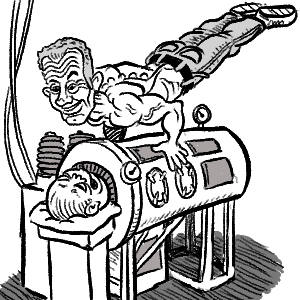
Before going into this logic, I want to say a few words about the reality and scale of the attack on public health research. A particular target has been research on infectious diseases like HIV/AIDS, COVID, bird influenza, and measles, with particular focus on vaccine research. The cuts have also targeted research to reduce the racial differences in disease and death; presumably, this targeting aims to maintain the pattern whereby people who are not white live shorter and sicker lives, and to do so in an environment where cuts to public health in general mean that there is more disease and more mortality among the working classes. Another target has been research in foreign countries, which has been devastating for diseases that are concentrated (for example) in Africa.
Another characteristic of these attacks is that they are broad and massive, with thousands of research grants having been abruptly terminated, additional research ended at the time of annual renewal (which has previously usually been just a formality), and with additional targeting of certain universities (such as Columbia). Another theme is that, due to action in the courts or otherwise, research that is halted is sometimes resurrected—although still vulnerable to additional attacks. Given the huge cuts in research budgets passed by Congress, however, such as a 40% cut in the NIH research budget, federally-funded research on public health will plummet, and cuts in the numbers of NIH and other staff processing grant proposals will make getting them become ever more difficult.
Overall, this pattern also aims at intimidation of researchers, and has demoralized and/or ended the careers of many others—some of whom have been angered and radicalized (to the left) rather than intimidated. Many have been contemplating leaving the country to find jobs elsewhere, and I have myself urged some young colleagues to consider this. Undoubtedly, many will find themselves working for corporations or the US military—which is probably one of the current regime’s goals.
One element that I have not seen previously discussed is that the pattern of cuts together with the desperation of students, post-docs, and faculty who need to publish may well set the stage for corruption, which is a common theme both in authoritarian regimes and in the ethics of the Trump and his allies.[1] Some of it will be semi-legal corruption—what Robert Kennedy wants, Kennedy will fund (since the institutional limitations on this have been dismantled)—which means that blandishments and inducements may yield grant money. Some is likely to be clearly illegal, such as bribing public officials. In any case, such corruption will likely also corrupt the rigid honesty that effective scientific research requires. (Indeed, in recent years, instances of outright scientific fraud seem to have become more frequent under the competitive pressures researchers have faced—and this can only increase given government and corporate attacks on the budgetary, intellectual and ethical foundations of science.)
What Kind of Rationality Underlies These Attacks on Public Health Research?
In this section, I will try to lay out what may be the underlying logic behind these attacks. I recognize that many readers, and many colleagues, simply see them as insane and self-defeating for the Trump regime’s own goals—and to some extent, they may be right. Nonetheless, even if these efforts are self-defeating, they do seem to have an inner logic.[2]
Despite all of their bluster about making America great again, the Trump regime is a product of an American ruling class in desperation. It faces at least two major threats for which it has no solution: The Chinese challenge to American economic and military domination and profits, and climate change.[3] Furthermore, looking around the world, it can forecast that failure to solve these problems will lead to major social unrest and perhaps rebellion in the United States itself.
Trump and his elite allies are a subset of the American ruling class that is following the lead of other countries’ rulers facing parallel threats such as Putin, Xi, Modi, and Orban. Its strategy is authoritarian rule and armed force to keep the people under control and a focus on unleashing “free enterprise” to meet its other problems. Both the lumpenbourgeoisie and the billionaires of high tech see competition (with support for themselves from government) as the best way to innovate and profit, and thus as the most likely pathway to find technical solutions to climate change (since a bottom-up eco-socialism is beyond their ken). To meet the military threats to imperial rule, they have adopted the traditional American policy—more money for the military. Since unregulated free enterprise is in their opinion necessary to meet these challenges, their Congress has approved vast tax cuts to put investible cash in the hands of those whom they consider able to use it best—the rich, since the “free market” will guide them to invest it optimally. They are doing their best to make the US a low-wage, high productivity economy (like China) so they can compete with their imperial rivals—and for this reason, too, they are attacking unions and all elements of the social wage such as health care and education.
So Why Attack Public Health Research?
In addition to more general issues like (a) saving money that could go to the military or to profit-making and investment and (b) intimidating and demoralizing potential political opposition, attacking public health research has several other effects in line with the Trump regime’s goals. These include:
- Hiding evidence about the dangers of fossil fuels, climate change, and other forms of ecological destruction.
- Re-directing trained and innovative researchers to working for private industry or the military—which may help maintain American military dominance or cope with climate change.
- Increasing the difficulties faced by the broad American working class. People who are sick or are caring for the sick or disabled are less able to organize militant opposition to employers’ efforts to lower labor costs.
- Reduce the numbers of people in “disposable” populations by reducing research discoveries that may keep them alive and healthy. One lesson of COVID has been that older people who are living off of pensions or Social Security are more likely to die, as were members of racial/ethnic groups Trump and his allies tend to look down upon (and who might be more likely to oppose them politically or vote against them) like Black and Brown people, and Native Americans. In addition, poor workers and undocumented immigrants are also disproportionately vulnerable to disease. This applies both within the United States and in other countries. The cutting off of public health and medical research in Africa, for example, is likely to lead to millions of people dying in the next decade.

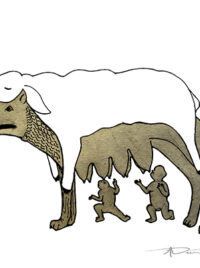
Artist: Drew Martin
As I write this, I am fully aware that this paints a picture of the Trump regime as at best indifferent to the suffering and deaths their policies are causing. Such indifference is fully in accord with the racist, elitist, and eugenic beliefs that many of them hold and even boast of2,3. Further, this is in accord with a long history of actions and non-actions not only by the MAGA movement and its their reactionary forebears, but also by their “opponents” in the Democratic Party wing of the capitalist class and political elites, who have actively supported genocide in Palestine for years now, and have been at best indifferent to the mass deaths caused by wars in Sudan and in Central Africa.
Resistance
Public health researchers and employees of public health agencies have mounted some resistance to these attacks, although with limited success to date. Defend Public Health, for example, was formed since the election of Trump to educate the public about the need for public health research and action, including by writing opinion pieces for local and national publications and by testifying before Congress and other legislative and administrative bodies. Pre-existing professional associations like the American Public Health Association have also engaged in a range of lobbying and testifying. Individual researchers and groups of researchers, sometimes aided by universities or other recipients of research grants, have sued for restoration of funds, sometimes with some success.
Like other forms of liberal response to the Trump regimes, none of these approaches will beat back the attacks. This is shown by the fact that Congress passed massive reductions in the NIH and CDC budgets, and this will reduce public health research drastically. Lobbying and pro forma demonstrations are forms of action appropriate for “normal times” (which may never return.)
Some forms of relatively “normal” opposition may have some success at continuing needed research. As long as this remains possible, for example, lobbying and mild protest may convince some states to increase or establish public health research programs. California, for example, funded a lot of AIDS-related research for decades. (It is not clear if this will be sustainable in the future.) Beyond that, various forms of “citizens’ science” or mutual aid research may be possible. Gay communities organized this around AIDS in the late 1980s and the 1990s, and some forms have continued. The Patient-Led Research Collaborative has conducted important research on Long COVID.
None of these actions will suffice to replace the public health research the Trump regime is destroying, but they can help, and can also feed into the more general resistance against attacks on public health programming and, beyond that, attacks on the living standards and freedoms of people in the US and the world. Such efforts to defend ourselves against the authoritarian state the Trump regime is are organizing will not be easy. When the ruling classes are desperate due to threats to their power and wealth, and turn to authoritarian rule, it takes mass disruptive action and perhaps insurrectionary efforts like those in European Georgia to resist them. Whether for better or worse, we are in a period where the normal activities of scientists will not be very successful. The most effective ways to further public health now have to go beyond research and normal politics to include organizing for mass action, political strikes that support and grow from what are called economic strikes and “strikes for the common good,” and deep political education of and by millions of people.
- Farber S. Donald Trump, a Lumpen Capitalist. Jacobin2018.
- Caplan A, Tabery J. Donald Trump Wants to Make Eugenics Great Again. Let’s Not. Scientific American. October 17, 2024 2024;
- Metraux J. Eugenics Isn’t Dead—It’s Thriving in Tech. Mother Jones2025.
[1] Even before now, the pressures of academic competition have led a number of researchers into what is politely called research misconduct. Here is one among many listings of incidents that have been uncovered, although I cannot vouch for its accuracy: https://research.uky.edu/research-misconduct/news. The current budget cuts and related fear create a climate for such corruption to become much more prevalent.
[2] I have discussed possible logics behind the broader attacks on science, including their links to religious obscurantist thinking and how capitalism generates a propensity for mystical thinking, in a previous article. See Friedman, Sam. 2025.Attacks on Science: Is there an underlying logic? New Politics 79. XX, NO. 3 SUMMER. pp. 21-29.
[3] Although some ruling capitalists and politicians may sincerely believe climate change not to be man-made, few are stupid enough to ignore Department of Defense warnings about its severity, the predictions of the Intergovernmental Panel on Climate Change, or the increase in forest fires and extreme heat events.
Author

Latest Issue
2025: Vol. 24, No. 1-2
Latest Issue
2025: Vol. 24, No. 1-2

Essays
Democracy in Danger
Essays
Democracy in Danger
By Robert R. Kaufman: Democratic Resilience in the United States: Containing Trump’s Threat to Democracy
Essays
Global Tensions
By Meera Nanda: India’s Conservative Revolution: The Postcolonial Left meets the Hindu Right
Essays
Global Tensions
By Donatella Della Porta: Eventful Protests Against the Israeli Genocide: The Italian “Hot Summer” for a Free Palestine
Essays
Global Tensions
By Dina Khapaeva: Investigating Putinism: History Over Ideology
Essays
Global Tensions
By Nader Entessar: Apocalypse Now? The Evolution of Trump’s Policies Towards Iran
Essays
The Assault on Public Goods
Essays
The Assault on Public Goods
By Sam Friedman: The Government Attack on Public Health Research
Essays
The Assault on Public Goods
By David Schultz: American Higher Education in the Era of Trump
Essays
Socialism and the City
By Shelton Stromquist: Mamdani, a “New Municipalism”, and the Undertow of Party Elites
Essays
Socialism and the City
By David R. Berman: A Socialist Mayor for New York? What History Suggests
Essays
Aesthetic Reevaluations
By E. San Juan, Jr: Reflections on Shelley’s The Cenci: Transgression, Exorcism, Sacrifice
Essays
Aesthetic Reevaluations
By Jack Miller: The Metonymy of Light: Three Early Works by Stan Brakhage
Author Meets Critics
Michael J. Thompson's Twilight of the Self
By Lauren Langman: On Michael J. Thompson’s Twilight of the Self
Author Meets Critics
Michael J. Thompson's Twilight of the Self
By Jeffrey A. Halley: Domination, Weirdness, and Art: On Michael Thompson’s Twilight of the Self
Author Meets Critics
Michael J. Thompson's Twilight of the Self
By Charles Thorpe: From Critical Agency to Critical Solidarity
Author Meets Critics
Michael J. Thompson's Twilight of the Self
Book Reviews
By Paul Buhle: Benjamin Balthaser’s Citizens of the Whole World
Book Reviews
By Galina Bogatova: Paul Chaisty and Stephen Whitefield’s How Russians Understand the New Russia
Book Reviews
By Patrick D. Anderson: David Golumbia’s Cyberlibertarianism
Book Reviews
By Paul Buhle: Harold Schechter and Eric Powell’s Dr. Werthless
