Reflections on Shelley’s The Cenci: Transgression, Exorcism, Sacrifice
The true difference between Byron and Shelley consists in this, that those who understand and love them consider it fortunate that Byron died in his thirty-sixth year, for he would have become a reactionary bourgeoise had he lived longer; conversely, they regret Shelley’s death at the age of twenty-nine, because he was a revolutionary through and through and would consistently have stood with the vanguard of socialism.
– KARL MARX, On Literature and Art (320-21)
I do not wish women to have power over men; but over themselves. It is justice, not charity….All the sacred rights of humanity are violated by insisting on blind obedience…A slavish bondage to parents cramps every faculty of the mind.
– MARY WOLLSTONECRAFT-GODWIN, A Vindication of the Rights of Women (167-70)
Once a darling of Romantic pantheon-worshippers, Percy Bysshe Shelley (1792-1822) suffered a decline after Eliot and American New Criticism elevated the metaphysicals and a modernist standard in the decades between the two World Wars. At least one college anthology, Literature of the Western World edited by Brian Wilkie and James Hurt, omitted Shelley at the apex of the Cold War. Surely not because Shelley was a visionary idealist or a sentimental dreamer. He scandalized his peers because of his anarchist belief in the perfectibility of mankind inspired by William Godwin. More scandalous was Shelley’s manifesto on The Necessity of Atheism (1811) for which he was expelled from Oxford. None of the detractors have seriously taken into account Shelley’s A Philosophical View of Reform (composed in 1820 but not publlshed until 1920), or the political resonance of The Cenci in the context of first-person accounts such as that of Neige Sinno (Christensen 2025), to contextuallize Shelley’s radical but nuanced view of the need for profound social changes and transvaluation of values.
The Establishment rejection of Shelley’s poetry was laid out by F.R. Leavis in the Thirties. Leavis applied an “individualistic explanatory code” that allowed him to attribute Shelley’s “abstract subjectivism” to the poet’s childhood. That period of growing up “left him bereft of any social or religious tradition which would have grounded self-expression in a wider context” (McCallum 1983, 165). In Revaluations (1936), Leavis privileged the idiosyncratic, arbitrary predispositions of the poet as the basis for his dismissal of certain writers excluded from his canon. Decades after, in 1957, D.W. Harding’s formalist appraisal followed Leavis’ cue in blaming Shelley’s narcissism, a view influenced by Mario Praz’s study, The Romantic Agony (1933), However, Harding perceives “discursive thought” amid the direct “expression of emotional states,” of moods and attitudes not dependent on intellectual analysis and ordering, as in some lines of “Adonais,” “Ozymandias, and ‘Ode to the West Wind” (1957, 210-29). This suggests that we need another standard of judgment to understand and appreciate Shelley’s poetics.
The academic orthodoxy may be sampled in this comment from the widely used entry in The Reader’s Companion To World Literature (1973). It attempts to mediate opposing views. Matthew Arnold’s “picture of Shelley as the ‘beautiful and ineffectual angel beating in the void his luminous wings in vain’ is a narrow judgment even on his poetry. And his prose is clear, vigorous, and brilliant, certainly never ineffectual or in vain, or in a void. Yet…Shelley moved in a world of abstract ideas, without reference to practical considerations or the everyday world,….without a sense of proportion or…a sense of humor” (Hornstein et al, 484).
A symptomatic exhibit is Shelley’s letter to his pregnant wife Harriet. complaining that she betrayed and abandoned him, and instructing her to repair the “injustice” by sending him “stocking, hanks & Mrs. Wollstonecraft’s posthumous works” (Davidson 219)–shades of Marquis de Sade’s ironic, deconstructive humor?
The bias against Shelley persists today. In the fifties, Raymond D. Havens cited T.S. Eliot’s stigmatization of Shelley with an example of the New Critic’s biographical optic. Eliot could not separate the man from his writing: “I find his ideas repellent…and makes it difficult to read the poetry without remembering the man [who was] humorless, pedantic, self-centered, and sometimes almost a blackguard” (quoted by Havens 169-70). If so, forget Shelley. The most recent sledgehammer stroke is from Paul Johnson who called the poet “a lifelong absconder and cheat.” Why? Because he abused “well-meaning and sensitive men like Castlereagh and Sir Robert Peel in ‘The Mask of Anarchy,’ just as he abused his creditors and discarded women” (49) So obsessed with Shelley’s “sexual and financial misdemeanors,” Johnson’s tirade becomes a symptom of malice and self-righteous vindictiveness. Against this moralizing dogmatism, we can take the efforts of Earl Wasserman, Harold Bloom, C. S. Lewis, and other scholars to reinscribe Shelley’s utopian, prophetic imagination as part of the Western canon, not to mention Paul de Man’s praise of the undecidable rhetoric of ‘The Triumph of Life” as certainly postmodern (93-124). Further confirmation is supplied by Donald Reiman’s tabulation of new appraisals in the 2002 Norton Critical Second Edition of Shelley’s works.
Beyond the Establishment Bias
In the thirty years of his life, Shelley composed verses noted for their intensity, sensuous imagery, and rhapsodic quality. Their themes and rhetoric sought to prove that, as he proclaims in Defence of Poetry (1821), poets are the “unacknowledged legislators of the world.” Proof of this ranges from the celebration of freedom and progress, “Hymn to Intellectual Beauty,” the lyrical drama Prometheus Unbound, Queen Mab, The Revolt of Islam, “The Mask of Anarchy,” and Hellas. All these are confirmed worthwhile pondering, except for the verse-drama The Cenci (1819) which, neglected for so long, acquired notoriety with Artaud’s version as an exemplum of his “theater of cruelty.” Shelley was surely an anarchist but not yet a metaphysical nihilist, as E.P. Thompson remarked with reference to Shelley’s influence on the socialist poems of William Morris (669) On the other hand, in a laudatory essay on “Shelley’s revolutionary poetry” (2022), Tess Lee Ack cites the 1819 “To the Men of England” and “The Mask of Anarchy” as proofs of Shelley’s radicalism, but fails to mention The Cenci.

Percy Bysshe Shelley
Substantial commentary has been given to this closet drama from its initial publication by Oscar Wilde and George Bernard Shaw, among others. In The Cenci, we are surely far from parsing abstract universals and cosmic ideals since the killing of the patriarch by his children and the violation of the incest taboo confronts us with the imperatives of casuistry and juridical ambiguity (Curran; Nicholl). We face the explosion of implacable emotions delivered in impassioned language. What is the story about? In 1577, Beatrice Cenci and her stepmother were beheaded for killing Count Cenci (1549-1599), widely known as a debauched, corrupt, cynical tyrant. He imprisoned and tortured the two women at his isolated castle Rocca Petrella. In their trial, violent abuse and rape of Beatrice was mentioned, as Stendhal cites from a contemporary account (163-202). But Pope Clement VIII discounted the Count’s criminality and approved the beheading of the women for fear that clemency might encourage homicide among the nobility. Today, offenders of the incest-taboo are judged felons guilty of statutory rape, having abused a blood relation; the rape is a crime deserving imprisonment. Given the traditional plebeian animus against the upper class, the Roman populace watching the execution sympathized with the fate of the victims, upholding Beatrice as a martyr of a tyrant-master and a proto-symbol of modern feminist solidarity.
Feminist scholars have of course noted the poet’s militant defense of the oppressed women, Beatrice and Lucretia. One may ask the simple preliminary question: Why was Shelley fascinated with the incestuous aristocrat whose cruelty seems out of proportion to the sociopolitical circumstances surrounding his actions? What intrigued Shelley in this exorbitant rapacity and the women’s ambiguous if ambivalent responses? We set aside here the question of why Shelley departed, if at all, from the view that Beatrice was not raped at all, only threatened, and that she had sexual relations with one of the murderers. We focus on the plot and its theatrical effects to discover why the defilement and the exorcism of its evil resonance served Shelley’s aim of exalting the female protagonist as sacrificial offering to the restoration of social order (emblematized by mother and daughter), and as agent of exorcism–purging the sin of violating the taboo and its transgressor. The play excites terror at the violence of the patriarch and the torturers, while enveloping the victimized women with the pathos of resignation.
Disrupting Everyday Life
The feudal lord Francesco Cenci (1549-1599) lived at the height of the Counter-Reformation led by Pope Paul IV and the Jesuits. The Roman inquisition was set up in 1541, while the Council of Trent proceeded from1545 to 1563. The St Bartholomew Massacre in France occurred in 1572. Pope Pius IV reasserted papal authority, a revised Index of Prohibited Books, henceforth “an ascetic quality unknown for centuries settled over Roman life” (Garraty and Gay 545). But during the Cenci affair, Pope Clement VIII was preoccupied with the intra-European conflict between the Dominicans and Jesuits over the issue of free will, God’s grace, and original sin; he died before he could decide this internecine war that involved feudal principalities (Fulop-Miller 96-99). It was in this milieu that Clement VIII in effect rejected the Jesuit Molina’s Concordia thesis on human free will, offering the Cencis as sacrificial victims to expiate the sin of the fathers and purge the violation of sacred taboos. He also embodied the voracity of the Church for real estate, confiscating the Cenci’s property and enlarging the Papal fiefdom, thus making it the prime defender of feudalism against peasant and guild revolts (Tigar and Levy 41).
All accounts center on Count Cenci’s cruelty and abuse of his family, the murder of his sons, and in particular the rape of his daughter. Other debauched patriarchs may have done the same, even more; but why focus on this violence, the torture of his family in his castle, Rocca Petrella, in the Kigdom of Naples? With his seigneurial estates diminished, the Count seems to lack the virtu that Machiavelli (1977, 193-206) ascribed to an effective Renaissance ruler such as Cesare Borgia. In fact, the Count seeks to prove his virility by abusing his first wife Ersiliaa Santacroce, and then his daughter (Britannica 2019, 660-661). Public accounts indicate that in 1598, Beatrice, her stepmother Lucrezia and brother Giacomo conspired to kill the Count and they were subsequently beheaded in 1599 by order of the Pope despite the community’s clamor for their pardon. On the surface, this “tragic resistance” of the three victims of patriarchal tyranny was etched in the public memory and became part of Italian/European folklore, inspiring Stendhal’s retellling, Alberto Moravia’s play, and Frederic Prokosch’s novel A Tale for Midnight, among other artistic versions. Are the scandalous acts of incest and barbaric sadism what attracted Shelley to.compose the play?
In his dedication of the work to Leigh Hunt, Shelley calls it “a sad reality” devoid of “presumptuous” instruction. in his “Preface,” he points to the Count’s “incestuous passion, aggravated by every circumstance of cruelty and violence’” toward his daughter, pushing her to escape from a “perpetual contamination both of body and mind.” She was urged to kill the Count “by an impulse which overpowered its horror’ (Shelley, Cenci 5). But what Shelley adds reveals his real motive: to expose the corruption of the Papacy whose motive was not “love of justice,” but rather because “whoever killed the Count Cenci deprived his [the Pope’s] treasury of a certain and copious source of revenue.” At any rate, Shelley attempts to justify the “fearful and monstrous” story with his realism and refusal to insist on a didactic purpose, a claim redolent of irony and shrewd suasion: “The person who would treat such a subject must increase the ideal, and diminish the actual horror of the events, so that the pleasure which arises from the poetry which exists in these tempestuous sufferings and crimes may mitigate the pain of the contemplation of the moral deformity from which they spring…The highest moral purpose aimed at in the highest species of the drama [not necessarily Shelley’s] is the teaching the human heart, through its sympathies and antipathies, the knowledge of itself…Imagination is as the immortal God which should assume flesh fo the redemption of mortal passion” (Cenci 7, 9)
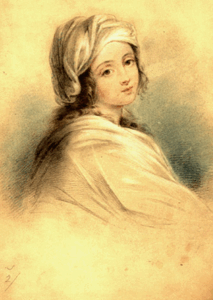
Portrait Believed to be of Beatrice Cenci
As his “Preface” indicates, Shelley believes that whatever injury or wrong has been committed, Beatrice should not resort to retaliation or revenge. And if she did, “she would have been wiser and better; but she would never have been a tragic character….It is in the restless and anatomizihg casuistry with which men seek the justification of Beatrice, yet feel that she has done what needs justification; it is in the superstitious horror with which they contemplate alike her wrongs and their revenge, that the dramatic character of what she did and suffered, consists (Cenci 7). Indeed, this seductive “superstitious horror” is what Shelley harnessed to discover the enigma of Beatrice’s affective conduct, her explanation of her action transcending secular norms. Her emphasis on kinship and love approximates Antigone’s invocation of an ancient, subterranean “law of the heart” from which Hegel’s Spirit drew its power (Bloch 121). However, Beatrice can only invoke her act of parricide as an exorcism by “the angel of His wrath” against “Cruel, cold, formal man; righteous in words,/ In deed, a Cain” (Cenci 101, 106)
Pathos Sublimates Terror
The terror involves a class or stratum of society, not a single individual. What really drives Count Cenci to such vile deeds, one may naively ask. Like most aristocrats of his time, the Count boasts of his power by ranting against the Pope’s intent to grab his property. His sarcasm betrays a countervailing hubris against the Church since he supplies their income with his bribes and cynically lauds his mock servility:
…No doubt Pope Clement
And his most charitable nephews, pray
That the Apostle Peter and the Saints
Will grant for their sake that I long enjoy
Strength, wealth, and pride, and lust, and length of day
Wherein to act the deeds which are the stewards
Of their revenue…
The secular power that the Count enjoys cohabits with the ecclesiastical hegemon, and thus feels free to do whatever he wants–‘to act the deeds” which include violence on his wife and daughter, unaware of his undermining the stability of his domestic bulwark. Is this a contest or competition between secular and ecclesiastical regimes? Or a display of that famous privilege accruing from Renaissance virtu.
Let us give the benefit of treating the Count’s lust, his perverse sensuality, as a manifestation of the absence of virtu. What does this entail? He kills someone who showed interest in his wife and daughter. He declares that his crime is to enjoy “sensual luxury, revenge, tortures, etc., vindicating that right “with force or guile.” He confides to Cardinal Camillo: “I love/The sight of agony, and the sense of joy,…/And I have no remorse and little fear”–sadistic but also erotic acts are “his natural food”(Cenci 15-16). When young, the Count obtained pleasure from lust, and later pleasure from hearing the children of his foes groan when he kills their father, Now he ruminates on a future “deed to act/Whose horror might make sharp an appetite/ Duller than mine.” As he grows old, he seeks for stronger delight:
….I the rather
Look on such pangs as terror ill conceals.
The dry fixed eyeball; the pale quivering lip,
Which tell me that the spirit weeps within
Tears bitterer than the bloody sweat of Christ,
I rarely kill the body, which preserves,
Like a strong prison, the soul within my power,
Wherein I feel it with the breath of fear
For hourly pain. (Cenci 16-17).
What Count Cenci wants is to dominate not only physically but spiritually. He assumes the role of totem of the primal horde when he eliminates his two sons. During the banquet, the Count rejoices in reporting the death of his “disobedient and rebellious sons.” He exults in the death of his “accursed sons,” tasting it like “a sacrament, and pledge with thee [wine like blood] the mighty Devil in Hell.” He warns anyone chiding him: “Beware! For my revenge /Is as the sealed commission of a king / That kills, and none dare name the murderer” (Cenci 24). Disrupting the world of routine work, Count Cenci’s transgressions against taboos opens up the domain of the sacred which, for Georges Bataille, ushers separate individualities into continuity with all being,”the limitless, infinite nature of sacred things” (85). So do the killing of Count Cenci and the execution of Beatrice and Lucrecia contribute to the affirmation of the reciprocity or interface of life and death, the profane world of taboos and the sacred world of religious life which relies on such prohibitions and interdictions.
The Enigma of Incest
The primal horde remains intact. In Totem and Taboo, Freud hypothesized the founding of social bonds with the collective slaying of the father who monopolized the women and wealth of the group. Relying on anthropological findings, Freud speculated that the brothers “renounced the women for whose sake they had killed the father, and agreed to practice exogamy. The power of the father was broken and the families were regulated by matriarchy” (Freud 168-69).This accords with the theory of exogamy and Claude Levi-Strauss’ explanation of the incest-taboo as the practice which distinguishes civilized humans from the animal kingdom (see Bataille 194-217). With Count Cenci suppressing his sons, we are left with the patriarch still at the helm, this time threatening to suppress “the wild girl,” Beatrice, who was horrified by the father’s “tyranny and impious hate.” Afflicted with fear and shame, In Act I, she pleads the assembled guests to condemn her father, but no one dares to censure the Count’s “firm, cold, subtle villainy” whose last words before retiring cues us to his next outrage, addressing Beatrice as “painted viper! /Beast that thou art! Fair and yet terrible!”
The Count will not spare Beatrice, as the narrative confirms. There are no brothers whose guilt would atone for the father’s death. Beatrice, Lucretia and Giacomo would not seek an animal or any fetish to serve as a totem-substitute for the dead Count. But the retelling of their deed would serve as the feast, “a solemn repetition of the father-murder in which social order, moral laws, and religion had had their beginnings” (Freud 169). The parricide discloses the sacred realm administered by the Church, the defender of patriarchal authority. Act IV stages the collaboration of daughter, mother-in-law and brother to prevent the Count from pursuing the plan of pollution–the rape of the daughter, making her taboo and sanctified at the same time. Their plotting to kill the father may be conceived as the sacrificial feast, the “occasion on which individuals rose joyously above their own interests and stressed the mutual dependence existing between one another and their god” (Freud Reader 496). However, historically, it was the Pope’s authority that upheld the patriarchal order by punishing the family that took revenge on its representative.
Paradoxically, it was this same act that created the demarcation between the sacred and profane since the polluted Beatrice acquires charisma as the violated person. She functions as the tabooed object which becomes the agency of affirming popular solidarity and will to sustain the power of the generative matrix in society. The surrogate totem, the embodiment of the community, is identified with Beatrice whose immolation may be interpreted as purgation or catharsis of the polluting patriarch and its vehicle of contagion, the Papal authority. But the dual figure of Demeter-Persephone (Beatrice and Lucrecia) may be Shelley’s answer to the irrationallity of the Papal authority, which recalls Shelley’s argument in The Necessity of Atheism, that God is an unproved hypothesis while the universe is pervaded by a “generative power” which so far remains incomprehensible. And since belief “is a passion of the mind, no degree of criminality can be attached to disbelief,” such as Beatrice’s disbelief in the justice of their punishment by the papal court.
Anatomy of Transgression
Shelley was an intransigent foe of conservatism and reaction, Since his expulsion from the academy due to The Necessity of Atheism, though sprung from a patrician family, he brooked no compromise with the privileged feudal lords and bourgeois merchants. He defied monarchic , imperial authority in his defense of Ireland’s independence. His partisanship for all revolutionaries are displayed in Prometheus Unbound, “The Mask of Anarchy,” “Ode to Liberty,” “The Revolt of Islam,” and other poems. There is no doubt of Shelley’s militant partisanship with the victims of inordinate bourgeois power and masculinist privilege.
In his 1821 discourse, “A Defence of Poetry,” he affirmed his allegiance to art as a teacher and inspiring critic. He praised the pedagogical value of the imagination in its grasp of a concrete organic whole, the dynamic activity in the evolving reality of life. Because poetry as the exercise of the human imaginative potential seeks to reveal “the image of life expressed in eternal truth,” in the dialectic of ultimate universal forms and sensuous experience, it performs a formative, educative role; hence poets/artists are “the unacknowledged legislators of the world” (Shelley, Defence 435). While traces of transcendental Platonic idealism may be discerned in his emphasis on the organic character of reality, he stressed the value of love or the “going out of one’s own nature.” This habit of sympathizing with others’ plight– (e.g.,Beatrice’s tragedy), as Shelley asserts, has already elicited universal sympathy– is what poetry cultivates in us, combining both its mimetic and expressive qualities (Abrams 130).
This complex dialectic of representation and expression informs the ambiguity of The Cenci, reproducing the social relations of domination while subverting it. Contradictions need to be recognized before resolving them, though the resolution remains in the imaginary realm (Balibar and Macherey). Paradoxically, mother-right–Freud alludes to ‘gynaecocracy” during the fatherless period (Group Psychology 87)–requires patriarchy to be eventually legitimized. This double motivation informing the Defence explains Shelley’s repudiation of any didactic, moralizing purpose in composing the drama. Perhaps, the courage and dignity of Beatrice may be interpreted as a riposte to Friedrich Engel’s widely held theory that “the overthrow of mother right was the world-historic defeat of the female sex” (736). But the ignominy of defeat is compensated for by the remembrance of the resistance.The beheading of Beatrice and Lucretia seems to uphold traditional patriarchal supremacy. However, it does not prevent us noticing how the Pope’s killing-power is ridiculed, with Camillo describing the Pope as “the engine/ Which tortures and which kills…a marble form,/A rite, a law, a custom: not a man” (Cenci 102).
Shelley’s perspective then is communalist-humanist, fundamentally antithetical to otherwoldly individualism. It rejects the possessive individualism of Count Cenci or the acquisitive individualism of the Papacy. While recognizing the religious sensibility of the Catholic masses, Shelley located it within the framework of the tragic situation, as in Lucretia’s intent of inducing the Count to confess before he dies (Act IV, scene 1). What demands explanation is the role of incest by rape in the representation of the fate of Beatrice and Lucretia, its meaning in the “political economy of signification” (Weimann 41). Shelley hoped to combine the mimetic or realist vocation of poetry with its Platonic/expressive impulse, using the Cenci narrative to construct a theater representing the transgression of limits: the limit of patriarchal/feudal authority and the limit of death/corruption of the body. Both transgressions–against the incest-taboo and against parricide–are sacramental acts “forming the synthesis between animal nature and humanity through the persistence of the taboo; we enter a sacred world, a world of holy things” (Bataille 79). We enter this world by way of Beatrice’s speech invoking the dead father’s ghost in Act V, Scene 1: “Even though dead, / Does not his spirit live in all that breathe, / And work for me and mine still the same ruin, /Scorn, pain, despair?” (Cenci 105).
One wonders about the alleged cathartic benefit of this tragic spectacle. Is Shelley simply aiming to arouse pity and fear, intending to produce catharsis, the generic motive of tragedies such as those of Sophocles and Shakespeare that he cites? Or can one perceive via a symptomatic reading the representation of the pleasure-principle juxtaposed with the death-drive, eros and thanatos, heuristic propositions elaborated by Bataille’s thesis on the erotic force of violating taboos as sacramental acts? Paul Ricoeur’s comment on Job’s disclaiming any retribution for this suffering seems appropriate to Beatrice’s situation: at the end, Beatrice relents, “ready to convert freedom and necessity into fate,” a tragic wisdom…that triumphs over the ethical vision of the world” (321-22).
The Sacred Contagion
We saw earlier the Count’s confession of his worship of the pleasure-principle: his hunger for “sensual luxury” and exorbitant delights. But more than this, he wants to control Beatrice’s will. In Act 2, he is infuriated: “yesternight you dared to look / With disobedient insolence upon me.” He curses her “fearless eye, and brow superior, and unaltered cheek,” vilifying her as “loathed image of thy cursed mother.” So it is not just physical pleasure that drives the Count but also suppression of Beatrice’s will, subjugation of conscience. He accuses Lucretia of teaching Bernardo, her son, “Parricide with his alphabet” (Cenci 33). He suspects the wife of plotting to do away with him, claiming to be God’s executioner, answering her denial with “I’ll kill you.” He forecasts the wickedness he has in mind when they are brought to their prison in the Castle of Petrella. The Count has no scruples in informing us of his diabolic, erotically-charged scheme:
Come darkness! Yet, what is the day to me
And wherefore should I wish for night, who do
A deed which shall confound both night and day?
’Tis she shall grope through a bewildering mist
Of horror….
The act I think shall soon extinguish all
For me: I bear a darker deadlier gloom
Than the earth’s shade, or interlunar air,
Or constellations quenched in murkiest cloud….(Cenci 35).
The Count’s purpose of imprisoning his wife and daughter in the Castle of Petrella is part of his scheme to impose his desire on Beatrice’s “stubborn will” so that ultimately he will gain his “greater point, which was / to poison and corrupt her soul” (Cenci 63). He seeks confirmation of his despotic authority. When we see him again at the opening of Act IV, before his death, he boasts that he has rendered Beatrice “vanquished and faint,”so that her infamy (the Count is given foreknowledge of the future) “shall have a fascination to entrap / Her loathing will…Her name shall be the terror of the earth….I will make / Body and soul a monstrous hump of ruin” (Cenci 65). This urge to ruin another human to meaningless matter, “the nauseating slime of negativity” which, for Terry Eagleton, is the essence of evil, involving “a megalomaniac overvaluing of the self, and an equally pathological devaluing ot it” (Eagleton 102-03). The drive to defile the daughter’s virginity kindles a transgression that voids the divide between the human and animal, unleashing the violence of the ensuing parricide.
At the opening of Act III, the Count’s scheme has been carried out when we behold the effect in Beatrice’s entrance, staggering and speaking wildly: “My brain is hurt; My eyes are full of blood.” Ominous marks of violation confront us, with their symbolic clues that the victim tries to articulate, confirming her pollution and her virtual reduction to a sanctified corpse:
Hope comes this hair undone?
Its wandering strings must be what blind me so,
And yet I tied it fast,–O, horrible!…..My God!
The beautiful blue heaven is flecked with blood!
….The air
Is changed to vapours such as the dead breathe
In charnel pits! Pah! I am choked! There creeps
A clinging. black, contaminating mist
About me….’tis substantial, heavy, thick
And eats into my sinews, and dissolves
My flesh to a pollution, poisoning
The subtle, pure, an inmost spirit of life!
{More wildly) No, I am dead! These putrefying limbs
Shut round and sepulchre the panting soul
Which would burst forth into the wandering air~
Evil has emerged as absence, the negation, the emptiness to be filled. The pollution sprung from violation of the incest-taboo creates the sacred locus of awe. The miserable Beatrice is transformed into a corpse, not to be touched or profaned, Lucretia asks her the source of her misery, and Beatrice responds: “Like Parricide…./ Misery has killed its father: yet its father/Never like mine….O, God! What thing am I?” (Cenci 43). Beatrice, the dramatic persona, has entered a zone of the uncanny, the unspeakable, the chaos of indifference. When Lucretia asks Beatrice what has your father done, Beatrice replies: “Who art thou, questioner? I have no father.” Sheer animal energy supersedes the taboos defining humanity. Beatrice’s description of her wretched condition evokes the reptiles and beasts of an imagined jungle overflowing with “prodigious mixtures and confusions strange.”
Resembling Persephone’s abduction, Beatrice’s misery drags her into a miasmc phantasmagoria. But she wakes up from the nightmare. Eventually, she restores the social norm ordained by birth, as if to seal the folkloric legend of the Cenci, legitimizing both the fact and the popular consensus of belief about her tragic fate. She acknowledges the presence of her mother, not the fancied “madhouse nurse” she thought. The traditional family is restored via a simulacra of mother-right. She marks the turning point between truth and fable, as she counsels her mother: “Yet speak it not, / For then if this be truth, that other too / Must be a truth, a firm enduring truth, / Linked with each lasting circumstance of life” (Cenci 44).The curse of her father’s rape transforms her into “a ghost shrouded and folded up / In its own formless horror.” But she vows to God to “keep these limbs, the unworthy temple of Thy spirit. / As a foul den from which what Thou abhorrest /Me mock Thee, unavenged….it shall not be!” She tells Orsino: I have endured a wrong’/ Which, though it be expressionless, is such / As asks atonement” (Cenci 50). Atonement as vengeance or retribution equals the parricide we witnessed in Act IV that violates the taboo of murder.
Given the incest taboo distinguishing humans from animals, women married outside the clan engender social organization and lawful exchange. Paradoxically, while the incest-taboo enables commodity exchange, as Emile Durkheim notes, it also creates the sacred sphere disclosed by defiling taboos. The violated daughter becomes the locus of awe and interdiction. Beatrice as index of the polluted place, the vessel of charisma, becomes the basis of social classification. The incest-taboo is the keystone for generalized exchange, the emergence of kinship relations (Levi-Strauss) and the patriarchal family as, for feminists, “the lynchpin of he systematic social and psychological subordination of women” (Minson 202). But the defilement does not lead immediately to the overthrow of the monopolizing patriarch until the women deploy Orsino and Giacomo, the surrogate sons, to kill the father with the help of Marzio and Olimpio–evidence that masculinity still prevails in the implementation of women’s needs and wants. Thus the traffic or exchange of women (as gifts, dowry, ransom, etc.) persists even with the vindication of their rights in the modern world.
The profane world of work asserts itself against the holy, sacramental realm of sacrifice. Before his death, Count Cenci savours his liquidation of his sons Rocco and Cristofano, anticipating the ordeal of Giacomo and Beatrice. He tries to defy the world of utilitarian, market-centered economy with an act of renouncing his worldly goods in a simulation of archaic potlatch, dispensing gifts to everyone in an orgy of abnormal extravagance:
When all is done, out in the wide Campagna,
I will pile up my silver and my gold;
My costly robes, paintings and tapestries;
My parchments and all records of my wealth,
And make a bonfire in my joy, and leave
Of my possessions nothing but my name;
Which shall be an inheritance to strip
Its wearer bare as infamy. That done,
My soul, which is a scourge, will I resign
Into the hands of him who wielded it…. (Cenci 64)
The Count appears to enact his own sacrifice. Not satisfied with this gesture of acknowledging “the sacred truth of God,” the Count vows to Lucretia: “For Beatrice worse terrors are in store,” to the point where “Body and soul a monstrous lump of ruin.” His extended prayer to God as he kneels before Lucretia exceeds all plausible claim to piety, a perverted plea that “this most specious mass of flesh,” “my bane and my disease, / Whose sight infects and poisons me, this devil/Which sprung from me as from a hell….Earth, in the name of God, let her food be/Poisoned, until she be encrusted round / With leprous stains!” The malice here knows no bounds, exploding with spontaneous force. Impurity, the blemish or stain of some filthy matter, reflects the Count’s own contagion, fashioning that taboo of polluted, infected matter that creates the demarcation line between the sacred from the profane, the untouchable terrifying object of hate/desire projected by the violator/guilty offender. The Count enacts the definition of evil as not only privation of good (as Saint Thomas Aquinas averred) but as a symptom of an unrelenting contradiction: ‘Evil involves a split between body and spirit–between an abstract will to dominate and destroy, and the meaningless piece of flesh that this will inhabits” (Eagleton 21).
The urbane and agnostic Shelley, however, will not indulge the Count’s satanic hubris. Shelley declared that he handled the “fearful and monstrous” act of incest “with delicacy” (Cenci 112). In allusion to the incestous injury he inflicted on his daughter, the Count pronounces his curse that Beatrice’s children will grow “more wicked and deformed, / Turning her mother’s love to misery.” The Count revels in cursing Beatrice, confessing that he feels like a “fiend appointed to chastise / The offences of some unremembered world, invoking a “multitudinous Hell” (Cenci 68). Contemptuous rage, anger, fear and loathing exude from the Count’s farewell address to Lucretia, the inconsolable stepmother. Erotic rapture blends with horror, “a fearful pleasure” augmented by “a giddy sickness of strange awe.” the Count’s heart “beating with an expectation/Of horrid joy.” Such ecstasy becomes a premonition of his death, mindful of its coming as he exits from Scene 1. Act IV.
The Father’s Killing as Exorcism
For Beatrice the sybilline protagonist, “All mortal things must hasten thus / To their dark end.” Thus the death of the predatory father is for her “a high and holy deed.” Before Olimpio and Marzio carry out Beatrice’s command, Beatrice sees the father’s death as “A dark continuance of the Hell within him.” Beatrice chides the male accessories for their scruples and brands them “cowards and traitors.” It would be a “deadly crime” not to stop “a thousand daily acts disgracing men.” In Prokosch’s novelistic retelling of the story, both Beatrice and Lucrezia were present at the actual killling (84-87). In Shelley’s play, the killing occurs offstage. After Olimpio and Marzio declare the Count dead, Beatrice celebrates the tyrant’s demise: “Darkness and Hell / Have swallowed up the vapours they sent forth / To blacken the sweet light of life….and the jellied blood / Runs freely through my veins.” She calls Marzio “a weapon in the hand of God / To a just use.” She exults in her llberation. Seeking to assuage Lucretia’s “agony of fear” at that “strange horror” of incest alluded to in a captured letter of Orsino, Beatrice counsels the mother in this memorable speech of vindication:
“What is done wisely, is done well…..
….The deed is done.
And what may follow now regards not me.
I am as universal as the light;
Free as the earth-surrounding air; as firm
As the world’s centre. Consequence, to me,
Is as the wind which strikes the solid rock
But shakes it not. (Cenci 77-78)
She is determined but not burdened with hubris. When Savella, the Pope’s Legate, arrests the daughter and wife, Beatrice declares boldly: “I am more innocent of parricide / Than is a child born fatherless.” Marzio accused of the murder, for her, was “a sword in the right hand of justest God” who avenged “The crimes which mortal tongue dare never name” (Cenci 81). Beatrice virtually confessed that it was her “fierce desire,” otherwise: “There was no other rest for me on earth / No other hope in Heaven.” Sheer frustration and desperation afflicted her since no authority tried to dissuade the Count from committing atrocities. This compelled Beatrice’s plea of self-defence. The last three speeches condense her argument for acting in self-defence against unjust, beastly power:
And yet, if you arrest me,
You are the judge and executioner
Of that which is the life of life: the breath
Of accusation kills an innocent name….
….”Tis most false
That I am guilty of foul parricide….
[Addressing Lucretia] Our innocence is an armed heel
To trample accusation. God is there
As here, and with His shadow ever clothes
The innocent, the injured, and the weak;
And such are we. Cheer up, dear Lady, lean
On me; collect your wandering thoughts…(Cenci 92-83)
But Shelley’s tragic vision disavows any happy ending. Before they appear for trial in Rome, Beatrice foreshadows their conviction. Her insight into secular/church authority resembles that of Shelley in The Necessity of Atheism and in Prometheus Unbound, Defiant to the core, Beatrice tells her stepmother that “power is as a beast which grasps and loosens not: a snake whose look transmutes / All things to guilt which is its nutriment.” She forecasts Pope Clement’s verdict of decapitation for fear their acquittal will expel that nutriment, the victims that it needs to sustain its domination. Compared to Orsino’s treachery and cowardice, Giacomo has the courage to defend his sister who “Stands like God’s angel ministered upon / By fiends avenging such a nameless wrong / As turns black parricide to piety.” Who is really guilty? Who is answerable for the Count’s death? Hearing Beatrice’s description of her wrongs that “could not be told,” and how her feat “stabbed with one blow my everlasting soul,” Marzio is subdued by Beatrice’s wounding look, “stern yet piteous,” and confesses to the judge that “’Tis I alone am guilty.” After Marzio’s death, Cardinal Camillo rules the proceedings to stop so that he can intervene with the Pope, the ultimate secular judge.
In the scene with Bernardo in a prison-cell, Beatrice wakes up from sleep. She tells her brother that we were all in Paradise, the cell resembling it without the father’s presence. Patriarchal authority is on trial in Beatrice’s response to the Judge’s question whether she is guilty of her feather’s death: “Or wilt thou rather tax high-judging God / That He permitted such an act as that / Which I have suffered, and which He beheld; made it untterable. and took from it / All refuge, all revenge, all consequence.” Does she resign herself to the verdict of Providence?
Not at all. She responds to Lucretia’s pathetic confession of yielding to admitting her guilt with a justification that God is still on their side, “the God who knew my wrong, and made /Our speedy act the angel of his wrath” (Cenci 101). The agnostic Shelley permits Beatrice to appeal to a mythical Athena for justice, a providential court free from Papal prejudice.
In the last scene of the play, Cardinal Camillo conveys the news to the family that the Pope has pronounced the final verdict of death for Beatrice, Lucretia and Giacomo. At first, Beatrice responds wildly, lamenting “No God, no Heaven, no Earth in the void world,” envisioning herself haunted by the father’s shape “which tortured me on earth,…he should come/And wind me in his hellish arms, and fix / His eye on mine, and drag me down, down, down” (104). Anguish, not remorse, overwhelms her. Shelley intensifies the pathos here, arousing not so much pity but awe and wonder that Beatrice might be forced to harm herself or others. What we read here is a clamor against the cold formalistic power of Papal authority (as the Cardinal himself suggests), an engine or machinery for torturing people to confess sins without knowing the circumstances or situations that drove people to sin. Beatrice’s final words signal a knowledge of her legend fostered by the portrait made by Guido Reni (disputed by many to be genuinely accurate) and the folklore nourished by ordinary folks. Her defiance of overbearing authority echoes Shelley’s radical poetics and the tragic vision of fate as inescapable necessity. Addressing Cardinal Camillo, Beatrice speaks libidinal truth to obscurantist power, affirming her dignity and self-worth:
For was he [the Count, with allusion to the Pope] not alone omnipotent
On Earth, and ever present? Even though dead,
Does not his spirit live in all that breathe,
And work for me and mine still the same ruin,
Scorn, pain, despair?…. [Addressing Lucretia]:
….I
Have met with much injustice in this world;
No difference has been made by God or man,
Or any power moulding my wretched lot. (Cenci 105)
Beatrice doubts Lucretia’s hope that the Pope will pardon them, a hope that resembles a bellef that Nature’s force can be persuaded to relent. Shelley’s realism and apprehension of the family as a locus of sympathy emerge here, with the maternal sentiment prevailing over patriarchal power, with Beatrice sharing penalties with brother and stepmother. We sense the erotic power of the death-drive manifest here in the pathos of the maternal embrace:
…Oh, plead
With famine, or wind-walking Pestilence,
Blind lightning,or the deaf sea, not with man!
Cruel, cold, formal man; righteous in words,
In deeds a Cain. No, Mother, we must die:
Since such is the reward of innocent lives;
Such the alleviation of worst wrongs.
And whilst our murderers live, and hard, cold men,
Smiling and slow, walk through a world of tears
To death as to life’s sleep; ‘twere just the grave
Were some strange joy for us. Come, obscure Death,
And wind me in thy all-embracing arms!
Like a fond mother hide me in thy bosom,
And rock me to the sleep from which none wake.
Live ye, who live, subject to one another
As we were once, who now…. (Cenci 106)
The sentiment of communal solidarity appears poignantly in Beatrice’s farewell speech to her brother Bernardo, who will be the only survivor of the family. Beatrice counsels Bernardo to nourish “mild, pitying thoughts” to lighten “sorrow’s load,” an element of the tragic vision in which Shelley frames the rationale of Beatrice’s final if grudging acceptance of her submission to the prevailing authority:
…..Err not in harsh despair,
But tears and patience. One thing more, my child,
For thine own sake be constant to the love
Thou bearest us; and to the faith that I,
Though wrapped in a strange cloud of crime and shame,
Lived ever holy and unstained. And though
Ill tongues shall wound me, and our common name
Be as a mark stamped on thine innocent brow
For men to point at as they pass, do thou
Forbear, and never think a thought unkind
Of those, who perhaps love thee in their graves.
So mayest thou die as I do, fear and pain
Being subdued. Farewell! Farewell! Farewell! (Cenci 107-108)
Pathos sublimates the resurgence of fear and pity. The tragic edge is neatly blunted here by the impulse of solidarity and sharing of burden expressed by Beatrice, somehow cognizant of her folkloric fame in the years after their execution. Shelley modulates the pathos by inserting Beatrice’s uncanny belief that the memory of their deeds will not be wholly negative as long as humans are rational and understand the true nature of what happened to them. Beatrice seems to aknowledge Shelley’s intent to surround the horror not with vulgar moralizing but with the idealizing pleasure of verbal art, having suppressed the cry for revenge and retribution. But is Shelley serious in claiming that his strategy of juxtaposing “beautiful idealisms of moral excellence” (Wilcox 202) will end the “anatomizing casuistry” and ‘superstitious horror” usually accompanying talk of the Cenci’s deeds? I conclude that Shelley’s materialist-realist craft succeeded in articulating the outcome of transgressing taboos (incest, parricide) and exorcising their repressive effects by plotting the trajectory of Beatrice’s responses. This particular arrangement of words (rhetoric, imagery, etc.) illustrates the imaginary resolution of real-life contradictions, whence arises the impact of Shelley’s theater as an aesthetic construction, an ideological artifact. Whether that has changed the public’s judgment of the whole Cenci affair, or advanced the poet’s revolutionary project at the time of performance, is a topic for another occasion,
One example of the latter is Fredric Prokosch’s 1955 novel, A Tale for Midnight. Its focus on brutality and excruciating pain, especially the harrowing effect of the rack on the witnesses, undercuts the narrator’s impulse to endorse the commiserating ethos of the Roman people. The crowd of plebeians and aristocrats were both flummoxed by the mysterious operations of the court and its functionaries. They were also bewildered by Beatrice as “a thing not quite Roman: somber, defiant, and a bit inhuman” (Prokosch 296). Melodramatic scenes and surprising reversals of fortune are the conventional elements deployed by the novelist to stir up a consumerist audience already numb from watching televised catastrophes and obscene destruction of millions.
Only the dramatist Antonin Artaud’s foregrounding of “cruelty” or the excessive force of nature, surpasses the novel’s morbid fascination with atrocities performed by actors inured to any conceivable horror. Artaud discerned the mythical aura of the characters invented by Shelley; for Artaud, the dramatis personae in Shelley’s artifice are amoral: “Neither innocent nor guilty, they are in the power of the same essential amorality which possessed those gods of the Mysteries of Antiquity from whom all tragedy had emanated.” characters endowed with “fabulous amorality that belongs to lightning as it strikes, and to the boiling explosion of a tidal wave” (Artaud x-xi). True enough, this myth-making resourcefulnes that Artaud grasped in Shelley’s play is none other than the prophetic, religious poetics that Harold Boom praised, imbued with an urbane irony that “civilizes the sublime, and makes a renovated universe a subject for gentlemanly conversation” (Visionary Company 297-98).
Knowledge of the Heart
Incest and parricide may be juicy fodder for scandal-hungry newspapers, but not proper themes for respectable bourgeois art. Shelley’s tragedy was never performed during his lifetime. Precisely the presence of incest and familial violence served to justify Lucio Fulci’s 1969 film La Vera storia di Beatrice Cenci, as well as subsequent versions. In his preface to the tragedy, Shelley acknowledged the violent passions in the report and, in his poetic rendering, aimed to “diminish the actual horror of the events” by increasing the ideal, “the pleasure which arises from the poetry which exists in these tempestous sufferings and crimes may mitigate the pain of the contemplation of the moral deformity from which they spring” (Cenci 7). Consequently, Shelley compressed the events and concentrated on Beatrice’s character and the flux of her emotions. From another angle, Shelley may also be heeding Aristotle’s dictum that “Tragedy is primarily an imitation of action, and that it is mainly for the sake of the action that it imitates the personal agents” (233). And the action here really pivots on Beatrice’s defense of her dignity and integrity against the Judge and Cardinal Camillo. Consider her long answer to the Cardinal in Scene 2, Act V: “What evil have we done thee?” Defending her “everlasting soul” and “untainted fame,” she cries out against the tyrannical patriarch and his advocates, the Roman Court and the Papacy:
But the wound was not mortal; so my hate
Became the only worship I could lift
To our great father, who in pity and love,
Armed thee, as thou dost say, to cut him off
And thus his wrong becomes my accusation;
And art thou the accuser? If thou hopest
Mercy in heaven, show justice upon earth:
Worse than a bloody hand is a hard heart.
If thou has done murders, made thy life’s path
Over the trampled laws of God and man,
Rush not before thy Judge, and say: “My maker,
I have done this and more; for there was one
Who was most pure and innocent on earth;
And because she endured what never any
Guilty or innocent endured before:
Because her wrongs could not be told, nor thought…
Think what it is to strangle infant pity,
Cradled in the belief of guileless looks,
Till it become a crime to suffer. Think
What ’tis to blot with infamy and blood
All that which shows like innocence, and is,
Hear me, great God! I swear, most innocent,
So that the world lose all discrimination
Between the sly, fierce, wild regard of guilt,
And that which now compels thee to reply
To what I ask: Am I, or am I not
A parricide? (Cenci 94)
This speech posits a rhetorical question that begs for no answer, only vigilant silence. It center-stages the question of parity, of justice: is killing the despotic father more heinous and culpable than defending one’s dignity and vulnerable personhood? What is at stake here? We are faced with the age-old predicament: can the standard of justice applied by the court be divorced from the power-hierarchy, the same authority that conceals the depravity of the father and the abuse of his daughter? Is the incest-taboo just a stage prop to advance the fall of the guilty party?
Grappling with those questions, we find Alberto Moravia (in his play Beatrice Cenci) foregrounding this problem of deciding whose scale of justice should prevail. At the end of Moravia’s drama, we watch Carlo Tirone, chief justice of the Abruzzi province, pronounce Beatrice guilty of parricide, to which she replies: “According to your justice, you will certainly be able to prove I am guilty of my father’s death. But you will never be able to prove that I am not at the same time innocent according to another justice–a justice which you can neither know nor, even less, administer” (186). Skepticism and relativism sneak into the mise en scene. Justice needs historical contextualization at this point, the balancing of what’s at stake. And this is where the general audience is compelled to choose either the Established authority of the masculinist, feudal Papacy, or uphold the dignity of women as an oppressed, subjugated class. To be sure, Shelley’s libertarian partisanship is not equivocal here.
Patriarchal hegemony proves itself irresistible. Clearly the authority of the feudal, monolithic Papacy asserted its verdict; the rest is history. But history’s slaughter-house is not neutral, as Hegel has warned us. The vicious Count may be a ruthless sadistic father but not a tyrant–he is the absolute ruler of the family (the original familia referred to slaves under the pater). Parricide, not tyrannicide, is the Pope’s conception of felix culpa, fearful of destabilizing the status quo. Even Thomas Aquinas restricted rebellion against tyrants to private assasination or community removal, because “bad people may take advantage of the moral licence to kill good rulers” (Childress and Macquarrie 634-35). Tyrants will do everything to make their desire the law for all, provided he can harness the power to implement it, as Machiavelli (1469-1527) already demonstrated in The Prince (see also Brinton 250-51). If Count Cenci is not a perverse, barbaric tyrant, how do we categorize him in his glee at the death of his sons and the persecution of his wife and daughter? Shelley considered the Count an “atrocious villain,” if not a monster, though his function as destroyer grounds the myth-making potentiality of the tragic vision embodied by the drama’s moments of reversal (peripeteia) and recognition (anagnorisis) the intricacies of which can be reduced to the formula of psychoanalytic transference (see Hogle).
The Defiled Virgin’s Sovereignty
Shelley believed that our knowledge of the heart will convert anguish into calm acceptance of fate, the trajectory of Beatrice’s affects. After such knowledge, what foregiveness? Catharsis of fear and pity will neutralize the aura of “superstitious horror” surrounding the catastrophes that struck the Cenci family. But Shelley omits the actual torture depicted in Prokosch’s novel and records only Beatrice’s tormented reflections of what torture will yield: “My pangs are of the mind, and of the heart, and of the soul, which weeps…/ To see, in this ill world where none are true, / My kindred false to their deserted selves” (Cenci 99). Our awe is replaced with compassion when Beatrice resigns herself to whatever the Judge finds worthy of belief. Let us begin with the intense pathos generated by the last Act. The scenario seems to distract or turn our attention away from the Count’s beastly crimes and the conniving Papacy. Beatrice’s speech seems more an acceptance of her punishment than a denunciation of vicious patriarchal aggression. Beatrice rejects hope and indicts “Cruel, cold, formal man; righteous in words; / In deeds a Cain.” Resignation to earthly wickedness overcomes wrath in Beatrice’s attempt to console her mother:
…No, Mother, we must die:
Since such is the reward of innocent lives;
Such the alleviation of worst wrongs.
And whilst our murderers live, and hard, cold men,
Smiling and slow, walk through a world of tears
To death, as to life’s sleep; ‘twere just the grave
Were some strange joy for us. Come, obscure Death,
And wind me in thine all-embracing arms!
Like a fond mother hide me in thy bosom,
And rock me to the sleep from which none wake,
Live ye, who live, subject to one another
As we were once, who now….
We apprehend here allusions to the maternal earth (Demeter/Persephone motif) and death’s sheltering cave, the sanctuary of slaves and fugitives presided over by female divinities. In ancient Rome, the emancipation of slaves took place at the altar of Feronia, who was a goddess related to mother earth (for the daughter’s mother-complex, see Jung 21-23). Beatrice’s reply to the Judge threatening her with torture universalizes her individual fate: “…what a tyrant thou art, /And what slaves these; and what a world we make,/The oppressor and the oppressed.” We can compare this, in Sophocles’ play, with Antigone’s reply to King Creon’s charge that she disobeyed the law. Ernst Bloch observes that Antigone “regards Creon’s commandment as a violence and injustice, and opposes it with the ancient unwritten law of the relationship of blood,” the law of piety nourished by chthonian powers and its affinity with the humanity of natural law–“in general, to all the interruptions of the jus factum…within the perimeter of Bona Dea…As natural law matures it feels itself drawn all the more to the invisible undercurrents of nature conceived as a woman” 114-115). The narrative of fertility rituals and worship of mother-right (from the pastoral age to the time of settled agriculture) intrude here. Beatrice’s resigned attitude at the end may be deemed analogous to the Stoic virtue of resignation in the face of misfortune, actualizing freedom as the recognition and acceptance of necessity with the advent of the Enlightenment (for alternative views, see Kasner; Curran. Shelley’s Cenci). This informs also her advice to her mother to “Take cheer! The God who knew my wrong, and made / Our speedy act the angel of His wrath” (Cenci 101).
Beyond Eschatology
Beatrice’s last farewell to her brother and mother contain no anger or despair, but a reminder of bearing only “mild, pitying thoughts” and truth in the faith that Beatrice “though wrapped in a strange cloud of crime and shame,/ Lived ever holy and unstained…and never think a thought unkind / Of those, who perhaps love thee in their graves” (Cenci 107). Her last speech to her mother is a remembrance of their affection as mother and child, a reaffirmation of maternal force uniting mother and daughter (the Demeter-Persephone bond). This symbolic gesture prefigures the solidarity of peasants, artisans, and merchants converging in the Reformation and the birth of individualism in the Renaissance and the concomitant rise of colonies and the imperial global market.
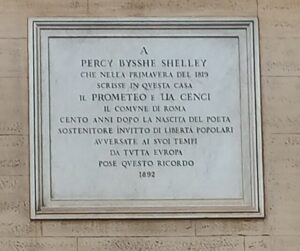
Plaque of House where Shelley wrote The Cenci in Rome.
Shelley’s attack on kings, priests and statesmen in Queen Mab and other poems may be flawed because of the failure of words, of language and metaphors congealed into totalizing ideologies. This linguistic inadequacy is what Stuart Curran (“End(s) of Ideology,” 600-607) sees as the basic problem that undercuts Shelley’s Necessitarianism and problematizes the ideology of Italian Catholicism in shaping the actions of the characters in The Cenci. But this objection is, in my view, simplistic. The reason is that language is not just a medium or means of communication or expression; rather, it is “a constitutive element of material social practice, the practice of human sociality” (Williams 165).The prior question then is how language as material- social practice operates, how this “practical consciousness” (Marx 158) is rooted in, and enabled by, the specific mode of production and reproduction of social life at any given concrete stage of history. Refusing the inadequacies of language/ideologies is what Artaud tried to do, succumbing instead to the devious, tangled semiotics of sound and spectacle which paradoxically generates its own ideological fixities, abstractions, and mystifications.
Shelley’s prophetic radicalism is not simply linguistic or verbal but actualized in its effects on readers, in the public sphere. Its locutionary power is performative. But his intuitive repudiation of ideologies as psychological/linguistic traps (relativized in Curran; Hogle) remains empty if its individualistic framework–the bourgeois sensibility and its Lockean/Cartesian hubris–is not replaced by a more communitarian or socialist-oriented praxis, as our emphasis on mother-daughter linkage proposes, and on the persistences of the feudal matrix of patriarchy (see Wolfson; Cafarelli). Beatrice finally ends her plea with the Judge: “If ye desire it thus, thus let it be, / And so an end of all. Now do your will,” given the torture rack as the signifier terminating communication. Here the archetypal image of the ‘Suffering Servant” appears, whereby “the suffering of the innocent broke the schema of retribution in pieces; sin [Beatrice’s guilt] and suffering are separated by an abyss of irrationality” (Ricoeur 325), enabling a tragic vision of the world where evil/necessity challenges reason and organic sensibility.
Beatrice’s suffering follows Wollstonecraft’s rationale for affirming women’s self-consciousness as gendered collectivity. Beatrice is not just a single, isolated person; she stands for all victims of patriarchal-lordship hegemony. Neither materialist nor idealist paradigm is the issue; rather, it is the efficacy of art/discourse as mediated by historical groups and collectivities in actual political struggles. I would argue that the hypothetical “end of ideology” is not a question of refining interpretation or deconstructing the claims of diverse ideologies, but rather a task of transforming the social-productive contracts and structures that articulate the synergesis of minds/bodies with the historical circumstances that limit or enable their potentials. A historical-materialist, fallibilist point of view would be useful in clarifying the issues here. Re-reading The Cenci and articulating its political entailments is one way of resolving the linguistic-ideological blind-alleys and dead-ends already noted, unless the idea that one can one can get beyond language to reach the ultimate substratum of raw, unmediated experience is an alibi for cynical indifference or acquiescence to the status quo.
Ultimately, the dialectic of historical catastrophes teaches us the way out of a self-inflicted predicament. Shelley condensed the antinomies and aporias of his time in the figure of Beatrice Cenci with her compromised stand, born from Shelley’s prophetic myth-making. From another perspective, Bertrand Russell, an admirer of Shelley’s writing, offers a hint of a solution in his remarks on the eclipse of the Papacy. With the conquest of Constantinople and the revival of Greek learning in the Renaissance after the Cenci family’s executions, Russell comments, “This sublunary sphere appeared no longer as a vale of tears, a place of painful pilgrimage to another world, but as affording opportunity for pagan delight, for fame and beauty and adventure” (486-87; see Brinton 176-211). The Cenci is one such adventure. One may hazard to suggest that Beatrice Cenci as the “angel of God’s wrath” serves as the herald of a new age in which Shelley’s imagination aspires to be “the immortal God which should assume flesh for the redemption of mortal passion” (Cenci 9).
Works Cited
Abrams, M. H. The Mirror and the Lamp.W.W. Norton, 1953.
Ack, Tess Lee, “Shelley’s revolutionary poetry.” Red Flag (Dec 21, 2022).
Aristotle. Rhetoric and Poetics of Aristotle. Modern Library, 1954.
Artaud, Antonin. The Cenci, a play by Artaud. Tr. Simon Watson Taylor. Grove Press,1970.
Balibar, Etienne and Pierre Macherey, “On Literature as an Ideological Form.” In Marxist Literary Theory. ed. Terry Eagleton and Drew Milne. Blackwell, 1996.
Bataille, Georges. Death and Sensuality. Ballantine Books, 1962.
Bloch, Ernst. Natural Law and Human Dignity. The MIT Press, 1986.
Bloom, Harold. How to Read and Why. Fourth Estate, 2000.
—–. The Visionary Company. Anchor Books, 1961.
Brinton, Crane, A History of Western Morals. Harcourt, Brace and Co., 1959.
Cafarelli, Anette Wheeler. “The Transgressive Double Standard:Shelleyan Utopianism and Feminist Social History.” In Shelley’s Poetry and Prose, ed. Donald Reiman and Neil Fraistat. W.W. Norton, 2002.
Childress, James and John Macquarrie, eds. The Westminster Dictionary of Christian Ethics. The Westminster Press, 1986.
Curran, Stuart. Shelley’s Cenci: Scorpions Ringed With Fire. Princeton UP, 1970.
Curran, Stuart. “Shelley and the End(s) of Ideology.” In Shelley’s Poetry and Prose, ed. Donald Reiman and Neil Freistat. W.W Norton, 2002.
Davidson, Cathy. The Book of Love. Plume/Penguin 1992.
De Man, Paul. The Rhetoric of Romanticism. Columbia UP, 1984.
Eagleton, Terry, Evil. Yale UP, 2010.
Encyclopedia Britannica. 2019. “Batrice Cenci, Italian Noble,” Vol 5., 11th edition; 660-661.
Engels, Friedrich. “The Origin of the Family, Private Property, and the State.” In The Marx-Engels Reader, ed Robert C, Tucker, W.W. Norton, 1978, pp. 734-759.
Freud, Sigmund. Moses and Monotheism. Tr. K. Jones. Vintage, 1939.
—–. The Freud Reader, ed. Peter Gay. W.W. Norton, 1989.
——. Group Psychology and the Analysis of the Ego. Bantam Books, 1960.
Fulop-Miller, Rene, The Jesuits, Capricorn Books, 1963.
Garraty, John and Peter Gay, eds. The Columbia History of the World. Harper and Row, 1972.
Harding, D.W. “Shelley’s Poetry.” In The Pelican Guide to English Literature, ed. Boris Ford. Penguin Books, 1957.
Havens, Raymond. “Shelley the Artist.” In The Major English Romantic Poets, ed. Clarence Thorpe, Carlos Baker, and Bennett Weaver. Southern Illinois UP, 1957, pp. 169-84.
Hogle, Jerrold. “Transference Perverted: The Cenci as Shelley’s Great Expose.” In Shelley’s Poetry and Prose. W,W. Norton, 2002.
Hornstein, Lillian Herlands, ed. The Reader’s Companion to World Literature. New American Library, 1973.
Johnson, Paul. Intellectuals. Harper and Row, 1988.
Jung, Carl. Four Archetypes. Princeton UP, 1969.
Kasner, Lisa. “National Trauma and Romantic Illusions in Percy Shelley’s The Cenci.” Humanities 94 (2019): 96-120.
Leavis, F.R. Revaluations. Chatto and Windus, 1936.
Levi-Strauss, Claude. The Elementary Structures of Kinship, Eyre and Spottiswoode, 1969.
Lewis, C.S. “Shelley, Dryden and Mr. Eliot.” In English Romantic Poets, ed. M.H. Abrams. Oxford UP, 1960.
Machiavelli, Niccolo. 1977. The Prince, ed. Robert M. Adams. W.W. Norton & Co.
Marx, Karl. “Shelley and Byron.” In Karl Marx and Friedrich Engels, On Literature and Art. Moscow: Progress Publishers, 1976.
Marx, Karl. “The German Ideology: Part I.” The Marx-Engels Reader, ed. Robert Tucker, W.W. Norton & Co., 1978.
McCallum, Pamela. Literature and Method. Gill and McMillan, 1983.
Minson, Jeffrey. Genealogies of Morals. St. Martin’s Press, 1985
Moravia, Alberto. Beatrice Cenci Farrar, Strauss & Giroux, 1966.
Nicholl, Charles. “Screaming in the Castle: The Case of Beatrice.” London Review of Books, 2013.
Potkay, Monica Brzezinski “Incest as Theology in Shelley’s The Cenci.” The Wordsworth Circle, 35, 2 (Spring 2004): 57-65.
Prokosch, Frederic. A Tale for Midnight. Little, Brown and Co., 1955.
Read, Herbert. “Shelley’s Philosophy.” In The Major English Romantic Poets. Southern Illinois UP, 1957, pp. 207-14.
Ricoeur, Paul. The Symbolism of Evil. Beacon Press, 1967.
Shelley, Percy Bysshe. A Philosophical View of Reform. Introduction by T.W. Rolleston. Oxford University Press, 1920.
—–. “A Defence of Poetry.” In Criticism: The Major Texts, ed. Walter Jackson Bate. Harcourt, Brace and World, 1952, pp. 429-35.
—–. The Cenci, ed. Roland Duerksen. The Bobbs-Merrill Co., 1970.
—–. The Necesity of Atheism. <www:academia.edu/124228187/The_Necessity_of_Atheism/>
—–. Shelley’s Poetry and Prose. Ed. Donald Reiman and Neil Fraistat. Second Edition. W.W. Norton, 2002.
Stendhal. Five Short Novels of Stendhal. Doubleday and Co., 1958.
Thompson, E.P. William Morris. Pantheon Books, 1976.
Tigar, Michael and Madeleine Levy. Law and the Rise of Capitalism. Monthly Review Press, 1977.
Weimann, Robert. “Text, Author-Function, and Appropriation in Modern Narrative: Toward a Sociology of Representation.” Literature and Social Practice, ed. Philippe Desan et al. U of Chicago P, 1989,
Wilcox, Stewart. “Present Values in Shelley’s Art.” In The Major English Romantic Poets. Southern Illinois University Press, 1957.
Wilkie, Brian and James Hurt, ed. Literature of the Western World. Macmillan 1984.
Willliams, Raymond. Marxism and Literature. Oxford UP, 1977.
Wojcik, Manfred. “In Defence of Shelley.” In Shelley, ed. R.B. Woodings. Aurora Publishers, 1969.
Wolfson, Susan J. “Poetic Form and Political Reform: The Mask of Anarchy and “England in 1819.” In Shelley’s Poetry and Prose, ed. Donald Reiman and Neil Fraistat. W.W. Norton, 2002.
Wollstonecraft-Godwin, Mary. A Vindication of the Rights of Woman. Penguin, 1972.
Author

Latest Issue
2026: Vol. 25, No. 2
Latest Issue
2026: Vol. 25, No. 2

Essays
Democracy in Danger
Essays
Democracy in Danger
By Robert R. Kaufman: Democratic Resilience in the United States: Containing Trump’s Threat to Democracy
Essays
Global Tensions
By Meera Nanda: India’s Conservative Revolution: The Postcolonial Left meets the Hindu Right
Essays
Global Tensions
By Donatella Della Porta: Eventful Protests Against the Israeli Genocide: The Italian “Hot Summer” for a Free Palestine
Essays
Global Tensions
By Dina Khapaeva: Investigating Putinism: History Over Ideology
Essays
Global Tensions
By Nader Entessar: Apocalypse Now? The Evolution of Trump’s Policies Towards Iran
Essays
The Assault on Public Goods
Essays
The Assault on Public Goods
By Sam Friedman: The Government Attack on Public Health Research
Essays
The Assault on Public Goods
By David Schultz: American Higher Education in the Era of Trump
Essays
Socialism and the City
By Shelton Stromquist: Mamdani, a “New Municipalism”, and the Undertow of Party Elites
Essays
Socialism and the City
By David R. Berman: A Socialist Mayor for New York? What History Suggests
Essays
Aesthetic Reevaluations
By E. San Juan, Jr: Reflections on Shelley’s The Cenci: Transgression, Exorcism, Sacrifice
Essays
Aesthetic Reevaluations
By Jack Miller: The Metonymy of Light: Three Early Works by Stan Brakhage
Author Meets Critics
Michael J. Thompson's Twilight of the Self
By Lauren Langman: On Michael J. Thompson’s Twilight of the Self
Author Meets Critics
Michael J. Thompson's Twilight of the Self
By Jeffrey A. Halley: Domination, Weirdness, and Art: On Michael Thompson’s Twilight of the Self
Author Meets Critics
Michael J. Thompson's Twilight of the Self
By Charles Thorpe: From Critical Agency to Critical Solidarity
Author Meets Critics
Michael J. Thompson's Twilight of the Self
Book Reviews
By Paul Buhle: Benjamin Balthaser’s Citizens of the Whole World
Book Reviews
By Galina Bogatova: Paul Chaisty and Stephen Whitefield’s How Russians Understand the New Russia
Book Reviews
By Patrick D. Anderson: David Golumbia’s Cyberlibertarianism
Book Reviews
By Paul Buhle: Harold Schechter and Eric Powell’s Dr. Werthless
