Fraud: The New Normal in Government
“One sees by experience in our times that the princes who have done great things are those who have taken little account of faith and have known how to get around men ‘s brains with their astuteness”.[1] This observation may seem to come from a populist think tank but it is from 1532 (Machiavelli, The Prince).
Shrewdness and cunning were always part of the art of obtaining and maintaining power, and democracies are no exceptions. And indeed, notwithstanding the moral depravity of deceit, ruling by cheating is all too common in constitutional history. As Simon Bolivar has stated in his Angostura address: “We have been ruled more by deceit than by force, and we have been degraded more by vice than by superstition.”[2]
Not only the demagogues used misleading rhetorics as a regular tool of emotional politics. Pericles, the great populist leader of Athenian democracy, lied about the state of affairs in Athens, “in name a democracy but, in fact, governed by its first citizen [Pericles].” Julius Ceasar, and Augustus lied when praised the Republican form of government and pretended to rule within the republican institutions – and the people and Senators (those who survived) rather enthusiastically participated in this game of deception.

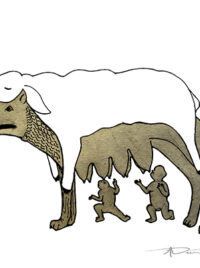
Artist: Drew Martin
Of course, there are fundamental differences among political mimicries in the art of misrepresentation which includes, among others fraud and lies and cheating. Hitler’s pretension to rule within the constitutional order of the Weimar Republic differs fundamentally from the claim by Chavez, Erdogan, or Orbán that they run a democracy, as they were elected originally lawfully and democratically. Hitler’s lie in 1939 that Poland has attacked Germany differs from the self-deception of American leaders who made themselves to believe about the existence of Iraqi weapons of mass destruction. The difference among political regimes is in the art of deception: why the rulers lie, and disregard facts known to them, how far they dare to mislead, and in the regularity of misrepresentation. Dictators and autocrats in the making cheat to end democracy, while in democracies politicians are lying within limits and even Machiavellian democrats among them do not intend, and in most of the cases do not annihilate democracy. Not that democracy would not be better without lies.
Illiberal democracies stand out in the history of political deception. Here the rulers not only lie, make false promises, manipulate, twist, distort and invent facts, withhold information, and doctor statistics. They go beyond these well-known practices of acquiring, maintaining and increasing power. Although the mountain of truthiness, ‘facts’ based on gut feeling reaches unusual height even by world history standards, there is nothing unusual here. The great innovation of contemporary populist leaders is that they govern with rules that systematically cheat. The leader of illiberal democracy pretends to rule according to the freely expressed wishes of his people, he claims that his regime respects the rule of law, human rights, and it is a democracy (only perhaps a better one than what you have in elite -ruled, inefficient democracies). This mimicry is necessary in those weaker states where the regime, its economy and even sovereignty depend on international relations as is the case of smaller European Union member states. This is also required in countries where the liberal, democratic expectations are still widespread in the electorate, and even those who dream of a strong leader of their stump insist on elections as the form of people’s government. Here the populist must (pretend to) play by these inherited rules. But powerful states, where the leaders and, increasingly, the general public believe that they do not depend of democratic traditions or expectations, these inhibitions are easily disregarded and the fig leaf of legality becomes very transparent, and deliberately so, because the not-anymore-hidden disrespect of decency, brutality, and violence is the welcome form of governing. Giving up the cat and mouse game of legalized cheating is a clear sign that the leader is becoming a full blown autocrat leaving behind the crumbling façade of democracy.
Systemic cheating (lying deceit, fraud, spin, tricks, workarounds and other forms of misleading) is at the heart of governing in illiberal democracies. Here institutionalized cheating by legal manipulation and manipulations of the law are constitutive elements of a potentially self-perpetuating political ‘regime’ (a potentially self-perpetuating political system and social order) that claims to satisfy the formal requirements of a constitutional democracy – until the ruler will feel this mimicry unnecessary. Even Putin had to go through a period of ‘managed democracy’ until he did throw it away (and could not afford it given the increasing need for oppression). But even today there are (formally multi-party) elections in Russia with pomp and fanfare.
Illiberal democracy manipulates what the people is and who they are; it manipulates the law too, to look like a system faithfully observing the constitution and the rule of law; it cheats to enable favoritism that it needs for domination in a patronage system and for the perpetuation of power. Regimes of cheat disregard that constitutional democracy cannot exist amidst constant misinformation that deprives it of facts and honest norms needed for rational discourse. A legal system that claims to empower people where it only caters to their bias and prejudice is a cheater: it will deprive people of their rational capacity necessary for democracy, and at the same time it will increase its legitimacy fraudulently by making the deceived people and many innocent bystanders believe that the system is democratic, constitutional etc. In this world of counterfeit, public procurement tenders are designed to guarantee successful cheat, as the tender sets conditions which can be satisfied only by a specific government crony. Or, if there are competitors with better offers than what ‘our guy’ has submitted, the evaluators will find legal grounds to disqualify the better offer, claiming national security interests or arguing that the offer is unrealistic. The above-mentioned grounds of exclusion are reasonable clauses of public procurement law, so how this can work? The evaluations are simply arbitrarily justified, if at all.
The law enables the cheating and the servants of the state know how to use the possibility of abuse. When a dealer sells his car that is overheating, he will answer upon inquiry that he had no problem with it on a very hot day in the desert. This is true in the sense that there was no overheating at the time when the vendor was in the desert four years ago and the car is overheating now. The statement is true but deceitful.[3] There is little difference between populist leaders of illiberal democracy on their way towards autocracy and the proverbial car salesmen.
Cheating means the observation of a rule only to depart from it , most often reaping undeserved benefits from the cheated persons or from the ‘system’ (the state budget). The cheater misrepresents himself as being in conformity with the norms, the rules of the game. Cheating does not require a false statement. I have an extra ace in my pocket that I use in the card game that enables me to show four aces in my hand. The four aces are there but I break the underlying assumptions which are based on a shared norm. These leaders of illiberal pseudo-democracies (mimicry-democracies) pretend to keep themselves within the game: “the game is valued, and so is its purpose and the objective, for example, of winning a football match (Maradona scores by handling the ball into the net).” [4] How you win the game does not matter. For many such leaders cheating with the law and on the law is not a moral problem and this is particularly true of populist rulers: they break those laws that they believe should not exist.
Ideally, the leader of the illiberal regime is in the position to set the rules that enable his cheating. The best aphoristic summary of the strategy comes from Latin-America: „hecha la ley, hecha la trampa“ (make the law and then find your way around it).[5] In the more advance stage of ruling by cheating the law itself creates the workarounds. The rules are tailor-made to achieve the outcome favoring the rule-maker. You require presidential candidates to have a university degree and if you don’t like the opposition candidate the degree-granting university will be able to determine that the degree was fraudulently obtained because twenty years ago the applicant transferred credits improperly. That may not be the case but this is a matter for the state-captured university being part of university. After all, such decisions pertain to autonomy required by academic freedom. We respect academic freedom in Turkey, don’t we? This is how in 2025 the popular leader of the Turkish opposition was barred from running for presidency. The academic qualification requirement was introduced in 2017 by the current President. Of course, this innocent rule ‘helps to have a well educated President’ and the President could not foresee that his future challenger will have a dubious degree. But a well-educated President knows a lot about Chekhov’s proverbial dramaturgy: a gun placed on the wall in act one is there for a purpose: to be used in act three.
This prescience works where there is total law-making power, for example when one has a subservient majority of dependent loyalists in Congress, or in the absence of a clear majority in a paralysed legislative body the Leader shall have enough constitutional authorization to rule by decree, where the divided legislation has no majority to overrule the decree. This is the typical case of decretismo in Latin America where at least in some countries the President has broad decree-making power to implement his policies in the absence of a working majority. After all, things have to arranged by someone.
In other instances, although the executive is limited in his decree-making powers in the absence of statutory authorizations, the executive will rely on decrees that are hardly consistent with the written statute or the spirit (values) of the constitution. But the Leader can afford such cavalier action as neither the captive loyalist parliamentary majority nor the captured judiciary will set aside the dubious decrees.
The easiest and most common form of creating legalized rule-bending is by grabbing emergency powers. This was already the way in the Roman Republic where dictators like Pompey, Julius Caesar or Augustus tried to obtain absolute power by being authorized to act as dictators. A Roman dictator had full powers of the state but for a limited time only, typically six months and for a specific task. The above military leaders asked for perpetual unlimited power in the name of some kind of emergency.
In contemporary emergencies which are used to extend executive power (a one man rule) the conditions of emergency are constituted by lies and misrepresentations; in other instances there are extraordinary threats but the powers are applied outside the scope of emergency, or the power is maintained even after the emergency ceased to exist (e. g. a pandemic is not there anymore). In Hungary, a country rightly admired as exemplary by despots in the making as an ingenuous, original inventor of techniques of abuse, the captured legislation authorized the government to amend all sorts of laws by decree in reference to situations that do not represent any emergency or much of actual threat as is the case of “emergency due to ongoing war in a neighboring country”. A state of such emergency was declared under the pretext of the war in Ukraine that for many years did not pose any threat to Hungary. Given this fake emergency (and others like the threat of migration) the government was able to carve out for itself the power to regulate the economy.
The new Prince feels no shame to rely on fallacies, non sequitur, and (knowingly) false factual assumptions (including denial of obvious facts). The authorities disregard the dictates of ordinary reason to serve the leader’s wishes, hiding behind a withered fig leave of legality. There is preference, even joy for the absurd in judicial interpretation of the law. Among the dozens of original and creative examples of this theatre of the absurd the non-imposition of environmental fines in Hungary offers an innocent school-book example. An emergency decree was issued as a measure of “Coordination of Defense and Security Activities” “due to hostilities in a neighbouring country” under the above emergency powers. The decree abolished environmental fines with retroactive effect, as well as fines which were to be imposed in the future. Who knows what kind of relationship could there possibly be between this environmental amnesty and the war in Ukraine or the improvement of national defense capabilities? Are pollution fines hampering Hungarian peace or defense efforts? (Hungary is the only NATO member that refused to provide arms to Ukraine). There is neither official nor political justification, not even an unofficial explanation for this decree – a derogation of an Act of Parliament. The lack of reasonableness or justification the absence of any link between the decree’s stated purpose and its subject matter necessitates an examination of the real intentions behind the environmental amnesty decree. What remains in front of this irrational arbitrariness is the fact that a little bit earlier a major foreign investor was found (repeatedly) in violation of emission standards and therefore facing minimal fines. The company allegedly threatened the government that it will stop investing. There is evidence that other major investors were also polluting big and may have had similar concerns. The irrationality disappears but that hardly makes the trick more palatable.
“To my friends everything, and the law to my enemies.” This leading maxim of illiberal cheating is attributed, in different versions to late early 20th century Italian Prime Minister Giolitti and Brazilian populist semi-dictator President Getulio Vargas. Softer illiberal democracies apply only exceptionally the second part of this favorite of Putin and are satisfied with making the law for the friends (see public procurement criteria). For the soft illiberal democracy, it is enough not to prosecute those loyalists who transgress the law, or pardon them as it happened in the Czech Republic with outgoing President Klaus, but prosecution of opponents is seldom applied, at least in the early stage of autocracy building. (The personal desire of revenge may disregard this rule of illiberal regime building.)
The successful illiberal leaders are outstanding in cheating and duplicity, but their success cannot be attributed to their personal excellence only. For Machiavelli, “A great pretender and dissembler …who deceives will always find someone who will let himself be deceived,“[6] but dupe citizens are not numerous enough for the large scale social acceptance and endorsement of the acts of misrepresentation. Not everybody is dupe or self-blinding. Cheating as successful governance is rooted in existing cultural patterns and traditions. Among these traditions the instrumental, disrespectful, and shameless use of the law is crucial, On the recipients’ side the skeptical public attitude to truth and facts contributes to the public acceptance and even endorsement of cheating. This fits into the mood in a post-truth world. If truth is not possible there can be no lie, and cheat and corruption become part of ordinary morals. This cavalier attitude was already quite common by the seventies of the last century. The novelist Joseph Heller provides a masterful example in his novel Good as Gold: “Perfect truth was not of determining importance in the exposition of Gold’s theory: he felt mutinously that he had as much right to falsehood, bias and distortion in his memoirs of Kissinger, as Kissinger did in his memoirs of Kissinger.“[7] Today one does not need a mutinous attitude to have the right to one’s truth and falsehood. It goes without saying that this “right” is part of individual freedom. What matters for the new populist Prince is to have enough people to accept his truth and falsehood and he is successful in the endeavor, as his truthiness, and falsehoods are to a great extent the truthiness of his believers, even before he has articulated these nonsenses. For example, the Prince has no difficulty when he offers fraudulent remedies and protection against threatening aliens. The enemies (the aliens, migrants, sexual perverts, the elite that conspired against the good people) were already lingering in the mind of great parts of the population, he just dared to extract it from the public paranoia, to give form to these phantoms.
Sometimes the half-baked, instinctive dictator does not even see that he is cheating, or invents facts and grievances, as he is convinced of the delusional reality of his grievance that serves as the basis of the regulations (“rising violence in the capital … disrupts the proper functioning of the Federal Government”).
The spreading of ’ truthiness’ by domesticated media is crucial in the manipulation of the public. The media are recruited into the service of the illiberal regime because the ruler controls the carrot of state assets (subsidies, advertisement) and the sticks of regulatory tools, and investigative authorities. In addition, in many non-established democracies without an existentially self-supporting citizenry the ruler can rely on the artificially increased personal dependence from the state and also on the inherited serf mentality that survived centuries of servitude.
According to the Hungarian proverb, “the mendacious will be caught sooner than a limping dog.” (“The path of a liar is short” — would be its Swahili equivalent.) But that is not so obvious when it comes to illiberal democracies, and their legal systems. Sometimes it is difficult to prove that the law itself is fraudulent, as law is based on the assumption that it is law itself to decide what is legal and illiberal legislation is keen to print as law what serves fraud. Ambiguity too helps the cheater.
Consider Poland under the rule of the Law and Justice Party (PiS) (2015-23). The PiS government is regularly accused by third parties including judgments of international courts of violation of the Constitution. In some instances, the PiS parliamentary majority used the shortcomings, loopholes, and open texture of the Constitution. These actions, for example a new system of judicial appointments enabling the government to appoint people who were considered loyalists were formally legal, though they were acts of cheating as the intent and result was to appoint judges who are not independent. In other instances the misrepresentation (lie) was more obvious. In 2016 a high ranking bureaucrat in the office of the Prime Minister decided – without specific legal authorization – not to send to the printer of the Official Gazette the decisions of the not yet captured Tribunal which he considered unconstitutional. According to the law the Tribunal’s decisions enter into force only by promulgation in the Gazette.
Even obvious violations of the Constitution can be declared lawful by a fraudulent court. Luis Parra was elected President of the Venezuelan National Assembly without the proper quorum, when the sitting Assembly President, Juan Guaido was not able to attend the vote being forcibly restrained by the armed forces. This parliamentary coup was found constitutional by the well selected Constitutional Chamber. For the judges all the procedural steps were appropriate and the quorum issue and Guaido’s absence were simply not considered.[8]
When the Supreme Court of India was supposed to determine the constitutionality of the emergency that Indira Gandhi, the incumbent Prime Minister has enacted in her attempt to turn India into a rump parliament-endorsed dictatorship, the Court’s judgement disregarded that the new electoral law that enabled her to run at elections was passed after Gandhi has jailed many opposition MPs on grounds of the emergency power that she has proclaimed. Moreover, the Indian Supreme Court ruled that the fact that Gandhi bribed her constituency did not disqualify her in the eyes of the Court, as she used her own assets to distribute gifts to members of her constituency. (It is true that until today candidates in India are expected to offer gifts – like in so many cases the fraudster can rely on the soft spots of public sentiment.)
Outright falsification may require shameless denial of existing legal and moral norms or a claim that an event occurred, which did not, or a norm exists or exists with a specific meaning while nothing is more far away from facts and truth. At the end of the day cheat is replaced with shameless arbitrariness and words mean what the power choses them to mean. Humpty Dumpty becomes the Queen of Hearts. Norms are not only denied: they can be invented in the service of the political power. The often quoted trick of the Supreme Court of Nicaragua regarding the unconstitutionality of the constitutional rule on presidential term limit illustrates it. In order to allow Noriega to run as many times as he wishes his Court invented an absolute human right for sitting Presidents to remain eligible as part of their inelianable individual passive voting right.[9]
With institutionalized cheating rationality and economic efficiency are devastated, and the regime of cheating is perpetuating an increasingly despotic corrupt regime. But public morals is what suffers the most serious damage. The problem with fraudulent government was already noted by Cicero: “There are two ways in which injustice may be done, either through force or through deceit; and deceit seems to belong to a little fox, force to a lion. Both of them seem alien to a human being; but deceit deserves a greater hatred.”[10]
During Communist days Vaclav Havel hoped that citizens will step out of “living with the lie” and that will end communism.[11] We are “living in lies” again, and only in former communist countries. The arbitrary regime that rules by cheat is disrespectful of its citizens and makes them complicit in its cheating.[12] Complicit or not, they are treated as dupes to be manipulated. And sometimes they are so dupe that they consider these lies as liberating, just because these are their own misunderstandings or paranoid representations (as is the case with the pandemy virus denial).
There is nothing surprising in the acceptance of regimes that rule by cheating. On the road to despotism, Hannah Arendt warns, “totalitarian movements conjure up a lying world of consistency which is more adequate to the needs of the human mind than reality itself; in which, through sheer imagination, uprooted masses can feel at home and are spared the never-ending shocks which real life and real experiences deal to human beings and their expectations.”[13]
Notes
[1] N. Machiavelli, The Prince, 2nd ed., transl. Harvey C. Mansfield. University of Chicago Press 1998. p. 69.
[2] Message to the Congress of Angostura. Dec. 18. 1819. Selected writings of Bolivar. compiled by Vicente Lecuna ; edited by Harold A. Bierck, Jr.; translation by Lewis Bertrand. New York : Colonial Press, c1951. Vol 1. 211.
[3] Thomas L. Carson Lying and Deception: Theory and Practice. Oxford UP. 2010 15-16
[4] G. Palombella, ‘The Abuse of the Rule of Law’, Hague Journal on the Rule of Law (2020) 12:387–397 Palombella refers to Green, ibid 389 ff
[5] . Ratliff, William, and Edgardo Buscaglia. ‘Judicial Reform: The Neglected Priority in Latin America’. The Annals of the American Academy of Political and Social Science 550 (1997): pp. 59–61.
[6] Machiavelli, op. cit. p. 70.
[7] J, Heller, Good as Gold (Corgi Books, 1980) p. 365.
[8] http://www.tsj.gob.ve/-/sala-constitucional-del-tsj-ratifica-a-luis-parra-como-presidente-de-la-asamblea-nacional
[9] Case No. 602-09, in the Amparo Writ Ortega et al. v. the Supreme Electoral Council of the Republic of Nicaragua. https://www.loc.gov/law/foreign-news/article/nicaragua-supreme-court-decision-permitting-president-others-to-seek-reelection/
[10] Cicero, On Duties (De Officiis) 1.41
[11] “Living within the lie can constitute the system only if it is universal…everyone who steps out of line denies it in principle and threatens it in its entirety …” Vaclav Havel, The Power of the Powerless. In Vaclav Have, Living in Truth, ed. Jan Vladislav (London Faber & Faber, 1986) 55-6.
[12] The politically unconnected businessman will participate in a public procurement tender, deliberately presenting a losing offer only to become one of the subcontractors of the winner.
[13] Hannah Arendt, The Origins of Totalitarianism N Y Houghton Mifflin 1994 352-3.
Author

Latest Issue
2025: Vol. 24, No. 1-2
Latest Issue
2025: Vol. 24, No. 1-2

Essays
Democracy in Danger
Essays
Democracy in Danger
By Robert R. Kaufman: Democratic Resilience in the United States: Containing Trump’s Threat to Democracy
Essays
Global Tensions
By Meera Nanda: India’s Conservative Revolution: The Postcolonial Left meets the Hindu Right
Essays
Global Tensions
By Donatella Della Porta: Eventful Protests Against the Israeli Genocide: The Italian “Hot Summer” for a Free Palestine
Essays
Global Tensions
By Dina Khapaeva: Investigating Putinism: History Over Ideology
Essays
Global Tensions
By Nader Entessar: Apocalypse Now? The Evolution of Trump’s Policies Towards Iran
Essays
The Assault on Public Goods
Essays
The Assault on Public Goods
By Sam Friedman: The Government Attack on Public Health Research
Essays
The Assault on Public Goods
By David Schultz: American Higher Education in the Era of Trump
Essays
Socialism and the City
By Shelton Stromquist: Mamdani, a “New Municipalism”, and the Undertow of Party Elites
Essays
Socialism and the City
By David R. Berman: A Socialist Mayor for New York? What History Suggests
Essays
Aesthetic Reevaluations
By E. San Juan, Jr: Reflections on Shelley’s The Cenci: Transgression, Exorcism, Sacrifice
Essays
Aesthetic Reevaluations
By Jack Miller: The Metonymy of Light: Three Early Works by Stan Brakhage
Author Meets Critics
Michael J. Thompson's Twilight of the Self
By Lauren Langman: On Michael J. Thompson’s Twilight of the Self
Author Meets Critics
Michael J. Thompson's Twilight of the Self
By Jeffrey A. Halley: Domination, Weirdness, and Art: On Michael Thompson’s Twilight of the Self
Author Meets Critics
Michael J. Thompson's Twilight of the Self
By Charles Thorpe: From Critical Agency to Critical Solidarity
Author Meets Critics
Michael J. Thompson's Twilight of the Self
Book Reviews
By Paul Buhle: Benjamin Balthaser’s Citizens of the Whole World
Book Reviews
By Galina Bogatova: Paul Chaisty and Stephen Whitefield’s How Russians Understand the New Russia
Book Reviews
By Patrick D. Anderson: David Golumbia’s Cyberlibertarianism
Book Reviews
By Paul Buhle: Harold Schechter and Eric Powell’s Dr. Werthless
