
David Golumbia’s Cyberlibertarianism
In Cyberlibertarianism: The Right-Wing Politics of Digital Technology, David Golumbia takes it upon himself to defend democracy from what he called “cyberlibertarianism,” a nebulous right-wing ideology that pervades the entire discourse surrounding digital technologies, even in self-defined left-wing spaces. The danger of cyberlibertarianism, he says, is that it undermines democracy by undermining governmental power. “One of cyberlibertarianism’s chief effects is to minimize or eliminate the power of democratic governments to choose which technologies fit their vision of a healthy society,” Golumbia warns, so “the future of democracy depends on the ability of citizens to reclaim that power from the companies and technologists that have so effectively undermined it” (xxiii). Following other scholars who have called for democratic intervention into the world of digital technologies, Golumbia argues that licensure, regulation, or even outright abolition are warranted and desirable methods for reversing the status quo and again subjecting technology to democracy (xxiii).
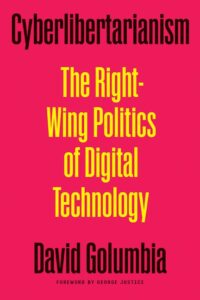
Notwithstanding the prima facie reasonableness of Golumbia’s main argument, Cyberlibertarianism over-promises and under-delivers. It promises to expose a pervasive, insidious, conspiratorial trend in which racist, sexist, free market fundamentalists have developed and promoted digital technologies saturated with their right-wing values and ideologies. It promises to show how even self-described liberals, progressives, and leftists have been suckered into adopting these inherently right-wing technologies, thereby unintentionally propagating ideas and systems they claim to oppose. And it promises to convince readers that we must put a stop to (almost all) digital technologies.
Golumbia’s promises, however, never materialize because his argument succumbs—in its unnecessary 400 pages of meandering asides—to all manner of obfuscations, contradictions, informal fallacies, double-standards, erroneous claims, and sometimes outright fabrications.
Cyberlibertarianism is plagued by three key failures. First, Golumbia’s analysis is plagued with ill-defined concepts. Golumbia’s entire analysis is framed by a conflict between “democracy,” which is never defined, and “cyberlibertarianism,” which is primarily defined as neoliberalism-gone-technological. Throughout the argument, it is simply assumed and implied that the United States is a “democracy,” but even those of us who do not find this assumption absolutely dubious would have no idea what they are agreeing with. Similarly, throughout the book, Golumbia’s primary normative heuristic is grounded in a vague distinction between “left-wing” and “right-wing,” which is not an analytical distinction but an affective distinction that inevitably reduces to “good” and “bad.” Second, there is Golumbia’s problematic failure to study the relevant primary sources for the topics and figures he discusses. As an English scholar, Golumbia ought to know that primary sources analysis is a basic requirement of Humanities research. Golumbia dedicates major portions of the book to criticizing figures like Edward Snowden, Julian Assange, and Glenn Greenwald, but he fails to examine the many books and articles written by them. His sources overwhelmingly consist of secondhand accounts and cherrypicked quotes excavated from online rumor mills. Third, Golumbia also fails to properly engage the relevant secondary sources in the peer-reviewed scholarship. When such sources are cited, they are engaged in an ad hoc and deceptive manner. Academic readers looking for indications of how Golumbia’s research fits into the scholarship will remain disappointed and confused, even once they’ve reached the Epilogue. In the end, the promised scholarly analysis and incisive critique give way to unnecessary insults and unsubstantiated claims, resulting in a shallow book that seems more firmly grounded in Twitter feeds than academic rigor.
In the spirt of empathy and humanism, readers ought to know that Golumbia succumbed to an aggressive form of cancer while finishing the book in 2023, and because it had already passed peer review, University of Minnesota Press decided to move forward with the work, publishing it in November 2024. On the one hand, the impassioned tone and confused structure of the work may have resulted from the fact that the author was suffering a serious illness while writing the book. On the other hand, the manuscript apparently passed peer review and was subsequently published by a university press, which means we must assess its contents as we would any work of scholarship.[i]
Cyberlibertarianism appears to be motivated by some compelling questions about the nature of digital technologies, but Golumbia’s unwillingness to engage in meaningful debate—he ignores scholarship, mischaracterizes sources, and resorts to ad hominem attacks—completely discredits both his conclusions and his authority as an author. Though this book is saturated with an admirable passion and informed by truly humanistic concerns, Golumbia’s careless prose and inept organization only exacerbate his indifference to the basic practices of academic argument. Cyberlibertarianism would have benefited from some editorial guidance, for should have been half as long and twice as scholarly. It is not that Cyberlibertarianism is merely flawed. Cyberlibertarianism should not be taken seriously, for it actually harms the discourses and the politics that Golumbia wanted to help. If we truly want a prognosis for our current political problems, we are better off disregarding Golumbia’s diagnosis.
The Unsound Methodology of Cyberlibertarianism
Cyberlibertarianism consists of seven chapters distributed across three parts. In Part I, “Cyberlibertarianism in Theory and Practice,” Golumbia attempts to explain what cyberlibertarianism is by situating it within the history of neoliberalism and introducing the cast of cyberlibertarian characters. He also provides an account of cyberlibertarianism’s “denialist” politics and provides examples of their anti-democratic disposition by citing the apparent cyberlibertarian opposition to the Stop Online Piracy Act and to the reform or repeal of Section 230 of the 1996 Communications Decency Act. In Part II, “Myths of Cyberlibertarianism,” Golumbia attempts to demystify what he sees as a host of cyberlibertarian truisms, from their ahistorical tendency to analogize digital technologies with the printing press to their rhetorical dependence on seemingly vague notions like “open,” “free,” “democratization,” “decentralization,” and “privacy.” In Part III, “Cyberfascism,” Golumbia attempts to trace an ideological line from anarcho-capitalism through social media and WikiLeaks up to contemporary far-right movements including the Alt-Right and Neoreactionism.
One of the major issues with Golumbia’s attack on cyberlibertarianism is that he fails to differentiate big versus small, corporate versus activist, in the context of digital technologies. This distinction is commonplace in the scholarship. In The Age of Surveillance Capitalism, for instance, Shoshana Zuboff criticizes giant surveillance capitalist corporations and digital activists who emphasize technological solutions over political ones. For Zuboff, corporations that employ techniques of surveillance capitalism are the real threat, and the technologically-minded activists simply offer what she views as an inadequate response to the threat. She does not lump the activists in with the surveillance capitalists and claim they are all part of the same phenomenon.[ii] We know Golumbia is aware of this meaningful distinction because it appears in his previous book, The Cultural Logic of Computation, where he differentiates three groups: those who succumb to an unabashed form of technological optimism, those who see digital technologies as the terrain upon which modern political struggles will be contested, and those who—like Golumbia—advocate for political struggles beyond the domain of digital technologies. Even though Golumbia finds serious limitations in the other positions, he nevertheless understands their differences.[iii]
Such nuance is completely absent in Cyberlibertarianism. Here, Golumbia lumps all of the following under the banner of cyberlibertarianism: cypherpunks, Electronic Frontier Foundation, American Civil Liberties Union, Facebook, Google, Julian Assange, WikiLeaks, Internet Archive, Tim Berners-Lee, Ron Paul, Mozilla Foundation, Edward Snowden, Glenn Greenwald, MIT Media Lab, Data & Society, danah boyd, Charles Koch Foundation, Lord William Rees-Mogg, Cory Doctorow, Esther Dyson, Uber, Lyft, George Gilder, George Keyworth, Alvin Toffler, Al Franken, Tim Wu, Reddit, David Friedman, Peter Thiel, Tor, Eric Schmidt, Curtis Yarvin, Nick Land, Lawrence Lessig, Tim May, Yochai Benkler, Steven Levy, Mike Masnick, Wikipedia, Richard Stallman, Cody Wilson, Steve Wozniak, and anyone who takes an interest in or supports open access, open source, cryptocurrencies, net neutrality, encryption, or peer-to-peer networks. And if you oppose the repeal of Section 230, Golumbia finds a special place cyberhell for you. Of course, Golumbia need not trifle with the wide variety of differences—and even conflicts—between the individuals and institutions caught up in his dragnet, for anyone who ever thought that any single digital technology did anything good for anyone is either an adherent of or a useful idiot for what he calls “cyberfascism.”
To understand how all manner of people and organizations become implicated in Golumbia’s attack on cyberlibertarianism, we must understand his conception of the term. According to Golumbia, cyberlibertarianism is neither an explicit ideology nor an organized movement; rather, it is an amorphous “right-wing” mood that spreads through contagion even into “left-wing” spaces. At its core, we find neoliberalism. “The neoliberal agenda is no secret,” Golumbia asserts. “Cyberlibertarianism functions as a less explicit outer shell of neoliberalism” (30). Of course, not everyone who finds themselves advancing cyberlibertarian ideas supports neoliberalism. While Golumbia fails to state this point clearly, he argues that cyberlibertarianism relies on sexy resistance motifs and pseudo-radical rhetoric to draw even neoliberalism’s opponents into the neoliberal fold, often without them realizing it. “Many followers of cyberlibertarian dogma are unaware of the ways such precepts serve right-wing political power,” Golumbia warns (68).
Cyberlibertarianism is so effective, Golumbia insists, because it “syncretic” and “inchoate.” Cyberlibertarianism is syncretic because it is a style of fascist politics that seeks to go “beyond left and right.” Through syncretism, fascists aim to recruit from the left or at least disseminate their fascist ideology into otherwise impenetrable circles. Golumbia chastises supposed cyberlibertarian compatriot Glenn Greenwald for feeding the fascist syncretist wave in the United States. He quotes Greenwald as advocating an alliance beyond the Democratic Party versus Republican Party divide as the best means for defending civil liberties and as praising Dennis Kucinich for seeking an alliance with Ron Paul to oppose an extension of the Patriot Act (70-72). Golumbia’s claim is more than a stretch. Greenwald was not advocating the transcendence of ideology into a universal militant nationalism; he was advocating a specific political coalition to prevent the renewal of specific legislation that, in his estimation, undermines civil liberties protected by the Constitution. What’s more, Golumbia embraces a double standard when it it comes to bridging political divides. In the process of defending the Stop Online Piracy Act, he praises bipartisanship, which he calls “the real form of cooperation in democracies” (36). It apparently never occurred to Golumbia that bipartisan cooperation is not inherently good, for some of the worst policies in U.S. history resulted from bipartisanism: the Chinese-Exclusion Act, the Gulf of Tonkin Resolution, the Patriot Act, the Authorization for Use of Military Force Against Iraq, the FISA Amendments Act—the list goes on. Golumbia is fine with Democrats and Republicans working together to pass the Patriot Act, but Democrats and Republicans working together to prevent its renewal is “syncretic.” According to Golumbia, then, when ostensible political opponents work together on issues he supports, its democracy; when ostensible political opponents work together on issues he opposes, its fascism.
Golumbia’s penchant for double standards has only just begun, for his charge that cyberlibertarianism is “inchoate” gives him license to say anything he wants—even if it isn’t true. “Inchoate refers to the fact that the preeminent cyberlibertarians frequently refuse to wear their narrow politics on their sleeves,” Golumbia says (68). Even though the term “inchoate” is repeated throughout the book, this is the single explanation readers are given of this core concept. But Golumbia’s move here has deep implications for the entire book: if cyberlibertarianism is always nebulous, always conceals itself, if cyberlibertarians are always elusive about their beliefs, always inchoate, then there is no reason to seriously study their arguments and respond with adequate counter-arguments. Because the cyberlibertarian’s expressed views are always suspect, Golumbia need not engage them—and he doesn’t. In fact, those sections of the book dedicated to examining the three people Golumbia seems to hate the most—Glenn Greenwald, Edward Snowden, and Julian Assange—Golumbia seems to go out of his way to avoid engaging with the relevant primary and secondary sources.[iv]
Wherefore Art Thou, Primary Sources?
Golumbia’s commentary on Snowden provides an excellent case study in anti-intellectual ranting. Though Snowden is discussed over the course of approximately forty pages, Golumbia fails to cite a single primary source authored by Snowden. He also fails to cite a single scholarly source on Snowden or the NSA documents he provided to journalists. Instead, Golumbia cites over a dozen videos, popular press articles (many of which are authored by people who hate Snowden), and other random material from the internet. Of course, Golumbia does not need primary sources to opine about Snowden’s politics, for he can simply intuit them as if he is a medium of all conspiratorial fascism. “Snowden’s politics are often misunderstood by progressives and others who sympathize with his hostility toward the United States,” Golumbia prognosticates (122). Between Greenwald, Assange, and Snowden, “Snowden is the least overtly partisan of the three,” he adds, “although that may be more appearance than fact” (117). Here, Golumbia insists that Snowden’s ideas “appear” one way and are in “fact” something else. In one incredible passage where he divines “the explicit and implicit political analyses Snowden offers,” Golumbia provides no citations at all (117). How can Golumbia know Snowden’s politics without citing any primary sources? How can Golumbia know Snowden’s politics without citing any secondarysources that have studied the primary sources?
If only Snowden had written something, like a memoir, in which he explained his principles, then Golumbia could read it, engage it, and cite it. (Snowden did write a memoir.)[v] Likewise, if only scholars had already published academic studies of Snowden in which his principles were examined, or complied a reader containing relevant and useful primary and secondary sources, then Golumbia could have built upon the existing research. (Scholars have published these things.)[vi]Golumbia feels entitled to avoid primary sources and ignore experts because everything surrounding so-called cyberlibertarians is “inchoate.” If someone’s expressed views are always a cover for their real beliefs, as Golumbia claims regarding cyberlibertarians, then there is no need to actually read their work. Simply call them a “cyberlibertarian” and you can say about them whatever you like. When it comes to Snowden, Golumbia’s only point, which is neither original nor convincing, is that Snowden hates America, hates the government, and hates democracy, despite the fact that these accusations contradict Snowden’s explicitly expressed views.
Golumbia’s commentary on Assange is even worse than his commentary on Snowden, for he slips past political argument and moves straight into ad hominem. Similar to his treatment of Snowden, Golumbia dedicates almost twenty pages to discussing Assange, but he examines only one primary source over two paragraphs, a meagre effort when studying someone who has dozens of books and articles to his name.[vii] Unlike his treatment of Snowden, Golumbia does not even pretend to examine Assange’s ideas by cherrypicking quotes from random interviews. Instead, he goes straight to insults and accusations. “This is not an exaggeration,” he proclaims: “Assange is a proto-Nazi political provocateur whose overt anti-Semitism, anti-Black racism, climate change denial, misogyny, hatred for democracy, and support for authoritarian political regimes…routinely fail to penetrate the minds of observers who see as dispositive his use of digital tools and antiestablishment affect” (116). To paraphrase, because Assange uses computers, no one but Golumbia sees Assange for the racist, sexist, fascist that he truly is—an amazing research finding if there ever was one. Ironically, Golumbia repeatedly accuses cyberlibertarians of resorting to ad hominem attacks as a way to avoid engaging their opponents (82, 112, 131-134, 203). Again, Golumbia fittingly avoids engaging the relevant primary and secondary sources on Assange and WikiLeaks. After all, the scholarship likely examines Assange’s expressed views, and because he in an “inchoate” cyberlibertarian, Golumbia implies that there is no really need to do so.[viii]
I take serious issue with Golumbia’s failure to study Snowden and Assange because his work is an extreme example of the neglect of primary sources in the study of whistleblowing and cypherpunk activism. For over a decade now, academics have studied whistleblowers, digital activists, and other similar individuals and groups without actually accounting for what these parties say about their principles, values, and decisions.[ix] But Golumbia’s approach goes farther. Whereas other scholars have simply found the primary texts to be unimportant, Golumbia claims that his subjects of study are “inchoate,” which given him license to ignore their stated positions and make whatever accusations he likes. If Golumbia wants to make a claim about what someone like Snowden and Assange believes, he would have to actually read their work and critique it. If Golumbia wants to claim that there is a disparity between what Snowden and Assangesay and what Snowden and Assange do, then he would still have to actually read their work to make this kind of argument. But Golumbia does none of this. Instead, he claims that there is a disparity between what Snowden and Assange say and what Snowden and Assange believe without examining what they say and without explaining the oracular powers he uses to divine their beliefs.[x]
When Golumbia calls cyberlibertarianism “syncretic” and “inchoate,” he is not describing properties that inhere in his object of study; he is establishing an argumentative path that circumvents the need for scholarship. While he wants to convince his reader that incoherence lies in the nature of cyberlibertarian politics, the incoherence actually lies in his conceptualization of cyberlibertarianism. Golumbia’s net is cast so wide that he catches too many disparate individuals and institutions in it; instead of rethinking his net, he blames his catch. Once he has ascribed elusiveness to his object of study, he is freed from the burden of studying it at face value. To be sure, critical readings always require us to start at the surface level of a text and then move into deeper levels of analysis, but Golumbia never even touches the surface of the text because he doesn’t even cite any sources. When it comes to Greenwald, Snowden, and Assange, Golumbia simply identifies people he hates and cites those who hate the same people. Like a perverse game of telephone, Cyberlibertarianism increasingly loses its meaning the longer is drags on.[xi]
Sources of Distortion in the Distortion of Sources
Unfortunately, Golumbia’s obfuscations, contradictions, and fallacies and only the tip of the ice berg, for when we subject his citations to direct examination, we find a number of erroneous claims and outright fabrications. In some instances, Golumbia cites sources that contradict the claims supposedly supported by the sources. “Assange directly intervened in a U.S. election through cooperation with Roger Stone, who himself used Jones and other conspiracy theorists for just that purpose,” Golumbia claims (116), citing a 2020 New York Times article that says, “The records shed no new light on whether Mr. Stone, 67, directly communicated with Mr. Assange before the election.”[xii] The New York Times article does not support Golumbia’s claim; in fact, it contradicts Golumbia’s claim. Unfortunately, such curious citational infelicities pervade the entire book.
When Golumbia attempts to prove that Snowden’s whistleblowing never prevented any harm and never stopped any illegal activity, he botches an examination of case law. Hepting v. AT&T was a 2006 class action lawsuit filed by Electronic Frontier Foundation (EFF) on behalf of AT&T customers who claimed that surveillance cooperation between the telecommunication giant and the NSA harmed customers who were entitled to damages. Golumbia argues that “the Ninth Circuit’s ruling” in Hepting v. AT&T proves that the courts found the NSA’s bulk collection of telephony metadata constitutional (124). Those who are familiar with Hepting immediately realize that something is wrong with Golumbia’s description, for the Ninth Circuit never ruled on Hepting. The case was dismissed in 2009 because Congress had granted retroactive immunity to telecoms in the 2008 FISA Amendments Act. When one checks Golumbia’s lone citation, they find that the article discusses not Hepting v. AT&T but Jewel v. National Security Agency, a similar EFF class action lawsuit filed in 2011.[xiii] In other words, Golumbia’s research is so careless that he confused two different court cases, a mistake that he could have easily avoided if he had only clicked on the very first link in the article he cites, which provides direct access to a PDF of the court’s memorandum.
Not only did Golumbia fail to read the court’s decision, he also failed to read the article he cited. Golumbia claims that the plaintiffs in Jewel “were unable to show how the [NSA] program in question had harmed them” (124). This is true, but it is not true because the evidence was evaluated in court. It is because the government was permitted to conceal the evidence by claiming that the relevant information was too sensitive and could not be released for national security purposes. The NSA was the only party with the potential evidence, and they were permitted to conceal that potential evidence. The accused agency was permitted to hide potential evidence of its criminality and then claim there was no criminality, and Golumbia thinks this is a good thing.
The Hepting and Jewel cases are not the only cases that Golumbis mischaracterizes, for his conclusions about United States v. Moalin also contradict the facts of the case and the content of the source he cites. In 2013, Basaaly Moalin and three other Somali individuals were convicted of illegally fund-raising for Al-Shabaab, a Somali terrorist organization. In United States v. Moalin, the four defendants appealed their convictions partly on the grounds that some of the evidence used against them was collected under the NSA’s bulk collection programs. In 2020, the Ninth Circuit Court of Appeals upheld all four convictions. For Golumbia, the Moalin case proves that no harm came from the NSA mass surveillance programs exposed by Snowden. “Yet even in a case where the defendants were convicted of just the sort of crime intelligence agencies are supposed to be looking for,” he proclaims, “the Court did eventually rule that their communications were not used this way. Had they been procured illegally, the resulting intelligence would have been inadmissible” (123).
Once again, Golumbia didn’t read the court’s decision; once again he didn’t even read his own source. As the article he cites reads: “the court held that the NSA’s former telephony metadata collection program violated FISA. Thus, not only was the collection of Moalin’s phone records unauthorized under the statute, but so was the collection of millions of Americans’ phone records that were swept up in the program.”[xiv] In other words, the metadata collected in the Moalin case was illegal. Golumbia apparently didn’t even bother to read the title of the piece, “Metadata Collection Violated FISA, Ninth Circuit Rules,” when he added it to his works cited list. The court did not uphold the convictions because the NSA’s surveillance was legal; the court upheld the convictions because the judges determined that Moalin’s telephony metadata was not used as the basis for probable cause. This is not difficult to understand, yet Golumbia refuses to read his sources and therefore obfuscates the truth to make the point he has already in advance determined is true. This is not critical empirical analysis—it’s unabashed dogmatic fabrication.
Golumbia’s citational infelicities are not restricted to his penchant for making things up and contradicting the sources he cites, for he often doesn’t cite any sources for his wild claims. Golumbia repeatedly complains about the anti-intellectualism of his cyberlibertarian enemies, arguing that they ignore the relevant scholarship on the topics about which they opine. But once again Golumbia is guilty of his own accusations. Take, for example, his comments on government mass surveillance. “It is true,” Golumbia axiomatically asserts, “that every government must have the power to surveil all telecommunications (and to some extent, even physical, non-electronic communications) in which its citizens engage” (123). Golumbia provides no source for this, ignoring the mountain of scholarship on this very issue. Similarly, Golumbia cites no sources for his claim that encryption prevents the FBI from prosecuting cases; in fact, it is more common to find the FBI lying about encryption than it is to find that encryption prevented successful prosecution.[xv] Golumbia also chastises Snowden for criticizing the government rather than “powerful defense contractor[s]” (117), but in Permanent Record, Snowden dedicates an entire chapter titled “Homo contractus” to criticizing national security contracting. Finally, he claims that the 2015 U.S.A. Freedom Act ended NSA bulk collection, but this is only partly true; telecom corporations still record all telephony metadata and government agencies can and do access such data without warrants thanks to the Supreme Court’s third-party doctrine.
Golumbia’s track record of claiming a cited source supports a claim when it explicitly states the opposite is a real concern for the academic integrity of the entire work. Readers would be fully justified in wonder whether he even read most of the sources he cites, for—as evidenced by his botched study of case law—much that he claims about his sources is demonstrably false. While the examples above have primarily centered around Snowden and Assange, these problems pervade Golumbia’s book. I tracked down dozens of sources across every chapter, and in almost every case I found the same problems: quotes taken only from introductions and conclusions; quotes taken out of context, and claims about cited sources that contradict the content of those cited courses. It’s not just that Golumbia is sloppy in his treatment of Snowden and Assange; he is sloppy with his treatment of nearly every topic and subject discussed in the book. And because he almost never situates his argument within the existing academic debates, the reader never knows how Golumbia’s position fits within the existing scholarship. Golumbia seems to be banking on the hope that readers will simply trust him. Given the pervasive citational infelicities in Cyberlibertarianism, such trust is unwarranted.
“Magnum Opus” or “Magnum Dedecus”?
In his Foreword to Cyberlibertarianism, George Justice—English scholar, Provost at University of Tulsa, and Golumbia’s friend and colleague—proclaims that the book is Golumbia’s “magnum opus” (xvii) and “the culmination of his life’s work” (xi). Those who are familiar with Golumbia’s work will readily agree that there is a noticeable trajectory running through his three books. But the trajectory of Golumbia’s work indicates not an ascension but a declension, withCyberlibertarianism sitting at the bottom of the slope.
In his 2009 book, The Cultural Logic of Computation, Golumbia examines a mode of thought he calls “computationalism,” which refers to a set of beliefs that reduce all aspects of human experience—society, politics, even human nature itself—to computational processes. Computationalism is promoted not only by a set of rhetorics, which frame computers as always good for us, but also by the computers themselves. While he acknowledges some of the empowering features of computers, Golumbia cautions us not to overlook the disempowering features of computers. “If an unassailable slogan of the computing age is that ‘computers empower users,’” he writes, “the question I want to raise is not what happens when individuals are empowered in this fashion…but instead what happens when powerful institutions—corporations, governments, schools—embrace computationalism as a working philosophy.”[xvi] Because the United States social structure displays “strong tendencies toward authoritarianism and perhaps even corporate fascism,” Golumbia seeks “to raise the question whether the shape, function, and ubiquity of the computing network is something that should be brought under democratic control in a way that it is not today.”[xvii] Against the digital conception of the human imposed by computationalism, Golumbia argues that we ought to instead adopt an analog conception of the human and society to help defend against the instrumentalist excesses fostered by computationalism.
The provocative-yet-compelling, forceful-yet-nuanced contours of The Cultural Logic of Computation begin to recede in Golumbia’s follow-up 2016 book, The Politics of Bitcoin: Software as Right-Wing Extremism. The book is largely a genealogy of anti-government right-wing ideology from the John Birch Society to contemporary anarcho-capitalists, with an emphasis on central banking conspiracy theories.[xviii] Golumbia frames his account though the lens of cyberlibertarianism. “At its most expansive,” Golumbia explains, “cyberlibertarianism can be thought of as something like a belief according to which freedom will emerge inherently from the increasing development of digital technology, and therefore entails that efforts to interfere with or regulate that development must be antithetical to freedom.”[xix] The Politics of Bitcoin indicates that Golumbia’s thinking is shifting away from his measured analysis of computationalismand toward a political-ideological analysis of cyberlibertarianism. Political critique certainly has a place in scholarship, but Golumbia fails to avoid the epistemic hazards of motivated reasoning.
Golumbia’s critique of Bitcoin is derailed, for example, when he blatantly fabricates details about the use of Bitcoin to support WikiLeaks. “Widespread interest in Bitcoin first emerged from its utility as a means to bypass the ‘WikiLeaks blockade,’” Golumbia writes in reference to the banking industry’s attempts to cut off funds to WikiLeaks following its publication of the U.S. State Department Cables in late 2010.[xx] When all major banks coordinated to cut off WikiLeaks’ funding sources, supporters began donating in Bitcoin, thereby circumventing the blockade. “Bitcoin made it possible for individuals to donate to WikiLeaks despite it being a violation of U.S. law to do so,” Golumbia falsely claims. For Wikileaks supporters, he says, “there is simply no consideration of the idea that it might be appropriate for financial providers to cooperate with the government against efforts that directly and purposely contravene perfectly valid law.”[xxi]
Golumbia’s analysis betrays his ignorance about the WikiLeaks blockade. It was never contrary to U.S. law to donate to WikiLeaks; rather, the U.S. government relied on cooperation from the private sector precisely because there was little or no legal basis for the government to act. After WikiLeaks began publishing the State Department cables—along with the New York Times, the Guardian, Der Spiegel, Le Monde, and El Páıs who, we must remember, were not targeted by the U.S. government and who are not subjected to Golumbia’s ire—the Obama administration sent a letter to WikiLeaks stating that it illegally received the documents (not that they illegally published the documents). A few days later, PayPal cited that letter and claimed that WikiLeaks had violated PayPal’s terms of service. Their decision was subsequently imitated by MasterCard, Visa, Bank of America, and others. Golumbia, of course, cites no sources for his claim; he simply wants it to be true. But there was no “perfectly valid law” at play, and WikiLeaks was never charged for any crimes by the Obama administration. Instead, the Obama administration relied on the banks to do what the government could not.[xxii] “If we were to consider what judicial process would be required for the government to exert this kind of force directly,” legal scholar Yochai Benkler notes, “the barriers in law would have been practically insurmountable.”[xxiii]
Of course, one might be willing to overlook Golumbia’s error as incidental to his larger project, but this error is not incidental. For Golumbia, the story of Bitcoin and the WikiLeaks blockade is supposed to demonstrate the lawlessness of cyberlibertarianism and the anti-democratic nature of digital technologies, which are among the major themes of Cyberlibertarianism. The WikiLeaks blockade story demonstrates the opposite: the government’s willingness to bypass legal channels by encouraging private companies to carry out its aims. The obfuscations and errors in Golumbia’s discussion of the WikiLeaks blockade stand as a microcosm of the obfuscations and errors that pervade Cyberlibertarianism.
There are, of course, many problems with Cyberlibertarianism, but the book has at least a few moments in which Golumbia actually attempts scholarship. In chapter 3, “Deregulation and Multistakeholderism: A Case Study of Section 230,” there are about six pages (thirteen, if we want to be generous) in which Golumbia examines the history of how Section 230 came to be and how it was subsequently interpreted by courts. But he does not argue his position on the law, he merely declares himself correct. How? By tagging those who disagree with him as “right wing” (that is, bad) and by tagging those who agree with him as “left wing” (that is, good). Instead of a sustained analysis of statues, case law, and scholarship, Golumbia reverts to a rhetorical heuristic in which his conclusion is proven before he begins. Similarly, in chapter 4, “Digital Technology and the Printing Press”—which is perhaps the only decent chapter in the book—Golumbia offers a critique of how digital activists draw an analogy between the printing press and digital technologies. He concludes that this common and powerful rhetorical maneuver amounts to one big weak analogy because it misconstrues that effects of both the printing press and digital technologies. But readers will likely struggle to engage this argument because it follows over 190 pages of terrible political theory, ad hominem attacks, and and meandering discussions.
Yet even the strongest chapter in Cyberlibertarianism is laced with hypocrisy because Golumbia accuses his opponents of purposefully dismissing experts when Golumbia himself is guilty of doing so. To demonstrate the point, it is helpful to quote Golumbia at length:
“As in so much cyberlibertarian discourse, scholarly research is repurposed and reanalyzed so that the scholars who did the research become disqualified as experts in their own areas of specialization…Cyberlibertarian discourse claims to engage with scholarship about important historical developments, but it shows its ideological nature by not understanding what that scholarship actually says…they reduce a complex and highly contentious series of historical changes into clear and settled truths, always pointing in the direction that happens to serve their worldview.” (195, 225, 226)
According to Golumbia, then, cyberlibertarians obfuscate expertise when it become a convenient way for them to discredit their adversaries. Yet Golumbia does exactly this in his treatment of the scholarship on the cypherpunks. “The ideas of the cypherpunks have become more prominent,” he insists, “leading to a burgeoning industry of commentators who reinterpret the story of its origins and purpose” (112). Who constitutes this “burgeoning industry of commentators”? Scholars! Golumbia cites only two academic articles on the cypherpunks and mischaracterizes both, claiming they say exactly the opposite of what they actually say. I know this because I wrote one of these articles.[xxiv] But researchers like myself and others who publish scholarship on the cypherpunks are dismissed as an “industry of commentators” who distort reality to serve our own worldview, something I’m sure Golumbia has too much integrity to ever do. So much for his respect for expertise.[xxv]
Cyberlibertarianism: The Right-Wing Politics of Digital Technology is laudable for its attempt to defend democracy and human rights from the threat of fascism, but Golumbia’s poor execution of the project impedes any good he sought to achieve. George Justice’s claim that Cyberlibertarianism is Golumbia’s “magnum opus” ought to be firmly rejected, for The Cultural Logic of Computation is far more interesting, compelling, and rigorous. Golumbia once quoted from Louis Althusser’s Philosophy of the Encounter to clarify that he offers “not a ‘demonstrative discourse’ or ‘discourse of legitimation,’ but a ‘position on the philosophical battlefield: for or against such-and-such an existing position.’”[xxvi] In The Cultural Logic of Computation, he takes a stance against computationalism, and he offers a fascinating analysis that demonstrates the existence of this mode of thought and highlights its features. Readers are likely to walk away from that book convinced that we should temper our enthusiasm for digital technologies. In Cyberlibertarianism, Golumbia seems to continue his Althusserian battle stance, this time taking on cyberlibertarianism. In this latter attempt at philosophical struggle, however, Golumbia audaciously rushes into battle unequipped for the fight. Because he takes aim at too much, he hits nothing. Having constructed his cyberlibertarian opponents as unrelenting anti-government activists, he models himself as their mirror image, defending almost everything government does without a hint of skepticism. If, according to Golumbia, cyberlibertarians demonstrate too much incredulity about government power, then Golumbia demonstrates too much credulity about government power.
In the end, cyberlibertarianism may be a real political phenomenon, but the cyberlibertarianism described by Golumbia is pure fiction. In Cyberlibertarianism, Golumbia charged into philosophical battle only to end up boxing with the shadows of his own imagination.
Notes
[i] Based on Golumbia’s past comments, we can assume that he would have welcomed criticism of his work even after his death, for Golumbia was willing to criticize Aaron Swartz after his tragic suicide in 2013. Swartz had used MIT’s open wireless network to downloaded millions of articles from Jstor. After he was caught, he returned the files to Jstor, who declined to press charges, but the Obama administration charged Swartz with thirteen felonies. According to all of his closest friends and relatives, his likely conviction drove him to suicide. But Golumbia disregards the judgment of those close to Swartz, arguing that his suicide had nothing to do with the Jstor episode and the subsequent charges. “It is a tragedy when anyone commits suicide,” Golumbia wrote in 2016, “but it is neither psychologically nor biographically sound to posit direct causal linkages between Swartz’s suicide and his [open access] advocacy, or even the overzealous prosecution he apparently faced for his actions at MIT, despite these linkages being a frequent refrain in discussions of Swartz’s story” (96). In other words, Golumbia knows better than Swartz’s loved ones what really drove him to suicide. See David Golumbia, “Marxism and Open Access in the Humanities: Turning Academic Labor against Itself,” Workplace 28 (2016), 74-114.
[ii] Shoshana Zuboff, The Age of Surveillance Capitalism: The Fight for a Human Future at the New Frontier of Power (Public Affairs, 2019).
[iii] David Golumbia, The Cultural Logic of Computation (Harvard University Press, 2009), 24-26.
[iv] For a comprehensive analysis of the problems with Golumbia’s discussion of Assange, Snowden, and the broader cypherpunk movement, see Patrick D. Anderson, “Surveillance, Encryption, and Cypherpunks in David Golumbia’s Cyberlibertarianism,” WikiLeaks Bibliography Blog, April 2, 2025: https://wikileaksbibliography.org/blog/surveillance-encryption-and-cypherpunks-in-david-golumbias-cyberlibertarianism/
[v] Edward Snowden, Permanent Record (Metropolitan Books, 2019). See also Edward Snowden, “Elected by Circumstance,” in The Assassination Complex: Inside the Government’s Secret Drone Warfare Program, ed. Jeremy Scahill and The Staff of the Intercept (Simon & Schuster, 2016), xi–xviii.
[vi] See David P. Fidler (Ed.). The Snowden Reader (Indiana University Press, 2015); Patrick D. Anderson, “Review of Edward Snowden’s Permanent Record,” Ethics and Information Technology 22, no. 2 (2020): 129-132; and Patrick D. Anderson, “On Moderate and Radical Government Whistleblowing: Edward Snowden and Julian Assange as Theorists of Whistleblowing Ethics,” Journal of Media Ethics 37, no. 1 (2022): 38-52.
[vii] For a comprehensive list of primary texts, see “Works by Julian Assange,” WikiLeaks Bibliography: https://wikileaksbibliography.org/works-by-julian-assange/
[viii] To my knowledge, I am one of the only scholars to ground research on WikiLeaks, Assange, and cypherpunks in the primary sources. See Patrick D. Anderson, “‘It’s not easy to do a WikiLeaks’: A Cypherpunk Approach to Global Media Ethics,” Ethical Space: The International Journal of Communication Ethics, vol. 19, no. 1 (2022): 4-18; Patrick D. Anderson, “Of Cypherpunks and Sousveillance,” Surveillance & Society,vol. 20, no. 1 (2022): 1-17; Patrick D. Anderson, “Privacy for the Weak, Transparency for the Powerful: The Cypherpunk Ethics of Julian Assange,” Ethics and Information Technology, vol. 23, no. 3 (2021): 295-308; and Patrick D. Anderson, Cypherpunk Ethics: Radical Ethics for the Digital Age (Routledge, 2022).
[ix] The supposedly academic writings on WikiLeaks have always been replete with distortions and have always ignored primary sources. See Patrick D. Anderson, “Review of Philip Di Salvo’s Digital Whistleblowing Platforms in Journalism: Encrypting Leaks,” New Media & Society, vol. 23, no. 6 (2021): 1731-1734; Patrick D. Anderson, “Review: Christian Cotton and Robert Arp (eds.), WikiLeaking: The Ethics of Secrecy and Exposure,” Logos: A Journal of Modern Society and Culture 19, no. 1 (2020): https://logosjournal.com/article/cotton-arp-wikileaks-review/; and Patrick D. Anderson, “How Not to Conduct Academic Research on WikiLeaks: A Case Study,” WikiLeaks Bibliography Blog, January 6, 2022: https://wikileaksbibliography.org/blog/how-not-to-conduct-academic-research-on-wikileaks-a-case-study/
[x] To be sure, I have criticized Snowden, but I did so on the basis of what he wrote, not based on vague conceptions of what I believe he believes. See Patrick D. Anderson, “Edward Snowden’s Julian Assange is an Unfamiliar Julian Assange,” Mint Press News, 27 September 2019: https://archive.md/i6mrK
[xi] Even Golumbia’s friends and colleagues suggested that he more rigorously engage with the explicitly expressed views of his interlocutors, but he apparently ignored that solid advice. See the interview with Chris Gilliard on “The Problem With Cyberlibertarianism,” Tech Won’t Save Us (podcast), January 30, 2025, comments at 10:00: https://www.thenation.com/podcast/archive/twsu-013025/
[xii] Sharon LaFraniere, “Roger Stone Was in Contact With Julian Assange in 2017, Documents Show,” The New York Times, April 29, 2017: https://archive.md/n1CSv
[xiii] Matthew Renda, “Ninth Circuit Deals 3rd Blow to NSA Spying Case,” Courthouse News, August 17, 2021: https://archive.md/vRAab
[xiv] Rachael Hanna, “Metadata Collection Violated FISA, Ninth Circuit Rules,” Lawfare Blog, September 14, 2020: https://archive.ph/eQvrD
[xv] See Patrick D. Anderson, “Review of Crypto Wars—The Fight for Privacy in the Digital Age: A Political History of Digital Encryption,”Cryptologia 47, no. 3 (2023), 291; see also Craig Jarvis, Crypto Wars—The Fight for Privacy in the Digital Age: A Political History of Digital Encryption (CRC Press, 2021), 377–378.
[xvi] Golumbia, Cultural Logic of Computation, 3-4.
[xvii] Golumbia, Cultural Logic of Computation, 27, 25.
[xviii] In a review of The Politics of Bitcoin, William Luther criticizes Golumbia’s political analysis for conflating too many disparate positions and for misunderstanding basic ideas in economic theory. “The aforementioned errors are compounded when Golumbia turns to bitcoin,” Luther notes. These same kinds of errors creep into Cyberlibertarianism. See William Luther, “David Golumbia, The Politics of Bitcoin: Software as Right-Wing Extremism,” The Review of Austrian Economics 32 (2019): 85-88. Available here: https://papers.ssrn.com/sol3/Delivery.cfm?abstractid=2973059
[xix] David Golumbia, The Politics of Bitcoin: Software as Right-Wing Extremism (University of Minnesota Press, 2016), 3-4.
[xx] Golumbia, Politics of Bitcoin, 35.
[xxi] Golumbia, Politics of Bitcoin, 35.
[xxii] See Yochai Benkler, “A Free Irresponsible Press: Wikileaks and the Battle Over the Soul of the Networked Fourth Estate,” Harvard Civil Rights-Civil Liberties Law Review 46 (2011), 311-397.
[xxiii] Benkler, “A Free Irresponsible Press,” 342.
[xxiv] The article Golumbia cites is Patrick D. Anderson, “Privacy for the Weak, Transparency for the Powerful: The Cypherpunk Ethics of Julian Assange,” Ethics and Information Technology 23, no. 3 (2021): 295–308. For my response, see Patrick D. Anderson, “How I Was Accused of Fascism for Writing About WikiLeaks,” WikiLeaks Bibliography Blog, March 12, 2025: https://wikileaksbibliography.org/blog/how-i-was-accused-of-fascism-for-writing-about-wikileaks/
[xxv] Golumbia also ignores the sole academic book on the cypherpunk movement, Anderson, Cypherpunk Ethics: Radical Ethics for the Digital Age.
[xxvi] Golumbia, Cultural Logic of Computation, 7.
Author

Latest Issue
2025: Vol. 24, No. 1-2

Latest Issue
2025: Vol. 24, No. 1-2

Essays
Democracy in Danger
Essays
Democracy in Danger
By Robert R. Kaufman: Democratic Resilience in the United States: Containing Trump’s Threat to Democracy
Essays
Global Tensions
By Meera Nanda: India’s Conservative Revolution: The Postcolonial Left meets the Hindu Right
Essays
Global Tensions
By Donatella Della Porta: Eventful Protests Against the Israeli Genocide: The Italian “Hot Summer” for a Free Palestine
Essays
Global Tensions
By Dina Khapaeva: Investigating Putinism: History Over Ideology
Essays
Global Tensions
By Nader Entessar: Apocalypse Now? The Evolution of Trump’s Policies Towards Iran
Essays
The Assault on Public Goods
Essays
The Assault on Public Goods
By Sam Friedman: The Government Attack on Public Health Research
Essays
The Assault on Public Goods
By David Schultz: American Higher Education in the Era of Trump
Essays
Socialism and the City
By Shelton Stromquist: Mamdani, a “New Municipalism”, and the Undertow of Party Elites
Essays
Socialism and the City
By David R. Berman: A Socialist Mayor for New York? What History Suggests
Essays
Aesthetic Reevaluations
By E. San Juan, Jr: Reflections on Shelley’s The Cenci: Transgression, Exorcism, Sacrifice
Essays
Aesthetic Reevaluations
By Jack Miller: The Metonymy of Light: Three Early Works by Stan Brakhage
Author Meets Critics
Michael J. Thompson's Twilight of the Self
By Lauren Langman: On Michael J. Thompson’s Twilight of the Self
Author Meets Critics
Michael J. Thompson's Twilight of the Self
By Jeffrey A. Halley: Domination, Weirdness, and Art: On Michael Thompson’s Twilight of the Self
Author Meets Critics
Michael J. Thompson's Twilight of the Self
By Charles Thorpe: From Critical Agency to Critical Solidarity
Author Meets Critics
Michael J. Thompson's Twilight of the Self
Book Reviews
By Paul Buhle: Benjamin Balthaser’s Citizens of the Whole World
Book Reviews
By Galina Bogatova: Paul Chaisty and Stephen Whitefield’s How Russians Understand the New Russia
Book Reviews
By Patrick D. Anderson: David Golumbia’s Cyberlibertarianism
Book Reviews
By Paul Buhle: Harold Schechter and Eric Powell’s Dr. Werthless
