Apocalypse Now? The Evolution of Trump’s Policies Towards Iran
In a March 30, 2025, telephone interview with Kristen Welker of NBC News, U.S. President Donald Trump stated: “If they [the Iranians] don’t make a deal, there will be bombing. It will be bombing the likes of which they have never seen.” This vitriolic statement was reflective of Donald Trump’s desire to remake the Persian Gulf region to his liking and force Iran to submit unconditionally to his policy demands. Prior to issuing this threat, Trump had warned Iran when he stated: “Every shot fired by the Houthis will be considered, from now on, as a shot fired by the weapons and leadership of Iran, and Iran will be held responsible and will suffer the consequences, and these consequences will be terrible.” Trump concluded his threatening remarks by warning Iran: “I hope you will negotiate, because if we have to intervene, militarily, it will be terrible for them [the Iranians].” Shortly after issuing his salvo of threats, President Trump softened his tone by claiming that he is a man of peace and that his military threats against Iran had been overblown and misinterpreted.
Artist: Drew Martin
After the first round of U.S.-Iran talks in Oman concluded on 12 April 2025, Trump opined that the talks have the potential of remaking the Middle East in a way that has not been seen. However, just three days before U.S. and Iranian negotiators were to meet in Oman, Trump and Israel’s Prime Minister Benjamin Netanyahu orchestrated a series of air strikes on Iran’s nuclear facilities. On June 13, 2025, Israel attacked Natanz nuclear enrichment plant as well as the Isfahan and Arak nuclear facilities. On June 22, 2025, the U.S. targeted Iran’s most heavily fortified nuclear sites by bombarding underground portions of the Natanz and Fordow uranium enrichment plants as well as the Isfahan uranium conversion facility. In its bombing campaign against Natanz and Fordow, the U.S. relied primarily on B-2 stealth bombers by using GBU-57 massive ordinance penetrator bombs, or the so-called “bunker busters.” In addition, the U.S. used submarine-launched Tomahawk cruise missiles against the Isfahan site.
Shortly after the conclusion of the attacks on Iran’s nuclear sites, Trump declared triumphantly that Iran’s nuclear facilities were thoroughly and completely destroyed, a conclusion that has been challenged by many experts. What is certain is that the U.S.-Israeli military campaign inflicted heavy damage to Iran’s internationally safeguarded nuclear facilities; the full extent of which remains to be determined. Moreover, notwithstanding the assassination of several Iranian nuclear scientists by Israel, Iran’s extensive nuclear knowledge, its centrifuge manufacturing capacity, the ambiguity about the whereabouts of its stockpile of 400 kilograms of 60-percent enriched uranium, and the country’s ostensible desire to keep the nuclear program going will remain one of the major driving force behind Trump’s next moves towards Tehran. Although Trump’s confusing, vacillating, and contradictory rhetoric about Iran may be reflective of the current state of political discourse in the United States, they should be understood in the framework of the broader Washington’s post-2001 policies in the Persian Gulf region. The purpose of this article is to provide a brief overview of the evolution of Washington’s foreign policy towards Iran in the first quarter of the twenty-first century.
In the aftermath of September 11, 2001 attacks and the subsequent invasion of Iraq by the United States, a group of influential neoconservative hawks began to formulate a new American foreign policy in the Middle East that they hoped would guide Washington’s policy in that region well into the twenty-first century. With their emphasis on regime change, the neoconservatives drafted grandiose plans to redraw the geostrategic map of the Middle East to Washington’s liking.
The genesis of the neocons’ formulation of a “new U.S. regional policy” dates back to the aftermath of the first Gulf War and the failed Shi’a uprising against Saddam Hussein in Iraq. Paul Wolfowitz, then Under Secretary of Defense for Policy and later the Deputy Secretary of Defense and a leading proponent of the Iraq war, took the lead in drafting a set of military guidelines called the “Defense Planning Guidance,” which are normally prepared every few years by the Pentagon. Wolfowitz’s draft argued for a revolutionary military and political strategy in the Post-Cold War era by rejecting the utility of containment as a relic of the Cold War. Most importantly, the report called for the adoption of a new strategy of preemption to replace containment and to be prepared to act alone when military action becomes necessary. Thus, Wolfowitz challenged the primacy of both containment and multilateralism in favor of compellence in advancing U.S. foreign policy objectives in the Persian Gulf and the broader Middle East.
By the same token, the neocon promoters of the compellence strategy denigrated the rule of law and international norms if they conflicted with the broader goals of compellence. In this vein John Bolton, a one-time influential neocon official who held numerous high-level positions in the U.S. government, including a stint as the national security advisor in the first Trump administration before he fell out of favor with Trump, stated that it is a big mistake for the U.S. to grant any validity to international law even when it may seem in Washington’s short-term interest to do so because those who promote adherence to international law are the people who want to constrict the U.S.
After the September 11 attacks, the neocons found a U.S. president who was receptive to their poicy prescriptions, and they sought to use the “war on terrorism” as a pretext to expand their foreign policy agenda. On September 13, 2001, Paul Wolfowitz set the tone by linking 9/11 attackers to Iraq. In an eerily similar scenario, in his waning days in office, Mike Pompeo, Donald Trump’s Secretary of State during his first presidential term, sought to link Iran to al-Qaeda, albeit without offering any verifiable evidence. Notwithstanding changes in nuances and approach to American foreign policy toward Iran over the past quarter of a century, the idea that Iran must be compelled to behave in certain manners or be forced to pay the piper has been incorporated into Trump’s foreign policy toward Iran.
The developments on the ground in the post-invasion Iraq and elsewhere in the broader Persian Gulf region compelled the Bush administration to ultimately scale back its pretensions as an international sociopolitical engineer in favor of a more traditional realist approach to foreign policy decision-making. Realpolitik soon gave way to a new “grand strategy” whose foundations, as John Lewis Gaddis noted, lie in the nineteenth-century American tradition of hegemony and unilateralism. In the Persian Gulf and Broader Middle East, this strategy called advocated preemption and compellence to replace containment and to be prepared to act alone when military action becomes necessary. Iran played a significant role in adoption of this evolving strategy. The idea that Iran must be compelled to behave in certain manners and cease its “malign policies” in the region has remained a constant principle of American foreign policy in the region.
The ideas of Bernard Lewis, the late Princeton historian of Islam and the Middle East, have played an influential role in framing America’s post-2001 Middle East policies. Lewis’s concept of a “new Middle East” was predicated on the region’s potential fragmentation, which became appealing to the neocons in the United States and their Israeli supporters. While not explicitly advocating for the breaking up of the Middle East, Lewis’s analyses have been interpreted by those favoring a muscular or militaristic American policy in the region as suggesting that the region’s diverse ethnic and religious diversity and its internal socioeconomic struggles can and should be used to create a regional order that promotes America’s hegemony in the region at the expense of potential adversaries.
The notion of fragmenting Iran has become an appealing concept for those elements in the Trump administration that may have come to the conclusion that Iran may be the last remaining obstacle to creating a new Middle East to further America’s long-tern strategy in the region. As geostrategic economist Michael Hudson stated, the war on Iran did not start under Donald Trump. The war on Iran started in 1953, when the CIA and the British MI6 helped to overthrow the nationalist government of Mohammad Mossadegh which had recently nationalized Iran’s oil.
As Hudson recalled from his early years working for the Hudson Institute in the 1970s, the Herman Kahn, the nuclear strategist and the model of the real life Dr. Strangelove, brought him to a meeting with some generals and military strategists to discuss what to do with Iran in case it once again tried to assert its autonomy and charted its own path away from that designed for it by Washington. This was during the reign of the shah when Iran was considered a staunch U.S. ally and a linchpin of America’s Middle East policy in the Persian Gulf. In the meeting with American generals and strategists, Herman Kahn discussed the option of breaking up Iran into five or six ethnicities in case it chose to pursue a policy of independent from Washington.
In other words, America’s concerns more than 50 years ago was how to handle the “Iran problem” if the shah decided to challenge the kind of international order that Washington was organizing. Kahn, who obviously was ignorant of Iran’s long history, then argued that Iran is a composite of many ethnic groups, and why the U.S. strategy should focus on “playing” on these ethnicities in case a crisis with Iran erupts. Herman Kahn identified Balochis, at Iran’s border with Pakistan, the Azeris, and the Kurds as ethnicities than should be organized, supported, and armed to facilitate the fragmentation of Iran if the need arises. This policy, which also dovetails with that of Israel’s long-tern plans, has received a major boost among the ardent hawks in Trump’s foreign policy team. When those in the Trump administration bring up the notion of “regime change” in Iran, they do not simply imply a transition from the Islamic Republic to a different regime. Their goal is the break up of the country and turning Iran into a weak and dysfunctional rump sate.
There was a momentary shift in Washington’s Iran policy under Barack Obama’s presidency. Obama constructed a unique paradigm to implement the goals of the U.S. policy in the Persian Gulf, especially regarding Washington’s foreign policy toward Iran. Under the George W. Bush’s administration, confrontation and economic strangulation ultimately became the main pillars of Washington’s policy toward Tehran. In its early stages, Obama’s policy of “engagement” had all the features of an emerging ‘grand strategy” in the region, with the Iran nuclear deal (JCPOA) as its anchor. However, the JCPOA proved to be ephemeral as neither Obama nor the other Western signatories to the deal were unable or unwilling to fully implement it. It was already dying a slow death when President Trump during his first administration terminated American participation in the JCPOA. The inertia of the Biden administration created a near paralysis in U.S.-Iran relations and exacerbated tensions in the Persian Gulf region. In effect, the Biden administration continued Trump’s policy of “maximum pressure” and military threats to resurrect the Bush policy of compellence to cow Iran into submission.
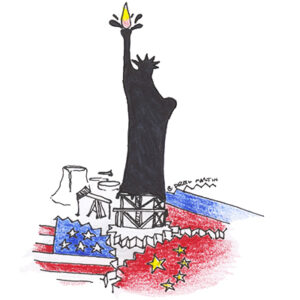
Notwithstanding a torrent of confusing and contradictory foreign policy pronouncement that are pouring forth from the Trump White House, there is indeed a tricontinental geopolitical strategy that is beginning to shape President Trump’s foreign policy during his second term in office. As the historian of U.S. foreign policy and international relations Alfred McCoy has noted, instead of bolstering the Cold War-era mutual-security alliance like NATO” Trump seems to prefer a word divided into three major regional blocs, each empowered by a “strong” leader like himself, with “Russia dominating its European periphery, China paramount in Asia, and the United States controlling, in a version of fortress America, all of North America.” In the words of Alfred McCoy, President Trump is intent on pursuing his tricontinental strategy at the expense of the “traditional trans-Atlantic alliance, embodied by NATO, that has been the foundation for American foreign policy since the end of the Cold War.”
In his second term, Donald Trump has pursued his tricontinental strategy to demolish what under the neoliberal world order was referred to as “the rules-based international order” which the U.S. supported and advanced as the pillar of Washington’s global policy since the end of World War II. How does the Middle East fit into President Trump’s tricontinental strategy? The short answer is a cog in his transactional worldview. For this to work as envisioned by Trump, the Middle East, especially the Persian Gulf region, must remain “peaceful” and free of destabilizing forces that may challenge Trump’s transactional policies. Israel (and its regional allies) will be tasked with ensuring the success of America’s transactional dominance in the Persian Gulf and the broader Middle East while the U.S. would focus on implementing its global tricontinental goals. Only time will tell us how successful Trump’s new policy will be.
Author

Latest Issue
2025: Vol. 24, No. 1-2
Latest Issue
2025: Vol. 24, No. 1-2

Essays
Democracy in Danger
Essays
Democracy in Danger
By Robert R. Kaufman: Democratic Resilience in the United States: Containing Trump’s Threat to Democracy
Essays
Global Tensions
By Meera Nanda: India’s Conservative Revolution: The Postcolonial Left meets the Hindu Right
Essays
Global Tensions
By Donatella Della Porta: Eventful Protests Against the Israeli Genocide: The Italian “Hot Summer” for a Free Palestine
Essays
Global Tensions
By Dina Khapaeva: Investigating Putinism: History Over Ideology
Essays
Global Tensions
By Nader Entessar: Apocalypse Now? The Evolution of Trump’s Policies Towards Iran
Essays
The Assault on Public Goods
Essays
The Assault on Public Goods
By Sam Friedman: The Government Attack on Public Health Research
Essays
The Assault on Public Goods
By David Schultz: American Higher Education in the Era of Trump
Essays
Socialism and the City
By Shelton Stromquist: Mamdani, a “New Municipalism”, and the Undertow of Party Elites
Essays
Socialism and the City
By David R. Berman: A Socialist Mayor for New York? What History Suggests
Essays
Aesthetic Reevaluations
By E. San Juan, Jr: Reflections on Shelley’s The Cenci: Transgression, Exorcism, Sacrifice
Essays
Aesthetic Reevaluations
By Jack Miller: The Metonymy of Light: Three Early Works by Stan Brakhage
Author Meets Critics
Michael J. Thompson's Twilight of the Self
By Lauren Langman: On Michael J. Thompson’s Twilight of the Self
Author Meets Critics
Michael J. Thompson's Twilight of the Self
By Jeffrey A. Halley: Domination, Weirdness, and Art: On Michael Thompson’s Twilight of the Self
Author Meets Critics
Michael J. Thompson's Twilight of the Self
By Charles Thorpe: From Critical Agency to Critical Solidarity
Author Meets Critics
Michael J. Thompson's Twilight of the Self
Book Reviews
By Paul Buhle: Benjamin Balthaser’s Citizens of the Whole World
Book Reviews
By Galina Bogatova: Paul Chaisty and Stephen Whitefield’s How Russians Understand the New Russia
Book Reviews
By Patrick D. Anderson: David Golumbia’s Cyberlibertarianism
Book Reviews
By Paul Buhle: Harold Schechter and Eric Powell’s Dr. Werthless
