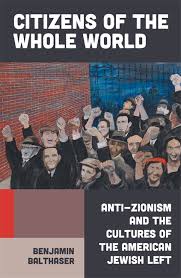
Benjamin Balthaser’s Citizens of the Whole World
This volume, by a cultural scholar teaching at Indiana University, South Bend, could not have appeared at a more auspicious moment. Some Facebook participants describe it as ”the most talked-about book,” and with good reason. It speaks about the long and (for the most part) quietly held non-zionist sentiments of many Jewish Americans.
At a moment when the Summer 2025 issue of Jewish Currents warns that dissenters feel themselves cast out of Jewish institutions and relationships, Citizens of the Whole World gives hope. Their anti-zionist views have historical ballast, even as the Jewish Community Centers, Hillels and assorted Judaic congregations rally to defend Israeli actions and as progressives working in Jewish/Judaic Studies programs in colleges and universities face an assortment of threats for the least dissenting expression.
Balthaser has done his homework. His intellectual history of anti-zionism is also informative precisely because so much effort has been made to bury this history. As he explains, the story holds a precious irony. The Jewish middle and upper classes in particular, from the 1850s onward until the Holocaust, viewed America as the safe and promising place, English as the language of choice, and alternatives as…distractions both impractical and unwanted.
German-American Jews, some of them arriving after the failure of the 1848 revolutions, set the tone for vast accomplishments just ahead. Certainly, modern US culture, high or low, could not have emerged without them. From Tin Pan Alley to the New York Philharmonic and the Ethical Culture Society (i.e., the sensible substitute for religion), a considerable class of Jews prospered and exerted their influence. Thriving garment businesses employing (and also exploiting) Eastern European cousins arriving from the 1890s onward reinforced the genteel Jewish identification with the new homeland. The Jewish working class Left, socialists and anarchists, had their own reasons to refuse zionist alternatives to class struggle.
The First World War, bringing new crises to European Jewry, along with the US immigration restrictions that followed, reshaped the controversies that Balthaser discusses with vigor. A keen intellectual historian, he lacks access to the story of the Yiddish world of politics and controversy, but he examines the wrangling of the Jewish Left at large with vividly close attention.
The Left had a lot to say. For such novelist/critics as Mike Gold—at once brilliant, articulate and viciously polemical—Jews are victims of a “de-territorialized diasporism,” signifying the “broken [Jewish] nation” that nevertheless goes on searching for answers and “reveres its writers and thinkers.” (p.29) The first Jew encountered in Gold’s famed novel Jews Without Money (1930) is mistaken for an African-American, no insult for the likes of Gold. Far from it. The Jewish bad guy of the novel is an upwardly mobile shnook trying to persuade urban Jews to move to the then all-white, outer Brooklyn. Thus an historic Marxist interpretation easier to maintain before 1950: Jews are the natural allies of those punished and discriminated against in the US.
Left-wing Jewish intellectuals in the US and Europe continued to ruminate and wrangle over these points even as history shifted the players. Without a doubt, the terrain became more difficult with the easing of anti-Jewish discrimination and the upward mobility made accessible by the GI Bill. Some of the most wonderfully new material in the book examines closely the arguments among Communist intellectuals during the 1940s. Expecting a return to Depression economic conditions, but also expecting (just as inaccurately) the triumph of the multi-racial Left organizations and popular culture that peaked during wartime, they struggled mightily with what Jewishness in particular meant to them. Their discussions, including the ruminations of young playwright Arthur Miller discussed at length in Alan Wald’s studies of American leftwing writers, remain vivid and insightful even now.
Balthaser is more interested, however, in a generation closer to his own. Within the 1960s-70s movements, ongoing assimilation impulses compete with leftwing passions going the other direction. For a cohort of New Left Jews, the
leftwing Jewish Chicago group or “collective” Chutzpah thus set themselves apart from the framework of liberalism often described (by Irving Howe’s widely read World of Our Fathers, for instance) as the “natural” framework of Jewish Americans. The cultural and political radicalism of Abbie Hoffman and his Yippies, not to mention Jane Alpert or for that matter, even Bob Dylan would do as well.
The problem for Chutzpah and other groups, along with tens of thousands of similar-minded activists of civil rights, peace, feminism and assorted other liberation movements, was that rightwing responses epitomized in Ronald Reagan won out. McCarthyism, the repression of the Jewish Left but also disillusion with the USSR, prepared the rise of a new, intense and heavily Jewish nationalism inflamed by Israeli military triumphs. Jewish idealist hopes had been turned inside out.
How did we get there? Balthaser has not one answer but many possible answers. The merger of American Jewish liberals and conservatives—so often at each others throats over taxes, unions and the New Deal at large—took shape with Six Day War because the various pieces of a puzzle fell into place at once. Before 1967, Jewish institutions, even those sympathetically interested in the Jewish State, had largely devoted themselves to Jewish refugees and the survivors of the Holocaust in particular. Suddenly, donor interests, political priorities and even Hollywood glitz (think of “Exodus,” a staggeringly biased film mainly remembered for handsome Paul Newman) led in. new direction. A “war of liberation” against the Arab states, so very unlike the unpopular Vietnam War, seemed proof of a refreshed Jewishness, even of Judaism reborn.
Balthaser is at his best dissecting the complications. Neoconservative luminary Nathan Glazer among others explained that American Jews, even when discriminated against, had been “prefiguratively white” and modern, unlike (for instance) African-Americans, who were obviously held back by an inferior culture. Jewish new leftists and their successors naturally saw the same picture from the other side: Jews had a special need to cast off such privileges and join the oppressed (leaning rightward from the Left, Marshall Berman predictably described this as the “romance of marginality,” p.133).
Jews had, of course, played a central role in the US Left in so many ways from the 1910s onward, from unions and community organizing (like the rent strikes in poor neighborhoods and the call, “Johnny, go get a Red!”) to the Popular Front world of entertainment, music and film, with some of the biggest stars and highest-paid writers/performers aboard. Some of them had even adopted the new and hopeful Israel as a place to perform, “Red Haifa” in particular. But all this was pretty much in the rear view mirror by 1980. What now?
The rejection of “suburbanism” that appeared to Glazer as both assimilation (escape from any Jewishness) and simultaneously a form of self-hatred, would be seen by many as a recuperation of radical grandparents’ dreams of a society based on something better than consumerism and nationalism of any variety. That is: the birth or, properly, the rebirth of something called the Jewish Left.
Thus, as Balthaser draws upon the past, the (Jewish) Bund, with a following of hundreds of thousands across the pre-1940 Pale, the “revolutionary identity politics before identity politics” (p.178) might be a guide to the present—as recuperated by a reborn Bund movement. Are there still grounds for a “working class, socialist subjectivity” (p.193) in a world of omnipresent downward mobility? If not mainly in the workplace, then perhaps in “community spaces” of assorted kinds?
Here, I think, is the most hopeful part of Citizens of the Whole World. The editor of Jewish Currents, Ariellle Angel, has recently been exploring the need of Jewish progressives for new communal zones, in no small part because peacenik Jews now feel excluded from hawkish synagogues, JCCs and such.
Better than or, more accurately, before anyone else, way back in the 1980s-90s, Melanie Kaye/Kantorwitz dissected the rightward drift and the urgent need to create a community of a new kind within Jewish America. New Jewish Agenda, founded on the aftermath of the massacre of civilians in Lebanon in 1982, served as a preliminary expression of Kaye/Kantorwitz’s vision until it was pretty much destroyed by institutional opposition. The spirit carried on in a variety of groups, especially the New York-based Jews for Racial and Economic Justice. And is reborn once again, as demonstrated in the enthusiasms of campus energies—whatever the repression at hand—and finally the Mamdani Campaign.
Author

Latest Issue
2025: Vol. 24, No. 1-2
Latest Issue
2025: Vol. 24, No. 1-2

Essays
Democracy in Danger
Essays
Democracy in Danger
By Robert R. Kaufman: Democratic Resilience in the United States: Containing Trump’s Threat to Democracy
Essays
Global Tensions
By Meera Nanda: India’s Conservative Revolution: The Postcolonial Left meets the Hindu Right
Essays
Global Tensions
By Donatella Della Porta: Eventful Protests Against the Israeli Genocide: The Italian “Hot Summer” for a Free Palestine
Essays
Global Tensions
By Dina Khapaeva: Investigating Putinism: History Over Ideology
Essays
Global Tensions
By Nader Entessar: Apocalypse Now? The Evolution of Trump’s Policies Towards Iran
Essays
The Assault on Public Goods
Essays
The Assault on Public Goods
By Sam Friedman: The Government Attack on Public Health Research
Essays
The Assault on Public Goods
By David Schultz: American Higher Education in the Era of Trump
Essays
Socialism and the City
By Shelton Stromquist: Mamdani, a “New Municipalism”, and the Undertow of Party Elites
Essays
Socialism and the City
By David R. Berman: A Socialist Mayor for New York? What History Suggests
Essays
Aesthetic Reevaluations
By E. San Juan, Jr: Reflections on Shelley’s The Cenci: Transgression, Exorcism, Sacrifice
Essays
Aesthetic Reevaluations
By Jack Miller: The Metonymy of Light: Three Early Works by Stan Brakhage
Author Meets Critics
Michael J. Thompson's Twilight of the Self
By Lauren Langman: On Michael J. Thompson’s Twilight of the Self
Author Meets Critics
Michael J. Thompson's Twilight of the Self
By Jeffrey A. Halley: Domination, Weirdness, and Art: On Michael Thompson’s Twilight of the Self
Author Meets Critics
Michael J. Thompson's Twilight of the Self
By Charles Thorpe: From Critical Agency to Critical Solidarity
Author Meets Critics
Michael J. Thompson's Twilight of the Self
Book Reviews
By Paul Buhle: Benjamin Balthaser’s Citizens of the Whole World
Book Reviews
By Galina Bogatova: Paul Chaisty and Stephen Whitefield’s How Russians Understand the New Russia
Book Reviews
By Patrick D. Anderson: David Golumbia’s Cyberlibertarianism
Book Reviews
By Paul Buhle: Harold Schechter and Eric Powell’s Dr. Werthless
