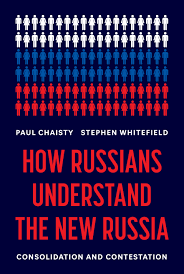
Paul Chaisty and Stephen Whitefield’s How Russians Understand the New Russia
Chaisty and Whitefield offer a compelling and meticulously researched investigation into how Russian citizens have come to understand, and sometimes resist, the hybrid political economy that emerged from the collapse of the Soviet Union. Drawing on nearly three decades of longitudinal survey data, the authors trace the evolution of public attitudes toward a system that presents itself as democratic and market-oriented in form, but is, in practice, marked by authoritarian rule and patrimonial capitalism.
This book is a major contribution to the fields of comparative politics, post-Soviet studies, and authoritarianism research. Rather than focusing solely on elite strategies or institutional developments, Chaisty and Whitefield place ordinary Russians at the center of their analysis, asking whether citizens have truly internalized the norms of this hybrid regime or whether the system remains fundamentally contested. They develop a framework that distinguishes between normative and practice-based acceptance of democracy and the market, identifying different types of regime supporters and opponents, including market democrats and statist authoritarians. At a moment when Russia’s political trajectory appears increasingly repressive and expansionist, this study provides a rare, empirical window into the attitudinal foundations that have enabled, sustained, and potentially now undermined the country’s post-Soviet political order.
Situated at the intersection of comparative authoritarianism, post-Soviet political economy, and public opinion studies, this book joins a growing body of scholarship that examines how hybrid regimes endure by manufacturing consent without fully extinguishing dissent. In contrast to studies that treat Russian citizens as passive recipients of state ideology or as wholly constrained by media control, Chaisty and Whitefield take seriously the complexity and heterogeneity of public opinion in an authoritarian context. Their work builds on and extends earlier debates about Russia’s failed democratic transition, engaging with key concepts like electoral authoritarianism, patrimonial capitalism, and sistema. By integrating normative frameworks of democratic consolidation with rigorous empirical analysis of survey data, the authors contribute to a nuanced understanding of how hybrid regimes operate not only through repression or elite manipulation, but also through contingent patterns of attitudinal alignment and disaffection among the governed.
The authors argue that Russia’s post-Soviet political system has undergone a unique form of hybrid consolidation, wherein formal democratic and market-based norms coexist with deeply authoritarian and patrimonial practices. Using the concepts of consolidation and contestation, Chaisty and Whitefield trace how, over time, many Russian citizens came to accept, not just tolerate, a fused system of electoral authoritarianism and partial market capitalism. This system, they contend, enjoyed a period of genuine attitudinal consolidation between 2000 and 2014, during which public support stabilized around both the normative ideals and lived practices of this hybrid order. However, the authors identify a turning point with the 2011–2012 protest wave and the 2014 annexation of Crimea, which marked a shift toward authoritarian nationalism and the reactivation of Soviet identity. This turn fractured prior consensus, polarizing Russian citizens between statist authoritarians and market democrats. The result was a renewal of system-level contestation, particularly around the normative foundations of governance, identity, and territorial legitimacy. In essence, the book charts the rise and unraveling of a fragile consensus, destabilized by the regime’s increasing reliance on expansionist, anti-Western, and traditionalist narratives that alienated those previously reconciled to hybrid governance.
Chaisty and Whitefield employ a robust longitudinal methodology, grounded in twelve nationally representative surveys conducted between 1993 and 2021, capturing the shifting political, economic, and identity landscapes of post-Soviet Russia. Their data come from face-to-face interviews with over 21,000 respondents across critical junctures, including the 1993 constitutional crisis, the 1998 financial crash, the 2011–12 protest wave, and the 2014 annexation of Crimea. Rather than focusing narrowly on leader approval or short-term sentiment, the authors develop original indicators to measure normative and experiential attitudes toward Russia’s hybrid political economy. Their key innovation lies in mapping three attitudinal archetypes: system consolidators, anti-system market democrats, and anti-system statist authoritarians. These are then analyzed in relation to policy preferences, voting behavior, and views on national identity. The authors carefully control for potential biases in authoritarian contexts, such as fear-based self-censorship, finding little evidence that rising repression suppressed respondent candor. Methodologically, the book stands out for combining political science survey rigor with sensitivity to contextual nuance, incorporating evaluative, normative, and identity-based variables to explain both support and contestation. This empirical architecture allows them to test whether political consolidation occurred, and what fractures emerged as the regime shifted toward expansionist authoritarianism. The findings unfold in the following themes.
Support for Authoritarian Stability
Across the survey waves, Chaisty and Whitefield find that support for the Russian hybrid regime, defined by electoral authoritarianism and a partially reformed market economy, consolidated steadily from the early 2000s through 2014. During this period, system consolidators (those who endorsed both democratic/market norms and their Russian practice) grew in proportion. Russian elections, though constrained, were effective in mobilizing support for regime-affiliated candidates, notably Vladimir Putin and United Russia, across ideological lines. Even non-voters often expressed general support for the system, suggesting that abstention was less a rejection of stability and more an accommodation to the system’s terms.
Attitudes Toward Democracy and Pluralism
Despite this apparent consolidation, many Russians retained ambivalent or critical views of the regime’s democratic credentials. Chapter 3 shows that anti-system market democrats, those who supported democratic and market ideals but rejected their Russian practice, constituted a stable and sizable minority. Chapter 6 reveals that this group was especially likely to abstain from elections out of principled disillusionment, and to favor protest as an alternative mode of political expression. Support for pluralism was further evident in preferences for civil rights and political freedoms, though increasingly muted among system supporters after 2014. Crucially, the chapter finds that non-voters who abstain for political reasons are more supportive of peaceful protest than either voters or non-political abstainers. By 2018, 72% of market democrat non-voters who opted out for political reasons expressed willingness to protest, suggesting that abstention may be a form of resistance rather than disengagement. The authors argue that the exit of system opponents from the electoral arena helps explain why Russian elections show little contestation: electoral politics has been depoliticized not only by repression and manipulation but also by the withdrawal of those most critical of the regime. In effect, electoral consolidation has been achieved by subtracting dissent, not resolving it, redirecting opposition energy from ballots to protest. This chapter thus reframes abstention as a politically meaningful act, especially as post-2014 divisions around national identity and governance deepen.
The Role of Identity, Nationalism, and External Threat Perception
Chapter 7 introduces a pivotal shift in public opinion: the reactivation of Soviet identity as a consequence of the Kremlin’s post-2014 expansionism. The annexation of Crimea and the war in Ukraine catalyzed a broad return to Soviet identification, particularly among older citizens and statist authoritarians. This identity revival reshaped support for authoritarianism and statist economics, while undermining the hybrid regime’s ability to appeal to civic nationalists and liberal reformers. Identity divides increasingly mapped onto system-level cleavages, contributing to renewed contestation after a period of seeming consolidation.
Media Narratives and Institutional Trust
Though not foregrounded in a single chapter, the findings suggest that media narratives and elite discourse played a central role in shaping identity politics and regime legitimacy. The state’s appropriation of Soviet symbolism helped recast expansionist foreign policy as a continuation of historical greatness, thus securing consent among older generations. However, trust in institutions such as elections and parties remained limited, particularly among politically aware non-voters, suggesting that regime stability rests more on emotional resonance and symbolic continuity than on institutional credibility.
Critical Assessment
One of the book’s greatest strengths lies in its methodological rigor and empirical depth. Drawing on nearly thirty years of nationally representative survey data, Chaisty and Whitefield offer a rare longitudinal analysis of public opinion in an authoritarian regime, an accomplishment few studies in post-Soviet political science can match. Their use of the New Russia Barometer and other face-to-face surveys provides an unusually rich dataset, allowing for fine-grained distinctions among regime supporters and opponents. The clarity with which they theorize “system consolidators,” “market democrats,” and “statist authoritarians” lends conceptual precision to what are often nebulous categories in studies of hybrid regimes. Importantly, they also test for and address concerns about respondent self-censorship in authoritarian settings, enhancing the credibility of their findings. The authors integrate theory and data with impressive coherence, weaving identity politics, regime legitimation strategies, and attitudinal cleavages into a single analytical frame. Moreover, the timeliness of the study, culminating just before the full-scale invasion of Ukraine, renders its insights not only empirically grounded but also politically urgent. By focusing on citizens rather than elites, the book humanizes the macro-political shifts of the past three decades and offers an indispensable foundation for understanding Russia’s authoritarian consolidation and its fragilities.
The book’s originality lies in its insistence that authoritarian consolidation is not just imposed from above, but is also shaped, unevenly and contingently, by the belief systems of ordinary citizens. In contrast to the dominant focus on elite behavior, media control, or institutional engineering in studies of Russian authoritarianism, Chaisty and Whitefield recenter the analysis on mass attitudes, treating the public not as passive recipients of propaganda but as active interpreters of their political and economic environment. Their typology of system attitudes, especially the distinction between normative and experiential support for democracy and the market, offers a conceptual refinement that challenges binary notions of regime support vs. resistance. Additionally, the integration of state identity formation into the analysis of political attitudes, particularly the resurgence of Soviet identity after 2014, breaks new ground in the study of how memory and nationalism intersect with regime legitimation. In doing so, the authors complicate the assumption that hybrid regimes endure solely by depoliticizing the electorate; instead, they show that identity-driven repoliticizationcan fracture what once appeared consolidated, revealing hidden lines of contestation within the authoritarian consensus.
Though firmly grounded in the Russian case, How Russians Understand the New Russia offers valuable insights for scholars of hybrid regimes, competitive authoritarianism, and democratic backsliding more broadly. Its typological framework and attitudinal analysis could be fruitfully applied to other contexts where democratic institutions persist in form but are hollowed out in practice, such as Hungary, Turkey, or Serbia. In particular, the authors’ distinction between system-level consolidation and “normal” policy contestation provides a diagnostic tool for evaluating whether pluralism within hybrid regimes reflects genuine democratic engagement or simply controlled dissent. Moreover, the emphasis on identity politics as a destabilizing force within authoritarian consolidation speaks to comparative cases in which nationalist or civilizational rhetoric has been used to legitimize illiberal shifts, often with unintended consequences. By demonstrating how elite-led appeals to memory and belonging can reconfigure public alignment in unpredictable ways, the book offers a cautionary tale about the fragility of authoritarian consensus. Its relevance extends to democratic regimes, too, where polarization around identity and legitimacy can erode institutional trust even in the absence of overt repression.
At the same time, while the authors acknowledge identity as a factor in the re-politicization of public opinion, especially in their final chapter on the return of Soviet identification, the book overall treats affect, ideology, and discourse as secondary to material interests and institutional performance. This empiricist orientation, while methodologically disciplined, overlooks the rich symbolic terrain in which Russian political consciousness is embedded. In a country where narratives of humiliation, civilizational exceptionalism, and metaphors of “fatherland” and “decay” saturate public discourse, the emotional and symbolic registers of political life deserve fuller attention. The resurgence of Soviet identity after 2014, for example, is treated primarily as a quantifiable shift rather than a discursive project of belonging actively curated by state media, war mythology, and memory politics. A more thorough engagement with theories of affect or ideology, perhaps drawing on poststructuralist or psychoanalytic traditions, would have helped explain why citizens internalize political identities that often run counter to their material interests or democratic aspirations. For the Russian case especially, where the public-private divide is historically blurred and political legitimacy is often rooted in mythic time and familial metaphors, exploring these non-material logics of attachment is not merely supplementary but essential. Without them, the full force of how authoritarianism sustains itself in everyday life remains only partially illuminated.
Although the book includes some demographic controls, such as age, education, gender, and ethnicity, in its statistical models, these categories are largely treated as variables of correlation rather than sites of structural meaning. This limits the analysis, especially in the Russian context, where gender, generation, and ethnic identity have played profound roles in shaping political experience and regime alignment. Gender, for instance, is addressed statistically (with men shown more likely to protest), but there is no reflection on the gendered dimensions of state paternalism, military mobilization, or political socialization under both Soviet and post-Soviet regimes. Likewise, age is noted but not theorized, missing an opportunity to explore intergenerational divides in memory, media exposure, or civic trust. Most conspicuously, while the authors acknowledge the discursive tension between russkii and rossiiskii identity, they do not substantively engage with ethnic heterogeneity, nor consider the postcolonial condition of Russia’s internal peripheries or Indigenous peoples. The book treats Russians as a largely homogeneous national unit, sidestepping how imperial hierarchies, settler-colonial dynamics, and center-periphery relations might shape regime support and contestation. In a multiethnic federation with a colonial past and present, omitting these questions risks reifying the very state-centered view the book seeks to examine. A more reflexive incorporation of ethnic, regional, and post-imperial positionalitieswould have added critical texture to an otherwise rigorous empirical project.
A notable limitation of the book is its exclusive focus on within-Russia opinion, with little attention to the perspectives of emigrants or members of the Russian diaspora. This omission narrows the analytic frame at a time when the post-2022 wave of politically motivated emigration is reshaping the boundaries of Russian political subjectivity. While the authors convincingly show how domestic identity shifts, such as the reactivation of Soviet belonging, affect regime legitimacy, they do not ask how those who opted out of the system entirely through emigration might complicate these patterns. Nor do they consider the possibility that diaspora publics could act as agents of contestation, generating alternative narratives of statehood, civic identity, and memory. Given the historical role of Russian émigré communities as both critics and carriers of national ideology, integrating this perspective could have extended the book’s relevance and challenged its state-territorial assumptions. In a globalized, post-imperial context, studying attitudes solely within national borders risks flattening the plurality of Russian political consciousness.
While the book excels in tracing attitudinal patterns and classifying public orientations toward Russia’s hybrid system, it is more reserved when it comes to articulating the normative implications of authoritarian consolidation. The analysis is largely descriptive and empirical, offering valuable insights into what Russians believe and how those beliefs change over time, but stops short of asking what these patterns mean for democratic values, human rights, or the long-term political trajectory of the country. This restraint may be a deliberate attempt to maintain analytical neutrality, but it comes at the cost of under-theorizing the stakes of the phenomena under study. For instance, the normalization of depoliticized elections, the decline in protest rights support, and the rise of identity-based illiberalism are treated as trends rather than as warnings. Given the book’s findings, especially the post-2014 re-politicization of national identity and the erosion of pluralism, a more explicit engagement with the ethical and civic consequences of authoritarian stabilization would have been warranted. In times of systemic violence and imperial aggression, scholarship must not only describe what is but also reckon with what is being lost.
Finally, as rigorous and illuminating as the book’s empirical apparatus is, its heavy reliance on survey data also constitutes a methodological limitation. Public opinion surveys, particularly in authoritarian contexts, are constrained in their ability to capture the ambiguities, silences, and symbolic registers that animate political life. Even expertly crafted closed-ended questions reduce layered subjectivities to fixed categories, leaving little room for affect, irony, or contradiction. The authors acknowledge these challenges, particularly around response bias, yet their broader framework leans toward a rational-choice interpretation, wherein citizens are assumed to form stable preferences based on regime performance, economic standing, or political efficacy. What remains less explored is how symbolic belief systems, historical trauma, imperial nostalgia, moral codes, or the mythology of Russia’s civilizational mission, structure political attachment in ways that exceed instrumental logic.
Now, I fully recognize that this critique reflects a different epistemological orientation, and that asking survey data to unpack emotional allegiances may be a bit like asking a spreadsheet to write poetry. But as a feminist postcolonial scholar, I find it important, perhaps even a professional obligation, to point out what slips through the empirical net. If there’s ever a safe space for ontological mischief, surely it is the “critical reflections” section of a book review.
How Russians Understand the New Russia is a landmark contribution to the study of authoritarianism, political hybridity, and public opinion in post-Soviet Russia. Its analytical precision, empirical breadth, and longitudinal scope provide an invaluable resource for scholars seeking to understand how ordinary Russians interpret the political system they inhabit, whether with consent, resignation, or resistance. For those working in comparative politics or regime studies, the book offers a rare empirical anchor to debates often driven by elite narratives or normative speculation.
Beyond the academy, the book holds relevance for practitioners, journalists, and diaspora activists seeking to make sense of the contradictions within Russian society. It offers tools for discerning when consensus is real and when it masks disaffection; when political quiet is stability and when it is a silence before rupture. In the wake of the full-scale invasion of Ukraine, mass emigration, and the growing moral polarization between state loyalists and exiled dissenters, this book provides a window into the deep ambivalence, perhaps even psychic fragmentation, of a society that has lived for decades under a hybrid, increasingly authoritarian order. As Russia enters a new phase of geopolitical isolation and internal repression, understanding the emotional, ideological, and institutional terrain mapped in this book is not only a scholarly exercise, it is a necessary one.
Author

Latest Issue
2025: Vol. 24, No. 1-2
Latest Issue
2025: Vol. 24, No. 1-2

Essays
Democracy in Danger
Essays
Democracy in Danger
By Robert R. Kaufman: Democratic Resilience in the United States: Containing Trump’s Threat to Democracy
Essays
Global Tensions
By Meera Nanda: India’s Conservative Revolution: The Postcolonial Left meets the Hindu Right
Essays
Global Tensions
By Donatella Della Porta: Eventful Protests Against the Israeli Genocide: The Italian “Hot Summer” for a Free Palestine
Essays
Global Tensions
By Dina Khapaeva: Investigating Putinism: History Over Ideology
Essays
Global Tensions
By Nader Entessar: Apocalypse Now? The Evolution of Trump’s Policies Towards Iran
Essays
The Assault on Public Goods
Essays
The Assault on Public Goods
By Sam Friedman: The Government Attack on Public Health Research
Essays
The Assault on Public Goods
By David Schultz: American Higher Education in the Era of Trump
Essays
Socialism and the City
By Shelton Stromquist: Mamdani, a “New Municipalism”, and the Undertow of Party Elites
Essays
Socialism and the City
By David R. Berman: A Socialist Mayor for New York? What History Suggests
Essays
Aesthetic Reevaluations
By E. San Juan, Jr: Reflections on Shelley’s The Cenci: Transgression, Exorcism, Sacrifice
Essays
Aesthetic Reevaluations
By Jack Miller: The Metonymy of Light: Three Early Works by Stan Brakhage
Author Meets Critics
Michael J. Thompson's Twilight of the Self
By Lauren Langman: On Michael J. Thompson’s Twilight of the Self
Author Meets Critics
Michael J. Thompson's Twilight of the Self
By Jeffrey A. Halley: Domination, Weirdness, and Art: On Michael Thompson’s Twilight of the Self
Author Meets Critics
Michael J. Thompson's Twilight of the Self
By Charles Thorpe: From Critical Agency to Critical Solidarity
Author Meets Critics
Michael J. Thompson's Twilight of the Self
Book Reviews
By Paul Buhle: Benjamin Balthaser’s Citizens of the Whole World
Book Reviews
By Galina Bogatova: Paul Chaisty and Stephen Whitefield’s How Russians Understand the New Russia
Book Reviews
By Patrick D. Anderson: David Golumbia’s Cyberlibertarianism
Book Reviews
By Paul Buhle: Harold Schechter and Eric Powell’s Dr. Werthless
