Crumb, Early and Late
Works Discussed:
The Life and Death of Fritz the Cat, by Robert Crumb. Seattle: Fantagraphics, 2026.
Tales of Paranoia. By Robert Crumb. Seattle: Fantagraphics, 2026.
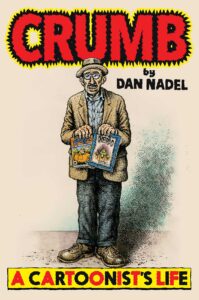
Crumb: A Cartoonist’s Life. By Dan Nadel. New York: Simon & Schuster, 2025.
Thanks to the comprehensive biography of Robert Crumb by Dan Nadel, based substantially upon the artist’s own archive, we can grapple better with the strange and sometimes dark corners of the life of the artist who, more than anyone else, changed the status of comic art. Crumb: a Cartoonist’s Life (2025) brought us very close, sometimes uncomfortably close, to the very personal world that could breed genius and some very troubled real life modern beings.
In a relative handful of his prolific drawings and interviews, Crumb wrote or spoke about the weight of his own status. To be an acclaimed artist in a thoroughly disrespected art form (something that did not change until 1995 or so) posed a series of dilemmas. Jokingly, in a long-forgotten drawing, he could see himself as the artist on his deathbed, seeking to console himself with his fame and also recognizing the effort as a last vanity. More often and in a few of his 1980s comics in particular, Crumb portrayed his own persona as multiple, good or bad, benevolent visionary or evil capitalist old style or hip-modern, supporter of the women’s movement or unrepentant seducer. Near the end of life and without longtime companion Aline at his side, he is by his own measure lonely, at times downright confused, still seeking some inner or outer, as in cosmic, truth that has eluded him since his Catholic boyhood days.
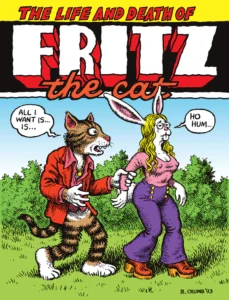
He had early on been, by Nadel’s careful accounting, an artist in need of making a living for himself and at least one woman (sometimes more), and also a son, later, also a daughter. This need is the best explanation for Fritz, ultimately a frustrating page-filler, even if it did not begin that way. Originated back in his adolescent years of collaboration with his brothers, Fritz came to life in a fanzine-like fashion, made for friends and a few others, somewhere beneath real publication.
An anthropomorphic creature who acted human-like with other animals—perhaps taking off Walt Kelly’s hugely popular Pogo—Crumb’s Fritz is a distinctly un-Pogo type. Meandering into the world of girlie-magazine Cavalier, once even on the front cover, this Fritz became the Crumb “product” suitable for forms of exploitation beyond the “Keep on Truckin’” T-shirts and mud flaps that his lawyers successfully sued when he and his first wife, Dana, ran out of money.
It had started out differently, or rather re-started from teenhood to the life of the young, not-entirely-responsible husband. Seeking paid artistic work but also adventure, young Crumb developed a habit of leaving his new wife behind (in Cleveland), going off on adventures that definitely included dames of the free-loving ‘sixties. The comic version, Fritz for Crumb, offered readers a completely irresponsible animal with, as the old saying went, “the morals of an alley cat.”
Fritz thus surrounds himself with typical hippie-hang-out male friends, and usually has somewhere close a plump lover, all too patient and clinging. If this narrative is drawn from real life of Crumb and wife Dana, we probably do not want to think about it too candidly. The artist himself was desperately trying to find a way forward, rather than returning to the drudgery of clever, contemporary drawings for greeting cards.
Fritz the professional poseur with no apparent talent or insights, but by his own measure, is a would-be “writer and poet.” He seems to be in college somewhere, impossibly far from publishing anything, even from finishing a degree. He claims to be an alienated intellectual stuck in a commercialized society, but is really
a two bit phony who can brag to a crow (aka African American) at how he has “studied the crow problem.” At a moment’s notice, he can also turn also into a pseudo-revolutionary, calling upon workers at large to arise (and then fleeing the actual cops who appear). He goes on the road, seemingly true to the Kerouac tradition, but only ends up back where he began, none the wiser.
Fritz never changes, from his earliest commercial appearance in Help! Magazine, 1965—the last effort of comics maven (and Mad inventor) Harvey Kurtzman to create a magazine of his own—to the end of the story only seven years later. Fritz the comic character meanwhile paled next to Crumb’s real artistic breakthrough, the revelatory Head Comix (1969), based more on LSD and the imaginative recuperation of old comic characters than anything like 1960s-Fritz.
What happened to Fritz between 1965 and 1972 is animation history as well as comics history. As usual, Dan Nadel tells it best. In 1969, a minor television producer and a promising young animator named Ralph Bakshi contacted Crumb to propose that he and a producer would create an “adult” animation feature, the first of its kind. Mad founder Harvey Kurtzman, Crumb’s idol but by then reduced to scripting “Little Annie Fanny” for Playboy, had already turned down an offer to make “Annie” into a film star. Crumb, rightly suspicious of the consequences of his work’s adaptation, wanted creative input if not control. Pressed for money and likely against his better judgment, he took $2,000 to fly from California to New York and to see some preliminary adaptations of his art work and story line.
Everything that happened afterward made Crumb sick at heart, as well as artistically outraged. He refused to sign the contract offered, and the studio dispatched a hustler to stay with wife Dana, who had power of attorney while Crumb was characteristically gone somewhere. She signed for him, and the project went ahead under a cloud. A half-century later, Rotten Tomatoes—or is it only AI?—suggests that the filmic satire on free love and revolutionary rhetoric in the 1960s can still make for fun watching. It is not hard to imagine the artist still grimacing and warning anyone who asks to stay away from the film.
The final story in The Life and Death of Fritz the Cat, titled “Fritz the Cat ‘Superstar,’” famously has his creation, still the same wretched exploiter of any girlfriend handy, now immersed in a cynical business deal of some kind and a TV talk-show star to boot. In short, all the “celebrity” things that Crumb was running away from. Outraged at this inattention, another girl friend stabs him to death with an ice-pick. As Crumb himself would have liked to stab the animated Fritz, if not Bakshi, who crashed a few animated features later, and went back to TV.
The depressing quality of all this might be seen against the descending reality of 1970, the end of the Flowers-in-your-hair ‘sixties innocence and the reality of Hells Angels carrying out a deadly attack on hippies at Altamont. But I do not think this is a convincing view.
Faced with the inevitable celebrity crush—in an interview with me, published in Cultural Correspondence in 1977, he wondered how Bob Dylan had managed to survive the sudden cult around himself—Crumb fled to the hinterlands. That is, he had already set up house in still-rural California a vast distance away from the Bay Area spiritually but close enough to get a bus. There, he formed an old-time music band, the Cheap Suit Serenaders, that he carefully kept form becoming mainstream.
Moving to Winters (near but not too near the UC campus at Davis), he settled down to his lasting relationship with Aline, and drew strips for an environmental-minded local paper for a while. As creeping suburbanism gradually struck, the couple made plans to move to Southern France and to a kind of personal anonymity. It turned out to a splendid idea. Producing only what he wanted, in old age creating individual drawings for collectors while clearing paths in the woods made centuries earlier, he could almost be said to have lived happily ever after. It was a balm not to be an American or a celebrity. Aline taught yoga locally, for something like twenty years. Meanwhile, his masterpiece adaptation, Genesis, appeared in 2005 and occasional collections of the two emerged.
By 2026, Crumb is a widower feeling very much alone. Although his daughter seems intermittently nearby, he spends too much time with himself. Polishing and repolishing his artwork, he can produce a brilliant comic, including the old style characters seen on the cover (the most prominent among them “The Bunch,” aka the late Aline). In a personal history of strange comics, Tales of Paranoia may be the strangest.
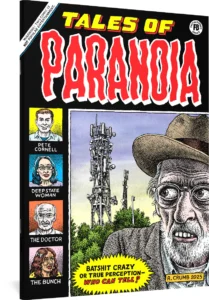
He is an old man here, as in real life, his face lined and his head balding. Nearly all the pages—apart from a story of the global business-scientific elite, “Deep State Woman”—include Crumb himself. Living up to the title, this Crumb repeatedly raises the spectre of elite conspiracy of science and business to sell drugs and otherwise keep us in thrall. Against the advice of a long-time friend, possibly his own doctor, he insists upon the possibility of high-level mind-control. Is he joking? Perhaps or perhaps not, and here is the entertainment of sorts, Crumb offering ways to peer into his mind.
It may help to know that he has been dyslexic since childhood, has always read books with difficulty, never driven a car, and so on. With Aline gone, he turns in upon himself, his own speculations.
One entertaining sidebar looks way back upon Crumb and wife, Dana, taking their first LSD trip together in Cleveland, 1966. This is of special interest because, famously, he “saw” a world of vernacular advertising, likewise earlier generations of popular clothes and hobbies, all this setting him upon a path of his own. In “The Very Worst LSD Trip I Ever Had,” he mainly suffers nausea and a sense of seeing or not seeing something that he can’t remember.
Another story, surely the best pages of the book, has Aline back to life remembering how her own books of comics seem to be cursed again and again, as the publisher goes bankrupt shortly after her books or collaborations with him reach print. The conversation ends back in the present, with the “spirit” Aline reminding Crumb to improve his always-poor posture and to clean the stove after he makes a meager supper for himself. He clearly cannot make sense of his life without her. She is thus always somehow present for the perplexed and doddering artist.
By placing Fritz the Cat alongside Tales of Paranoia, we may contemplate the beginnings and endings of Crumb’s artistic oeuvre. Somewhere between these, Crumb had placed his stamp upon comic art. No one who draws comics or thins about comics, possibly anywhere in the world, can escape his work. A weighty thought.
Author

Latest Issue
2026: Vol. 25, No. 2
Latest Issue
2026: Vol. 25, No. 2

Essays
Essays
By Robert J. Antonio: Implementing Project 2025: Day One and After
Essays
Essays
By Dilip Simeon: Domination and Chaos: India’s Radical Conservatism
Essays
Essays
Essays
Essays
Essays
Fanon at 100
By Paget Henry: Frantz Fanon and the Crisis of Our Current Transitional Period
Essays
Fanon at 100
Essays
Masculinity in Crisis
Essays
Masculinity in Crisis
By George Lundskow: Making Racism and Misogyny Great Again: The Emptiness and Misplaced Meaning of Angry Young White Men
Review Essay
Book Reviews
By Douglas Kellner: Domenico Losurdo’s Western Marxism: How it was Born, How it Died, How it Can Be Reborn
Book Reviews
By Michael J. Thompson: Meera Nanda’s Postcolonial Theory and the Making of Hindu Nationalism
Book Reviews
By Keanu Heydari: Timothy Scott Johnson’s Repeating Revolutions: The French Revolution and the Algerian War
Book Reviews
By Miron Clay-Gilmore: William M. Paris’ Race, Time, and Utopia: Critical Theory and the Process of Emancipation
Book Reviews
Book Reviews
By Paul Buhle: Noah Isenberg’s Edger G. Ulmer: A Filmmaker at the Margins
