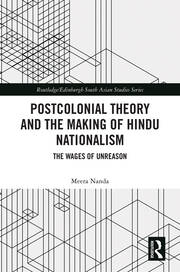
Meera Nanda’s Postcolonial Theory and the Making of Hindu Nationalism
Once confined to the arcane recesses of literary theory seminar rooms and abstruse academic journals, postcolonialism can say today that it is thoroughly in vogue. More than mere lingo for the self-righteous pseudo-left, it is now the policy for academic administrators who cannot seem to get on the bus fast enough. Even amidst the vigorous “anti-woke” politics of the moment, many professors are still asked to “decolonize” their syllabi. In fact, the verbal form of the term – which gets ever more meaningless the more it is applied – seems to have no end in sight. In psychoanalysis, medicine, and law, the movement toward decolonization seems without end. At its best, this is an attempt to broaden the canon of texts and ideas, traditions and points of view that have been wrongly neglected in western intellectual circles. At its worst, it is a disingenuous attempt to codify a formalized multi-culturalism by the academy as commodity form.
But what matters at a deeper level still is postcolonialism’s valorization of anti-Western and anti-rationalist traditions. This is occurring at a time when the forces of capitalism and globalization as well as an unregulated form of technological logic is withering the vitality of Enlightenment humanism, thereby weakening any coherent counter-vailing critique.[1] In viewing history as a canvas for cultural politics where western power is to be viewed not merely in terms of its anti-Enlightenment traditions and forces, i.e., those that were actually responsible for the colonial enterprise, it instead conflates this with Enlightenment ideas and principles.[2]By setting their sights on the Enlightenment, science, values such as secularism and human progress, the critique of tradition and custom, postcolonial theorists move almost check by jowl with the political right. The reactionary movements of the modern world have always been anti-Enlightenment. In their defense of hierarchy, of tradition, and of the non-rational, they have always sought to protect private power over democratic accountability, hierarchy over equality, and private interest over the public good. With the left increasingly identifying with such intellectual fads, it is little wonder why today’s movements against the rising tide of authoritarianism and growing appeal of fascism is milquetoast at best.
Meera Nanda’s important new book seeks to make a further connection. She sees that the attack on western rationalism, a long tradition within the postmodern left, is in fact politically suspect. The object of her book is to demonstrate a connection – more of an elective affinity than direct association – between the spread of postcolonial theory and the rise of the anti-modernity of the Hindu Right in India. Following up on her superb 2003 book, Prophets Facing Backward, she wants to show how science and technology can be wedded to anti-Enlightenment ideas and regressive cultural values, this time showing how postcolonial theorists have aided this project.[3] As she argues: “I am not suggesting that the Postcolonial Left singlehandedly lit the fires of Hindu chauvinism. What I am claiming is that it has enabled the fire to spread by disabling a principled critique of Hinduism and Hinde nationalism that could have acted as a fire retardant.”[4]
Nanda argues that the origin of this phenomenon begins with the cultural and political despair that overcame intellectual circles in India in the 1970s. Beginning in the 1960s, there was rising discontent over the degree of corruption and growing social disparities. The Indian National Congress, the party that spear-headed and achieved independence was composed of a miscellany of wealthy landowners, industrialists, rural landlords, urban professionals, an upwardly mobile middle class and farming families. The class structure failed to incorporate the rural and urban poor. “This nexus,” Nanda writes, “between Congress and the dominant classes led to a massive failure to deliver on the promise of a better life for those left out.”[5] What resulted was a social crisis leading to a state of emergency decree by Indira Gandhi from June 1975 through March 1977. Jayaprakash Narayan, a veteran of Mahatma Gandhi’s Sarvodaya movement, “would take a page out of events of 1968 in Europe and call upon the ‘youth power’ to usher in his ‘Sampoorna Kranti’ or ‘Total Revolution.’”[6]
Narayan’s total revolution consisted of an opposition to parliamentary democracy as well as a commitment to swaraj, or “indigenous-ness” which itself implied a complete rejection of foreign ideas and institutions. This reflected Gandhi’s own conservative ideals: specifically, adherence to an ideal social order made up of “self-regulating communities bound by moral restraints of dharma that limited human desires.”[7] It is here that one of Nanda’s most consistent themes is developed: the thesis that this anti-western, anti-rationalist turn is akin to the intellectual and political currents in Weimar Germany. These ideas, which would nourish and give rise to Nazi ideology was based on the idea that modern rationality and its secularist values were to be demolished for a backward-looking aspiration toward tradition and community. “Like the Weimar conservatives,” Nanda writes, “postcolonial intellectuals have made clearing the ruins of the Enlightenment reason their primary goal. Like the Volkisch romantics of early-twentieth century Germany, they too are searching for a Third Way, an ‘alternative modernity’ rooted in indigenous modes of knowing and living.”[8]
The term “conservative revolution” captures Nanda’s argument well. She dissects the ideas of influential Indian postcolonial intellectuals such as Ashis Nandy, Dipesh Chakrabarty, Partha Chatterjee, Aditya Nigam, Vandana Shiva, Claude Alvares and others. What unites them is a sense that a resistance to western traditions and thought is crucial for protecting the Gemeinschaftliche forms of life of traditional rural Indian culture and community. Here is where the elective affinity between their supposedly left-wing critique of western Enlightenment traditions and the right-wing politics and ideology of Hindu Nationalism come into focus. For both movements seek to undermine not only the normative values of secularism and universalism, but they also seek to displace western science with indigenous traditions of knowledge. What Nandy calls “critical traditionalism” conveys the idea that these traditional forms of life and knowledge can be seen as alternatives to western modernity and its values of individualism, work, secularism and productivity.
In fact, modern science is repudiated for its “epistemic violence.” For Nandy, the people have an “epistemic right” to live in accordance with their own ideas about what they consider right, wrong, true and false. As Nanda summarizes this view, the people “not only have the freedom of having their opinions but also of having their own facts as well.”[9] For the postcolonial theorist, western science’s epistemic violence essentially consists in its separation of fact from value. As Nanda explains:
The values of objectivity or value-neutrality that modern science ideally aspires for were declared to be fascistic signs of mental illness because they demand a separation of the object of knowledge from the ethical-social-aesthetic values of the knowing subject. This reduces the lived, first-person experience of the natural and social worlds to pure abstractions, shorn of all meaning and purpose.[10]
Figures such as Bacon and Galileo are indicted by these thinkers for “denuding the world of magic and mystery.”[11] So, Nandy argues, reflecting on the course of western cultural history, the Catholic Church was in fact justified and right to persecute Galileo since he was a force in pushing the objectivistic, value-neutral understanding of nature.
We can see how this indictment of modern science leads to a further concern about secularism. It is one thing to call into question the powers and cultural prevalence of instrumental reason, as did countless humanistic critics form left and right in the west. But once we see the connection between modern scientific rationalism not as an instrumental or technical application of science, but as a new vantage point from which we can call into question the prevailing norms of the community into which I have been born and socialized, then things become politically problematic. But this is precisely the point that the postcolonial theorists want to press. What Vandana Shiva once termed “monocultures of the mind” refers to this negation of traditional forms of knowing and thinking in favor of the West’s rationalism.[12]
But Nanda argues that it is here that we see the demise of the secular ideal in India. Once we embrace folk traditions and ways of knowing, then we enter the realm of real relativism. Once we jettison the sphere of justification, of the exchange of reasons for our moral beliefs and forms of authority – something essential to the value of secularism as a place holder for democratic rationality – then we are at the whim of the powerful and their arbitrary “reasons” for asserting their authority. As Nanda writes: “Khap panchayats, for example, derive their extra-legal powers to enforce retrograde laws against inter-caste and inter-faith marriages precisely because their claim to have ‘their own reasons’ which the state has no business interfering with.”[13]
These ideas and critiques of the left postcolonial theorists feed into a new form of modernism that is being enacted in India today. From the British historian of fascism Roger Griffin, Nanda borrows the term “palingenetic” to describe a form of modernism where a “reborn India was to be a modern, technologically advanced nation, but with the soul of ancient Bharat, the quintessential land of Gemeinschaft.”[14] Palingenetic modernism is this embrace of modern technological forms of reason, science and technology but with the backward glance toward tradition, custom and religion. It is therefore wrong to see what is happening in India – and, one can say by extension, in many parts of the world that are seeing a surge in far-right politics – as conservativism or reactionary politics. For the palingenetic modernists, it is not a conservation of the past that they seek to achieve, but “an attempt to provide a new metanarrative, a new coherent story, that can replace the sacred canopy that religion, traditions, and local customs provided before it was battered by the forces of modernity.”[15]
The project is therefore to provide alternative patterns of reason, to revive the “spiritual,” mystical and mythical elements of human experience, and to protect and to amplify the traditional forms of power, hierarchy and order that they believe constituted the past. The project to make India “Bharat” therefore means to create this new modernity: one where technological progress is wedded to traditional belief systems and forms of life. These traditional values are to displace the modern attitudes of reason, skepticism, individualism, materialism, and so on. Nanda sees parallels with the romantic backlash against the Enlightenment with thinkers such as Johann Gottfried Herder and his seeking for truth das Volk and the need to revive organic forms of community to protect against the colonization of individualism and materialism. These ideas were set out before the postcolonial theorists by revivalist thinkers such as Sri Aurobindo and Swami Vivekananda whose aim was to revive the spiritual life of traditional Hindu culture. But in their zeal to oust western thought as “epistemic violence” and a continued contamination from colonialism, Nanda argues, “[t]he Postcolonial Left is only reviving the revivalists and, in the process, providing aid and comfort to the current crop of Hindu revivalists.”[16]
The postcolonial left and the thinkers of the Hindu right therefore, for Nanda, point in the same direction. By jettisoning western scientific values and epistemic skepticism, experiment and progress, they advocate for indigenous knowledge produced from within the structure of Hindu beliefs – what they term “inner science” – as a legitimate competitor to western science. As Nanda describes it:
At the heart of inner sciences lies a “rishi state of mind” achieved through yoga, tantra, and mantras. In this state of altered consciousness, the “rishi mind” can tune into cosmic consciousness and “primordial vibrations.” Since all matter is simply a manifestation of cosmic consciousness and primordial vibrations, it can be known by a “direct experience” of this consciousness.[17]
One might ask: what is the point of it all? After all, can we not say that there is a destructiveness to modern science and technology? Perhaps western values such as individualism, liberalism and materialism have created one kind of modernity, one that has its own contradictions and damaged history? Why can we not consider alternative social formations, perhaps those inspired by indigenous communities that live closer to nature and human need rather than an alienated urban existence and reliance on capital? What seems to be in Nanda’s crosshairs is not these concerns, however. Rather, it is how the left has gradually eroded the principles and ideals of Enlightenment reasoning and instead romanticized traditional cultures at the expense of such ideals and principles. Indeed, one can make the case that postcolonialism as a theme and concern can be integrated into a more critical, rational, non-postmodern theory.[18] But, Nanda forcefully asserts, the postcolonial theorists “well-intended radicalism, however, has hollowed out the substance of modern standards of rationality and modern aspirations of freedom and justice that cut across cultures.”[19] This reinforces Ernest Gellner’s critique of postmodern relativism when he argued that “everything about the condition of mankind in our age makes it utterly plain that cognitive relativism is false. It is false because an enormous mass of social facts establishes this, and not because it would have disastrous consequences if true.”[20]
What Nanda wants to defend is the way that western reason enables us to see both “the rational unity of mankind” as well as the “moral unity of mankind.” For both are the true inheritance of western science and rationalism; a science and rationalism that can serve as a means for self-critique and the confrontation with traditional forms of authority and domination. This was the appeal for many in the non-western world who saw in the west’s categories of modern rationality a means to break down the encrusted values systems and superstitious mentalities that prevented the establishment of republican forms of government.[21] Nanda emphasizes that the better path for critical and radical intellectuals is to champion the scientific capacity that all human share: “Rather than defend tradition against the onslaught of science, the more fruitful task for those who are concerned with the subaltern would be to nurture what Popper calls a ‘second-order tradition,’ that is, a tradition of critically assessing the inherited tradition.”[22]
Far from being a means of suppression and domination, the scientific attitude developed most robustly in western culture is not a unique property of western culture. In fact, it is essential to see that it an inheritance for all humanity. Universalism is not a cultural value of the west, it is a potential standpoint for any thinking, reflecting human being. It provides a “trans-cultural” vantage point to secure the validity of truth-claims, whether about the natural world or the moral-political world. Nanda is right to insist on the dual values of rational and moral universalism. For without these we are at the whim of cultural categories that insulate power relations from critical scrutiny. She is right to stress that “universal does not mean uniform,” that all human beings possess the capacity for basic scientific reasoning and theory, or an “abductive instinct,” and that only the exchange and scrutinizing of reasons can provide for those kinds of political authority that are accountable to a common, public interest.
In many ways, Nanda’s trenchant critique of the irrationalism of postcolonial theory echoes similar critiques by others in recent years.[23] But what stands out is its defense of the deep structure of science and Enlightenment ideas and their salience for any viable expression of left politics. In western democracies, Left politics, ideas and theory has essentially become little more than fashionable nonsense. The culturalist turn to identity politics, gender and race at the exclusion of class as the essential variable of power has merely legitimated the deep structures of power while at the same time strengthening the far right. Postmodern theory and its ideological successors have gutted the Left of its most radical ideas: that of reason, universalism, democracy and equality. Nanda will have none of it. Her book stands as a stark warning to the effect Left intellectuals can have, when they get theory wrong, on the process of political and cultural regress. In her own words: “What the Left theorized, the Right has weaponized. Postcolonial theory has become an argument for. Making India Bharat. If this sad saga has any message for the Ivory-Tower Left, it is this: Be careful of what you wish for.”[24]
Notes
[1] See the recent polemic by Aldo Schiavone, Occidente senza Pensiero. (Bologna: Il Mulino, 2025).
[2] For an important corrective to this narrative, see Sankar Muthu, Enlightenment against Empire. (Princeton: Princeton University Press, 2003).
[3] Meera Nanda, Prophets Facing Backward: Postmodern Critiques of Science and Hindu Nationalism. (New Brunswick, NJ: Rutgers University Press, 2003).
[4] Meera Nanda, Postcolonial Theory and the Making of Hindu Nationalism: The Wages of Unreason. (New York: Routledge, 2025), 7.
[5] Nanda, Postcolonial Theory and the Making of Hindu Nationalism, 53.
[6] Nanda, Postcolonial Theory and the Making of Hindu Nationalism, 54.
[7] Nanda, Postcolonial Theory and the Making of Hindu Nationalism, 56.
[8] Nanda, Postcolonial Theory and the Making of Hindu Nationalism, 64.
[9] Nanda, Postcolonial Theory and the Making of Hindu Nationalism, 83.
[10] Nanda, Postcolonial Theory and the Making of Hindu Nationalism, 83.
[11] Nanda, Postcolonial Theory and the Making of Hindu Nationalism, 84.
[12] Vandana Shiva, Monocultures of the Mind: Perspectives on Biodiversity and Biotechnology. (London: Zed Books, 1993).
[13] Nanda, Postcolonial Theory and the Making of Hindu Nationalism, 106.
[14] Nanda, Postcolonial Theory and the Making of Hindu Nationalism, 147.
[15] Nanda, Postcolonial Theory and the Making of Hindu Nationalism, 153.
[16] Nanda, Postcolonial Theory and the Making of Hindu Nationalism, 186.
[17] Nanda, Postcolonial Theory and the Making of Hindu Nationalism, 217.
[18] For an example, see Filippo Menozzi, Postcolonial Historical Materialism: The Heritage of Critical Theory. (London: Bloomsbury, 2025).
[19] Nanda, Postcolonial Theory and the Making of Hindu Nationalism, 233-234.
[20] Ernest Gellner, Postmodernism, Reason and Religion. (London: Routledge, 1992), 55.
[21] This was particularly true in China during the late-nineteenth and early-twentieth centuries. For an important study of this integration of western reason in Chinese intellectual and political life, see Vera Schwarcz, The Chinese Enlightenment: Intellectuals and the Legacy of the May 4th Movement of 1919. (Berkeley, CA: University of California Press, 1986). This should be contrasted with the project of creating an anti-Western cultural politics while at the same time incorporating western scientific, industrial and technical modes of modernization. See Cemil Aydin, The Politics of Anti-Westernisn in Asia: Visions of World Order in Pan-Islamic and Pan-Asian Thought. (New York: Columbia University Press, 2007).
[22] Nanda, Postcolonial Theory and the Making of Hindu Nationalism, 238.
[23] Most importantly see Kevin B. Anderson and Janet Afary, Foucault and the Iranian Revolution: Gender and the Seductions of Islamism. (Chicago: University of Chicago Press, 2005); Vivek Chibber, Postcolonial Theory and the Specter of Capital. (London: Verso, 2013); and Vasant Kaiwar, The Postcolonial Orient: The Politics of Difference and the Project of Provincializing Europe. (Chicago: Haymarket Books, 2015).
[24] Nanda, Postcolonial Theory and the Making of Hindu Nationalism, 225.
Author

Latest Issue
2026: Vol. 25, No. 2

Latest Issue
2026: Vol. 25, No. 2

Essays
Essays
By Robert J. Antonio: Implementing Project 2025: Day One and After
Essays
Essays
By Dilip Simeon: Domination and Chaos: India’s Radical Conservatism
Essays
Essays
Essays
Essays
Essays
Fanon at 100
By Paget Henry: Frantz Fanon and the Crisis of Our Current Transitional Period
Essays
Fanon at 100
Essays
Masculinity in Crisis
Essays
Masculinity in Crisis
By George Lundskow: Making Racism and Misogyny Great Again: The Emptiness and Misplaced Meaning of Angry Young White Men
Review Essay
Book Reviews
By Douglas Kellner: Domenico Losurdo’s Western Marxism: How it was Born, How it Died, How it Can Be Reborn
Book Reviews
By Michael J. Thompson: Meera Nanda’s Postcolonial Theory and the Making of Hindu Nationalism
Book Reviews
By Keanu Heydari: Timothy Scott Johnson’s Repeating Revolutions: The French Revolution and the Algerian War
Book Reviews
By Miron Clay-Gilmore: William M. Paris’ Race, Time, and Utopia: Critical Theory and the Process of Emancipation
Book Reviews
Book Reviews
By Paul Buhle: Noah Isenberg’s Edger G. Ulmer: A Filmmaker at the Margins
