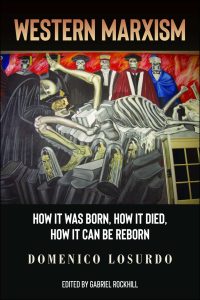
Domenico Losurdo’s Western Marxism: How it was Born, How it Died, How it Can Be Reborn
Italian Marxist Domenico Losurdo’s screed against Western Marxism is a product of the Cold War that dominated global politics between the end of World War II until the Fall and Collapse of Soviet Communism in 1989 and the early 1990s. The structuring Manichean dichotomy that organizes its polemic is a Battle between East and West, with the East representing Soviet Communism and communist-led national liberation struggles, while the West represents colonialism and imperialism. Losurdo’s ridiculous argument is that Western Marxists totally ignore Western colonialism and national liberation struggles and are thus complicit with Western imperialism/colonialism. I shall argue, however, that Losurdo’s attack on Western Marxism is ultimately apologetics for Stalinism and the Soviet Union and totally distorts the fact that Western Marxists have largely championed National Liberation struggles.
Losurdo’s narrative is especially noxious for those of us who became aware of Marxism and National Liberation Movements in the 1960s and 1970s, and especially for a generation like my own which was radicalized by the civil rights movements, the New Left and anti-war movement, and later the feminist and pro-LBGTQ+ movements. For us patriarchal capitalism was a racist system of oppression at home and imperialism abroad against which we organized and struggled. When I came to Columbia University as a graduate student in philosophy in 1965, I shared my parents’ New Deal Democratic Party belief that FDR was their God and Savior, who hauled them out of the depths of the Depression, sending them to college to get degrees and then to Washington where they received government jobs, until World War II arrived and my father went to Pearl Harbor to serve in the Navy for the rest of the war.
Initially, this meant that I shared my parents’ patriotism and belief in the U.S. military as a beneficent force for good. This belief was soon to be tested by the Vietnam War, and I recall vividly going over with fellow Columbia graduate students to hear Noam Chomsky lecture on Vietnam at Barnard in 1966, that was across the street from Columbia. Professor Chomsky gave a brilliant lecture on imperialism, and I and my fellow students were immediately anti-war activists, sharing the perspectives of the New Left. Chomsky, at the time a Professor of Philosophy at MIT, was known to philosophy students for his controversial philosophy of mind and linguistic theory, but proved himself a brilliant public lecturer, providing an entire history of post-World War II Vietnam and both its French and American colonization, the National Liberation Movement that drove out the French, the raging Civil War in the country, and how the US intervened against the Communist North in support of a corrupt South Vietnamese government in the ongoing Vietnam war, providing a sharp critique of U.S. interventionism and imperialism. I walked away with a much deeper understanding of the dynamics of Vietnam and imperialism, and a great respect for Noam Chomsky who I would later meet and whose writings had an impact on my view of media and politics.
My immersion in the New Left was intensified by the reading of Erich Fromm, much of which I read in college, and Herbert Marcuse, whose books I and my cohort seriously read in graduate school (although in reading groups, not in our seminars!). At Columbia in May 1969, I heard Herbert Marcuse lecture one evening, and talked with him for the first time the next day during a reception in the Philosophy Department. We were asking Marcuse about Heidegger and his study with him, and what he thought of Heidegger today. Marcuse joked that he heard Heidegger was chiseling his philosophy in stone in Germany, highlighting what he took as the reactionary and archaic nature of Heidegger’s thought which he expounded upon for a whole. None of the philosophy professors showed up, and at one point Marcuse asked me and other graduate students to escort him to the West End Bar where earlier Alan Ginsberg and the Beat poets hung out, and where at the time my fellow graduate students also ate, drank, and discussed philosophy, politics, and other issues of the day.
By my third year as a graduate student I was increasingly immersing myself in studies of Marxism and neo-Marxism and in 1969 I received a German Government Fellowship (DAAD) to study philosophy in Tubingen where I took the seminars of utopian Marxist philosopher Ernst Bloch. I also bought pirate edition of the Frankfurt School and began a life-time immersion in the tradition of Critical Theory. Further, I went to anti-Vietnam war demonstrations in Germany where students and progressives were strongly against U.S. imperialism, as they were in Paris where I completed my Ph.D. and participated in French New Left politics and demonstrations against the Vietnam war and imperialism.
After returning to the U.S. in 1973 I received a job at the University of Texas teaching Marxism and like many of my 1960s cohorts we began participating in Marxist journals, conferences, and groups. Hence, Losurdo’s picture of Western Marxism and its alleged failure to critique and engage colonialism and imperialism overlooks that the emergence of the New Left and its Western Marxism emerged as a major set of theories and politics which were strongly anti-imperialist and pro-National Liberation Movements. The positive aspect of his book Is Losurdo’s fierce denunciation of Western imperialism and racism, but this strong critique is undermined by his claim that only Stalin and the Soviet Union and Maoist China were anti-imperialists who supported anti-colonial struggles, totally white-washing Stalinism and its repression of non-Russian nations and peoples in the Soviet Union, to say nothing of his system of Gulag concentration camps which rival Hitlers.[i]
Indeed, Losurdo spends page after page detailing the horrors of Hitler and fascism, ignoring totally the vast literature documenting the horrors of Stalinism. Stalin is praised for his laser focus on production, but Losurdo does not discuss Stalin’s work brigades, labor campaigns, suppression of the peasants, and elimination of dissidents which rival Hitler and German fascism.
Losurdo’s ”critique” of Western Marxism is even more pathetic than his praise of Stalinism and the overlooking of its crimes. His book is full of very short denunciations of Ernst Bloch, Herbert Marcuse, Horkheimer and Adorno, and others who allegedly ignore colonialism and National Liberation Struggles. His denunciation of Marcuse for ignoring imperialism is especially appalling and revealing to completely ignore the Western Marxist critique of imperialism and support for National Liberation movements.[ii]
Equally dishonest is his failure to give an account of Western Marxism, to engage its key thinkers, and to provide convincing interpretations and critiques. His passing references to Ernst Bloch for ignoring colonialism are all negative and fail to point out that Bloch was a powerful critic of fascism and of the Vietnam war where he was a passionate critic, going to demonstrations, writing polemics against it, and even appearing on the radio and television.[iii] When I interviewed Bloch for the last time in the 1970s he was very eager for my report on the Portuguese revolution which was just taking place and I had visited Portugal, taken part in demonstrations and discussed the revolution with Portuguese students and protesters. In my interview with Bloch shortly after I returned from Portugal, we discussed his great interest in anti-colonial revolutions in India, China, and throughout the Third World, totally refuting Losardo’s ludicrous claim that Bloch was indifferent to anti-colonial struggles.
Of the three most acknowledged founders of Western Marxism, — Lukacs, Korsch, and Gramsci -– Losardo has little to say, and, of course, Lukacs and Gramsci escape all critique as they were life-long fellow communists, although Losardo makes little or no effort to expound their contributions to Western Marxism, as if he could not stand to point out that it had any positive aspects, innovations, or analyses and reconstructions of Marxism for the contemporary era. As for Korsch, Losardo tactfully ignores him, referring to him only one time in the book in the context of an assault on his fellow Italian Marxist Lucio Colleti[iv] who cites Korsch as a “revolutionary Marxist” (p. 97), and Losurdo does not take issue with this designation.
Indeed, in his American exile from Nazi Germany, Korsch was very interested in colonial studies and wrote about the Philippines, for instance, in his 1947 article “Independence Comes to the Philippines,” where he analyzed the transition from nominal colonial rule to new forms of imperialist control, which he described as using puppet governments to control states that were nominally recognized as independent.[v] Korsch argued that while formal independence was recognized, Western domination continued through different mechanisms, with the Philippines serving as an example of this shift in neo-imperialist strategy.[vi]
Losurdo also has trouble dealing with Herbert Marcuse who emerged as a leader of the “New Left” in the 1960s and 1970s who was active in the anti-Vietnam war movement and an avowed anti-imperialist.[vii] Since Losurdo cannot attack him in substance on his defense of national liberation movements and attacks on imperialism, he must mock the German-American exile from Hitler’s fascism, claiming that for Marcuse “subjective hopes and aspirations ends up overwhelming analytical lucidity. Marcuse sighs, ‘quantitative change would still have to turn into qualitative change, into the disappearance of the state… at least in some of the liberation struggles in the Third World’” (Marcuse in Losardo, p. 250). Yet then Losurdo mocks Marcuse as a romantic searching for “the advent of a ‘new anthropology’ in Vietnam,” when Marcuse refers to park benches in North Vietnam as only big enough for two lovers to enjoy their privacy (ibid.)
Losardo has an easier time in shaming Horkheimer and Adorno. The Introduction notes that Horkheimer dismissed those engaged in anti-colonial national liberation struggles as “the savage barbarism of the East” (21), and Adorno and Horkheimer’s support of the US in the Vietnam war famously earned them the enmity of German students in the 1960s who disrupted Adorno’s seminars and occupied the Frankfurt Institute.[viii] Yet Losurdo also completely ignores the many contributions to Neo-Marxism in Adorno and Horkheimer’s work.[ix]
Moreover, the mocking Stalinist Losurdo is not only petty in his potshots at Western Marxists, but is incredibly repetitive, repeating time after time the heinous crimes of Hitler and Western colonialism, while praising again and again the wonders of Stalin and Soviet Communism. He makes it appear that Stalin and Russia alone defeated Hitler, leaving out the thousands of allied soldiers and others who fought and died to defeat fascism.[x] He repeats ad nauseum his praise of the Soviet Union and China, repeating over and over their miraculous feats of industrialization and production, as rapturously as the most committed capitalist ideologues of production praise the wonders of capital and the free market. And while Losurdo compiles ad nauseam the horrors of imperialist colonialization, there is not a word uttered about the crimes, camps, and repression in the East communist bloc, for in Losurdo’s blinkered vision the West is the incarnation of Evil, while the East is purely Good…
Although Losardo notes the collapse of the Soviet Union he has hardly a word to say about Putin who is currently waging genocidal slaughter in the Ukraine. Losardo’s book was published in 2017 well after Putin invaded and illegally annexed the Crimean peninsula in March 2014.[xi] Putin’s invasion of Ukraine and his genocidal slaughter of its people, ongoing as I write in early 2026, represents the same sort of imperialism that Losurdo condemns in Hitler/German and other forms of Western imperialism. The sole reference to Putin is in the context of a fantasy that Losardo projects of Western powers wanting to seize and control China and Russia in the present day where he writes: “The war that the United Sates is preparing for is against China, the country born of the greatest anticolonial revolution in history and, directed by an experienced Communist Party, or against Russia, which under Putin, has wrongly, according to the White House, thrown off the neocolonial control that Yeltsin had accepted and adapted to (thanks to savage and predatory privatization, the West was in fact able to control the immense energy patrimony of the country)” (210).
The publication of this highly embarrassing polemic by Monthly Review Press is the low-point in their publication of many excellent books that helped educate my generation and many subsequent generations in the tradition of Marxism and radical thought. While Monthly Review represented a tradition of orthodox Marxism, they never, to my recollection, fell into the clutches of Stalinism to the extent of Losordo’s Manichean vision of Good East vs Evil West. Monthly Review published many books and articles in its journal attacking Western imperialism and promoting National Liberation Movements, but I don’t recall any vicious and ludicrous polemics against the New Left and Western Marxism to the extent of Losardo’s book.
Thus, ultimately, Losurdo’s polemic tells us more about the Stalinist mind and the poverty of orthodox Marxist polemics than about the rich legacy of thought of Western Marxism, which I will describe in a forthcoming book Neo-Marxism in the Contemporary Era (Routledge, in press). I look forward to what I hope are productive discussions about Neo-Marxism which will help us to appraise its contributions and limitations in creating a critical theory of society and radical politics in the direction of democratic socialism and human liberation.
Notes
[i] On Stalin’s Gulag, see Aleksandr Isaevich Solzhenitsyn, The Gulag Archipelago. New York: Harper, 1973, on-line athttps://en.wikipedia.org/wiki/The_Gulag_Archipelago (accessed January 24, 2026). See also a Google AI-generated page of articles and books on Stalin’s crimes at https://www.google.com/search?q=Stalinism+repression+of+non-Russian+nations+and+peoples+in+the+Soviet+Union+Gulag+concentration+camps+&sca (accessed January 24, 2026).
[ii] See Douglas Kellner, Herbert Marcuse and the Crisis of Marxism. Berkeley and London: University of California Press (USA) and Macmillan Press (England), 1984; and Herbert Marcuse. The New Left and the 1960s. Volume Three, Collected Papers of Herbert Marcuse, edited with Introduction by Douglas Kellner. London and New York: Routledge, 2004. My book on Marcuse stresses his deep involvement with the New Left and the papers collected in Herbert Marcuse. The New Left and the 1960s demonstrate his involvement with the New Left, support of National Liberation Movements and critiques of imperialism.
[iii] See the chapter on Bloch in my forthcoming volume Neo-Marxism in the Contemporary Era. New York and London: Routledge (in press).
[iv] Losurdo expends much energy and many passages assaulting his fellow Italian Marxists like Lucio Colleti, but I do not have the knowledge of Italian Marxism to properly appraise Losurdo’s attacks in this domain. I do recall, however, that Telos editor Paul Piccone and other contributors to the journal published many praise-worthy articles by Italian Western Marxists and promoted this tradition that the Stalinist Losurdo wants to bury and suppress. For a positive view of Italian Marxism, see Paul Piccone, Italian Marxism. Berkeley, California: University of California Press, 2020.
[v] Karl Korsch, “Independence Comes to the Philippines”, Asia, 21, 11, (1947). On Korsch’s consistently revolutionary theory, see Douglas Kellner, Karl Korsch’s Revolutionary Historicism. Austin, Texas: University of Texas Press, 1977.
[vi] E. San Juan Jr., “Imperialism Under Its Victims’ Eyes,” in U.S. Imperialism and Revolution in the Philippines on-line at https://link.springer.com/chapter/10.1057/9780230607033_2 (accessed November 12, 2025).
[vii] For documentation, see Note ii above.
[viii] Uncle Wiki provides profuse documentation of these events along with pictures and video at https://www.google.com/search?q=Adorno+and+Horkheimer%E2%80%99s+support+of+the+US+in+the+Vietnam+war+famously+earned+them+the+enmity+of+German+students+in+the+1960s+who+disrupted+Adorno%E2%80%99s+seminar+and+occupied+the+Frankfurt+Institute&sca(accessed November 13, 2025).
[ix] I demonstrate the contributions to Neo-Marxist theory of Horkheimer, Adorno, Pollock, and other members of the Frankfurt school in my book Critical Theory, Marxism, and Modernity. Cambridge, UK and Baltimore, Md.: Polity Press and John Hopkins University Press, 1989, as well as in my forthcoming book on Neo-Marxism cited in Note ii.
[x] In addition, Losurdo ignores the contributions in the fight against fascism by Neo-Marxists, especially by members of the Frankfurt School who fought fascism through their work with the OSS. See the contributions Marcuse made in his work in the Office of Strategic Services (OSS) in papers I collected in Technology, War, and Fascism, edited with Introduction by Douglas Kellner. London and New York: Routledge, 1998 (Volume One, Collected Papers of Herbert Marcuse); Portuguese translation, Technologia, Guerra e Fasismo, 1999; Sao Paolo, Brazil: UNESP. Losurdo’s acolyte, Gabriel Rockhill, who edits the book under review and contributes a celebratory Introduction, makes the ludicrous claim that Marcuse worked for the CIA because he was a member of its predecessor the OSS. See Gabriel Rockhill’s, Who Paid the Pipers of Western Marxism, The Intellectual World War. New York: Monthly Review Press, 2025. See also the critical review of the book by Charles Reitz, “When Marxist Intellectuals Collaborated With the CIA,” Counterpunch, December 12, 2025) at
https://www.counterpunch.org/2025/12/12/when-marxist-intellectuals-collaborated-with-the-cia/#:~:text=Given%20the%20accompanying%20context%20of,criticisms%20of%20Old%20Left%20policies(accessed January 24, 2026.
[xi] Mark Galeotti and Irene Cano Rodríguez, Putin Takes Crimea 2014: Grey-zone warfare opens the Russia-Ukraine conflict. Oxford UK: Osprey Publishing, 2023.
Author

Latest Issue
2025: Vol. 24, No. 1-2
Latest Issue
2025: Vol. 24, No. 1-2

Essays
Essays
By Robert J. Antonio: Implementing Project 2025: Day One and After
Essays
Essays
By Dilip Simeon: Domination and Chaos: India’s Radical Conservatism
Essays
Essays
Essays
Essays
Essays
Fanon at 100
By Paget Henry: Frantz Fanon and the Crisis of Our Current Transitional Period
Essays
Fanon at 100
Essays
Masculinity in Crisis
Essays
Masculinity in Crisis
By George Lundskow: Making Racism and Misogyny Great Again: The Emptiness and Misplaced Meaning of Angry Young White Men
Review Essay
Book Reviews
By Douglas Kellner: Domenico Losurdo’s Western Marxism: How it was Born, How it Died, How it Can Be Reborn
Book Reviews
By Michael J. Thompson: Meera Nanda’s Postcolonial Theory and the Making of Hindu Nationalism
Book Reviews
By Keanu Heydari: Timothy Scott Johnson’s Repeating Revolutions: The French Revolution and the Algerian War
Book Reviews
By Miron Clay-Gilmore: William M. Paris’ Race, Time, and Utopia: Critical Theory and the Process of Emancipation
Book Reviews
Book Reviews
By Paul Buhle: Noah Isenberg’s Edger G. Ulmer: A Filmmaker at the Margins
