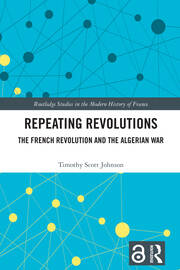
Timothy Scott Johnson’s Repeating Revolutions: The French Revolution and the Algerian War
Repeating Revolutions examines how France’s revolutionary past became a working political language during Algeria’s struggle for decolonization from the 1930s through the 1960s. Johnson’s central claim is that invocations of “1789” mattered because they operated as historical analogies that shaped political perception and legitimated action. Defenders of empire appealed to revolutionary universalism to portray French rule as progressive development and to recast coercion as tutelage. Anticolonial actors mobilized the same inheritance to indict the Republic for violating its own principles and for converting rights into imperial privilege. Johnson also follows procolonial militants and counterinsurgency theorists who treated decolonization as the return of revolutionary disorder traced to regicide. His wager is that tracking these analogies situates opposed actors inside a shared field of argument and clarifies how Algeria and the Revolution were co-constituted as objects of knowledge in scholarship and state discourse, with attention to militant politics.
The Introduction provides the book’s conceptual architecture with unusual clarity. Johnson treats the coupling of 1789 and the Algerian War as a “timeknot,” drawing on Dipesh Chakrabarty’s language for entanglement through reference and expectation. His premise is that repetition yields difference (Deleuze). Each return to 1789 re-describes the Revolution and re-describes decolonization, even when speakers present themselves as guardians of stable meaning. Johnson also treats the Revolution as political myth, a shared narrative resource that naturalized expectations about progress and emancipation, as well as narratives of national decline. He identifies recurring plots, including a paternal plot in which independence appears as the culmination of French universalism and a declension plot in which Algeria confirms that revolutionary rupture never ended. Analogy, in this account, is a form of historical thinking that rewrites the past it cites. The effect is to keep “1789” unstable and contested, with continuing political productivity across changing contexts.
Method is central to the book’s contribution. Johnson describes his approach as intellectual history “in the open air.” He reads specialist historians alongside public commentary and follows social scientific work where it stabilized categories of interpretation. He also brings militants and military theorists into view when their texts entered broader circuits of persuasion, including courtrooms and propaganda infrastructures. This scope allows him to treat scholarly debate as part of political history and to treat political rhetoric as a form of historical reasoning. It also supports one of the book’s most consistent strengths: attention to the institutions that circulate analogy, including anniversaries and publishing venues, along with state information systems.
Chapters 1 and 2 chart the prewar and early-war terrain. Chapter 1, “Debating the Revolution’s Legacy,” shows Algerian nationalists invoking French revolutionary symbols well before 1954, often to expose republican hypocrisy. Johnson distinguishes reformist appeals for inclusion within a republican frame from rhetoric that cast colonial privilege as a new ancien régime. He then turns to metropolitan debates after World War II, when antifascism strengthened the Revolution’s authority as a language of renewal. Specialists worried about anachronism and about the contamination of revolutionary history by Cold War polemics. Johnson’s reconstruction of the controversy around Daniel Guérin and his anti-Jacobin reading is especially instructive because it demonstrates how disputes over Robespierre became disputes over the legitimacy of revolutionary politics in the present.
Chapter 2, “The Soul of the Republic and the Algerian Crisis,” treats 1789 as a moral standard for judging the Republic’s conduct in Algeria. Johnson opens with the July 14, 1953, march in Paris and the violence that followed, using commemoration to stage colonial contradiction. Critics of repression and torture invoked the Declaration of the Rights of Man and a language of republican virtue. Johnson also traces how memories of occupation entered these arguments, so that Algeria could appear as a threat to the Republic’s moral integrity and to civic responsibility. The chapter is strongest when it shows how appeals to revolutionary virtue could discipline the left’s own self-understanding and set limits on what counted as legitimate resistance.
Chapter 3, “Dual Revolutions,” centers on 1958 as a moment of condensed historical imagination. The bicentennial commemoration of Robespierre’s birth coincided with the crisis that ended the Fourth Republic and returned de Gaulle to power after the May 13 events in Algiers. Johnson shows how commemoration and broadcast programming widened the audience for revolutionary scripts within a broader public debate. On the left, “committees of public safety” in Algiers signaled counterrevolution and revived fears of fascist recurrence. Procolonial activists and segments of the army framed the moment as civic mobilization in defense of French Algeria. Johnson also tracks the Bonapartist coding of de Gaulle, which linked emergency authority to an older cycle of revolution and consolidation. This chapter is particularly effective in showing how commemorative infrastructure can intensify analogy and convert it into an everyday interpretive reflex.
Chapters 4 and 5 track the analogy’s circulation across solidarity politics and Algerian critique as the prospect of independence became harder to evade. Chapter 4, “To Be French Today Is to Be Algerian,” follows metropolitan activists and the Jeanson network trial, where defendants and lawyers drew on revolutionary language to frame clandestine support for the FLN as fidelity to French principles, including the right to insurrection. Johnson treats the trial as a scene in which legal argument and press coverage turned historical reference into political self-fashioning, often through appeals to continuity with anti-Nazi resistance. Chapter 5, “Broken Mirrors,” reframes the problem from Algerian perspectives through Frantz Fanon and Jean Amrouche. Johnson shows how attachment to revolutionary promise could coexist with racialization and exclusion, and how 1789 could become compromised when France claimed the Revolution and denied its rights to colonized subjects. Chapter 5 clarifies why Algerian actors sought a decolonized historical grammar as metropolitan solidarity intensified. It also clarifies how revolutionary reference could sustain French centrality within emancipatory idioms.
Chapter 6, “Revolution and Counter-Revolution,” moves to procolonial and counterinsurgent archives. Johnson connects counterrevolutionary traditions to revolutionary war theory and to the propaganda infrastructures of the French Army, with attention to the political culture that culminated in OAS militancy. Here 1789 serves as warning and diagnosis. Decolonization appears as ideological subversion and the FLN appears as heir to revolutionary violence that demands counterrevolutionary response. Johnson’s work here is especially useful on the overlap between appeals to republican order and integralist projects of restoration since both could enlist revolutionary imagery and repudiated revolutionary emancipation.
Chapters 7 and 8 shift from political rhetoric to knowledge production. Johnson argues that historians and social scientists made North Africa legible as historical in ways that challenged orientalist assumptions of stasis. This work made analogies to ancien régime France more plausible for metropolitan audiences by supplying categories through which Algeria could appear as a society in motion. He then follows the conceptual formation of the “Third World” through revolutionary analogy, tracing how Alfred Sauvy’s formulation echoed Sieyès’s Third Estate and translated an older script into global politics. Johnson closes by returning to analogy as method, emphasizing that comparisons rewrite the past they cite and reorganize what later historians can see. His suggestion that the experience of Algeria contributed to the later legibility of other revolutionary histories, including Saint-Domingue, is one of the book’s most compelling bridges between intellectual history and historiography.
Johnson’s study succeeds on its own terms. It offers a persuasive account of analogy as historiographical operation with political consequences, and it does so without converting historical actors into vehicles for theory. The writing is restrained. The conceptual claims are explicit. The chapters consistently link discourse to the institutions that circulate it. The book also clarifies how revolutionary reference can authorize solidarity and delegitimate empire, with implications for coercive governance and for scholarly periodization. The result is a study with substantial value for historians of modern France and decolonization, along with readers interested in the politics of historical knowledge.
The book also invites questions that sharpen its historiographical value. The archive is strongest for Francophone publics and literate elites. How far did revolutionary analogy travel beyond those circles? What changes if Arabic-language political culture becomes the primary archive, or if rural worlds structured by other forms of authority take analytic priority? A second question concerns causality. Johnson demonstrates that analogy organized perception and legitimated action. The evidentiary threshold for showing outcome effects remains higher than the threshold for showing rhetorical or ethical justification. What sources would allow a stronger claim about outcomes, such as internal memoranda or administrative correspondence? The book also raises a methodological question that merits explicit discussion: when does analogy function as explanation, and when does it function as alibi?
Repeating Revolutions will reward historians of modern France and decolonization, especially readers interested in commemoration and political myth. It will suit graduate seminars that move between intellectual history and the history of empire. Its central lesson is that revolutions persist through the histories later actors tell about them, and those histories shape what becomes thinkable as emancipation.
Author

Latest Issue
2026: Vol. 25, No. 2
Latest Issue
2026: Vol. 25, No. 2

Essays
Essays
By Robert J. Antonio: Implementing Project 2025: Day One and After
Essays
Essays
By Dilip Simeon: Domination and Chaos: India’s Radical Conservatism
Essays
Essays
Essays
Essays
Essays
Fanon at 100
By Paget Henry: Frantz Fanon and the Crisis of Our Current Transitional Period
Essays
Fanon at 100
Essays
Masculinity in Crisis
Essays
Masculinity in Crisis
By George Lundskow: Making Racism and Misogyny Great Again: The Emptiness and Misplaced Meaning of Angry Young White Men
Review Essay
Book Reviews
By Douglas Kellner: Domenico Losurdo’s Western Marxism: How it was Born, How it Died, How it Can Be Reborn
Book Reviews
By Michael J. Thompson: Meera Nanda’s Postcolonial Theory and the Making of Hindu Nationalism
Book Reviews
By Keanu Heydari: Timothy Scott Johnson’s Repeating Revolutions: The French Revolution and the Algerian War
Book Reviews
By Miron Clay-Gilmore: William M. Paris’ Race, Time, and Utopia: Critical Theory and the Process of Emancipation
Book Reviews
Book Reviews
By Paul Buhle: Noah Isenberg’s Edger G. Ulmer: A Filmmaker at the Margins
