
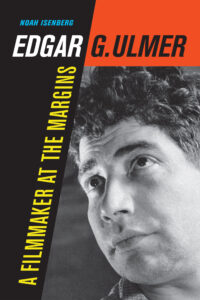
Noah Isenberg’s Edger G. Ulmer: A Filmmaker at the Margins
Perhaps now, a decade or so since the landmark study of a unique but mostly forgotten director, can the importance of Edgar Ulmer be appreciated. Or perhaps not. Ulmer so successfully evades categorization, and dwelt so often and long in the low-production-value world of films, that he has not yet truly emerged as an important cinematic creator, and may never! But we hope for better, as the old categories wobbly and sometimes give way. Pauline Kael would never have approved, since Ulmer worked with a Left that she never ceased cursing in print. But she has been dead a long time.
The scope of Isenberg’s scholarship— to take the single most unique aspect of this study first—is pretty astonishing. He had access, more or less, to the family files, in the hands of Shirley, Ulmer’s widow. And Shirley, in collaboration with their daughter, worked furiously for years to get Ulmer’s films shown and recognized. Still, the global character of Ulmer’s life, the multi-lingual sources, the sheer breadth of his sixty-some films, his relationship with producers (when he actually had a producer) and actors, would pose a serious problem for even the most sympathetic film historian. Isenberg, a far-reaching scholar, had done better than anyone else could do, perhaps than anyone else would wish to do so well.
Central European to the core, Ulmer first took life in a Moravian village in the modern-day Czech Republic in 1904, but soon after, the family moved to Vienna. This would be crucial. His wine-merchant father and his mother, a sometime opera singer, seem standard types of the age. Secular Jews in a cultural center, they would have remained a comfortable family if his father had not died in 1916, in an Austrian uniform, fighting the Italians. Some critics have attributed this or that Ulmer film with an absent father to Edgar’s status. Actually, Vienna counted for everything.
Young Edgar Ulmer wanted badly to be a modernist novelist, a la Thomas Mann, but never could finish the novel in his head, with its reputedly vivid depiction of wartime Vienna. Destiny took him elsewhere. Later fashioning himself as an “aesthete from the Alps”and avid admirer of Von Stroheim (p.15), he had been placed in foster-care in Sweden by his mother, following his father’s death, a misfortune that turned into good fortune by moving back to Vienna in 1920 in the household of the Schildkraut family, well connected in the arts (Rudolph Schldkraut would later become a distinguished Hollywood actor of the “ethnic” type). There he found his calling in the Burg Theater, where he could be tutored by the then-famous Max Reinhart.
Our budding actor reached the US at age 19, in 1924, with a supporting role in “The Miracle,” a play directed by Reinhart, with Rudolph Schildkraut playing the lead. There, in New York, Ulmer imbibed “Yiddish Broadway” in its glory years, an introduction that must have led in roundabout ways to his directing four Yiddish films a decade later.
Brilliant in claiming past, possibly dubious credits for himself, Ulmer managed to get hired by Hollywood mogul Carl Laemmle that same year, at Universal’s Art Department. He toiled at Universal for four crucial years, meeting future collaborators all around, meanwhile directing small-budget Westerns. Back in Germany, he worked with the famed F.W. Murnau on the high-rated and artistic film Sunrise (1927) perfecting his notion of the cinematic set design. Ulmer may have returned to Hollywood in ten days—the evidence is unclear—but back in Germany at the end of the decade, he collaborated in the creation of a cinematic classic, Menschen am Sonntag (1930). A film with little plot but great impact on cinema far beyond Germany, it captured a Sunday in Berlin of ordinary things, ordinary people. The accidental meeting of two young men with two young women, largely performed by amateurs (at low cost), could be praised by the likes of prestigious Russian critics as being outside and against the cinema of the capitalist film world.
This experience, according to Isenberg, set Ulmer on his unique and idiosyncratic path. Damaged Lives (1930) treating venereal disease, was bold, remarkable and a minor hit. Metaphorically speaking, many fellow artistic German immigrants would recollect that all their lives were damaged, especially because the Germany they left behind had disappeared under Hitler. When the opportunity arose, they had something important to say, often enough through connections with the Hollywood Left.
The Black Cat (1934), one of the most remarkable films of its time by way of contemporary plot and expressionist set, would be important for Ulmer himself also for its music, a dark romanticism. In popular memory, it would be the glorious reuniting on screen of Boris Karloff and Bela Lugosi, as two rivals in the past world war now fighting (among other things), to the common ruin, over a female they both desire. It was one of Universal’s top hits of the year and a model for horror films, closer than others to the continuing horrors of actual war in the actions of its survivors. War is never glorious.
The Black Cat had, of course, nothing to do with the famed short story by Edgar Alan Poe upon which innocent movie-goers must have thought it was somehow based. Artistic-minded critics would say that it fairly summed up, in ambience and set, the German art film of the Weimar period. The “omniscient camera,” somehow entering the minds of the actors, seemed to open a brilliant future for Ulmer. This future closed soon, within the mainsteam, when he took a young Shirley Alexander from the arms of Laemmle’s favorite nephew into his own.
Still a young man with some brilliant work behind him, Ulmer was now “dead in Hollywood.” In strange and unpredictable ways, this personal tragedy worked to his advantage. Constantly forced to scrounge for directing jobs and money, Ulmer exercised the most amazing creativity. His four Yiddish-langage films, starring stage personalities and at least one famed cantor, have never been equalled—because the Yiddish world audience disappeared by 1945, Israel took less than no interest in Yiddish culture, and assimilation as much as wiped out the possibilities in the US. Grine Felder/Green Fields (1937) remains the most viewed Yiddish film of all time.
But as magnum cultural history scholar George Lipsitz pointed out decades ago, the Yiddish trio constituted only a chunk of Ulmer’s most remarkable work. His discovery of a vibrant ethic and racial vitality slightly well below the surface of middle class magazines and tabloid newspapers brought him to make nearly a dozen films, both possible and also necessary, because he needed help in scounging the money and even the sets for this work.
Three Ukrainian-themed films could be said to have almost called an articulate diaspora into existence—more than a million Ukrainian immigrants in North America, an overwhelming lower-class population, here found a voice. And not only a voice, in dialogue and singing, but very much a life in folk dance, a film appearance that stirred an organized Ukrainian folk dance circuit into existence. I only happened to see an hours-long performance in New York in 1980, performed in ethnic costumes for a labor history event at Columbia University, connected vaguely to the CPUSA.
Moon Over Harlem (1939), an entry in the short-lived boom of films made about African American life and once again on hustled-together funds, offered a glimpse of reality. No matter that it focused on criminality and offered a typical love story: in the casual ambience of the African-American actors, Ulmer offered audiences something that they could learn from and perhaps enjoy. Likewise, Club Havana (1945) among others sought to offer up exotic music and a touch of culture not so exotic to the populations in New York and elsewhere who spoke and also sang outside of English on a daily basis.
One could argue that Ulmer gave something like the same treatment to “Teens,” a category only coming into existence in wartime, with soda shops and swing music providing a glimpse of the home front awaiting war news. Jive Junction (1943) was also an effort to relate current “jive” music popular with teens, to the continuing effort to make the classical repertoire relevant, very much to the taste of Ulmer himself.
No account of Ulmer could avoid Detour (1945), which almost defined noir film by stripping it down to essentials (a parking lot as Los Angeles) and offering a sense of the spiritual emptiness of postwar America.
It would be impossible to recount, let alone analyze, the dozens of films that do not escape Isenberg’s earnest efforts at details of production and sometimes, deeper inspirations. Ulmer’s own aspiration, as far as it can be grasped, was simply to go on.
It would be irresponsible of a reviewer who collaborated on several volumes about Hollywood Blacklistees and their film efforts, not to note that Ulmer reached into the Left community before and after 1950, when some very available, i.e., unemployed screenwriters would be available for for some of his hardest-hitting films. These would include the militantly anti-capitalist Ruthless (1948), written by Alvah Bessie and Gordon Kahn, his remarkable Western (set in Mexico), The Naked Dawn (1955), written by the otherwise forgotten Julian Zimet, and The Cavern (1964, his last film) written in part by an uncredited Dalton Trumbo.
The reviewer also feels compelled to note three low-budget favorites that would likely escape notice otherwise. The Naked Venus (1959) used footage from contemporary European nudist campus (above the waist shots only) for a mother’s plea against American-stye moral repression. Beyond the Time Barrier (1960), said to have been shot largely in a department store window), in the true SciFi vein of the time, warns against the effects of atomic waste poisoning the inhabitants of the future. That Ulmer gave Hedy Lamarr the opportunity to make an adult film about sex and love when the Breen Office wanted no realism, would alone make The Strange Woman (1946) worth seeing.
Shirley Ulmer, hanging in with her husband through thick and thin (including his occasional adultery), a sometime script doctor or stage director and sometimes even a fill-in cameo actress, was a believer, a real trooper. With their daughter, Arienné, Shirley worked furiously to reach the small but growing crowd of 1970s devotees that appeared with the campus revival of old films, and to reach beyond. UCLA’s 1983 declaration of Ulmer as “King of the Bs” surely marked a new phase, and a touring version sponsored by the Goethe Institute, guaranteed respectability of a sort.
Thus Detour became the first B film to be included in the National Film Registry of the Library of Congress. International fame for the late Edgar Ulmer followed, and eventually, it would become easy for even mainstream critics to discuss prestigious new films in relation to his lasting influence. Peter Bogdanovich, thirty years after an interview with Ulmer, thus praised Bluebeard (1946, a film that some described as a love-poem to the streets of Paris) and emphasized once more that the director’s genius had triumphed over his impoverished means of production.
Noah Isenberg closes with the thought that Ulmer would surely have joined the “indy” digital era of individual creation with joy. Indeed. But it was his special qualities, in a film era that demanded so much material support, that made him unique.
* Special thanks to magnum American Studies savant George Lipsitz for his appreciation and his insights into Ulmer long before the rest of us grasped the director’s importance.
Author

Latest Issue
2026: Vol. 25, No. 2

Latest Issue
2026: Vol. 25, No. 2

Essays
Essays
By Robert J. Antonio: Implementing Project 2025: Day One and After
Essays
Essays
By Dilip Simeon: Domination and Chaos: India’s Radical Conservatism
Essays
Essays
Essays
Essays
Essays
Fanon at 100
By Paget Henry: Frantz Fanon and the Crisis of Our Current Transitional Period
Essays
Fanon at 100
Essays
Masculinity in Crisis
Essays
Masculinity in Crisis
By George Lundskow: Making Racism and Misogyny Great Again: The Emptiness and Misplaced Meaning of Angry Young White Men
Review Essay
Book Reviews
By Douglas Kellner: Domenico Losurdo’s Western Marxism: How it was Born, How it Died, How it Can Be Reborn
Book Reviews
By Michael J. Thompson: Meera Nanda’s Postcolonial Theory and the Making of Hindu Nationalism
Book Reviews
By Keanu Heydari: Timothy Scott Johnson’s Repeating Revolutions: The French Revolution and the Algerian War
Book Reviews
By Miron Clay-Gilmore: William M. Paris’ Race, Time, and Utopia: Critical Theory and the Process of Emancipation
Book Reviews
Book Reviews
By Paul Buhle: Noah Isenberg’s Edger G. Ulmer: A Filmmaker at the Margins
