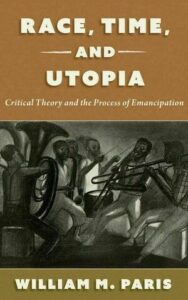
William M. Paris’ Race, Time, and Utopia: Critical Theory and the Process of Emancipation
In this book, philosopher William Paris develops an account of racial injustice that centers the relationship between freedom and time. In his own words, Paris aims to “develop the hypothesis that racial domination is at bottom the domination of time by one group over another and thus emancipation must entail delivering the control of time out of the hands of one set of agents and into another’s.”[1] Put simply, modern capitalist societies are “comprised of distinct forms of life that organize time according to different rhythms and values.”[2] A fortiori, two questions orient this text: 1) how should we diagnose and conceptualize the temporal domination of racial justice? 2) if we have internalized this form of life then what resources can we develop principles for a transformed and free form of life that we have never experienced? To answer 1), Paris offers readers an account of racial fetishism which refers to the “cognitive distortions into the experience of all agents living in racially unjust societies that make it appear as if race operations independently of our social practices.”[3] To answer 2) Paris argues that Black Power thought can be the basis for “envisioning a society where social relations are transparent and open to critique from the racially dominated” and the subsequent creation of a world “where the justifications for how we organize our social time are brought under the control contestable political institutions rather than political institutions being constrained” by racist capitalist relations.
Paris’ Race, Time, and Utopia is an original work that enhances research agendas that are centered on philosophy of race, continental philosophy, and Africana philosophy. The work is also theoretically ambitious and productively engages the ideas of Black nationalists like Du Bois, Martin Delany, and Marcus Garvey. The originality in this sense is hard to overstate. Since the 1980’s, there’s been a consensus among Black/Africana philosophers of race that Black nationalist ideas are ‘essentialist’, ‘retrograde’, and at best should be revised to fit within the paradigmatic confines of liberal democratic theory. But Paris breaks with this dominant tendency in the field and shows how Black Power thought can be something other than a nationalist relic of masculine, patriarchal rage that centers men at the expense of Black women and queer people. Students and professors in philosophy, Black Studies, or those who specialize in Black diasporic thought from other disciplines would undoubtedly benefit by engaging Paris’ arguments.
Race, Time, and Utopia is grounded in critical theory and philosophy of race. However, his argument for understanding racism as a phenomenon grounded in ‘non-synchronicity’ and deep engagement with Black nationalists like Garvey or Black Power theorists like James Boggs gives his ideas a decolonial normative potential that most of the dominant rubrics in philosophy of race simply don’t have. I highly recommend this text. Some of the key Black thinkers in the text could’ve been engaged beyond their earlier works, especially Du Bois and Fanon. Yet, Paris’s refreshing engagement of Black Power thought for the purposes of normative theory has the potential to inaugurate new trends in philosophy of race towards an engagement with the basic concepts (i.e. Black Nationalism, Pan-Africanism) that the Black Diaspora have used to understand themselves. If Paris’ arguments are any indication of what to expect from philosophers of race, the view that an autonomous historical dynamic unites and coheres around the ideas produced by Black theorists throughout modern history (abolitionism, the Back to Africa movement, Black nationalism, African nationalism, Pan-Africanism) may one day be popular in the field. But that day has yet to come.
[1] William M. Paris, Race, Time, and Utopia: Critical Theory and the Process of Emancipation, (Oxford University Press, 2025), 4.
[2] Paris, Race, Time, and Utopia, 5.
[3] Ibid, 19.
Author

Latest Issue
2026: Vol. 25, No. 2
Latest Issue
2026: Vol. 25, No. 2

Essays
Essays
By Robert J. Antonio: Implementing Project 2025: Day One and After
Essays
Essays
By Dilip Simeon: Domination and Chaos: India’s Radical Conservatism
Essays
Essays
Essays
Essays
Essays
Fanon at 100
By Paget Henry: Frantz Fanon and the Crisis of Our Current Transitional Period
Essays
Fanon at 100
Essays
Masculinity in Crisis
Essays
Masculinity in Crisis
By George Lundskow: Making Racism and Misogyny Great Again: The Emptiness and Misplaced Meaning of Angry Young White Men
Review Essay
Book Reviews
By Douglas Kellner: Domenico Losurdo’s Western Marxism: How it was Born, How it Died, How it Can Be Reborn
Book Reviews
By Michael J. Thompson: Meera Nanda’s Postcolonial Theory and the Making of Hindu Nationalism
Book Reviews
By Keanu Heydari: Timothy Scott Johnson’s Repeating Revolutions: The French Revolution and the Algerian War
Book Reviews
By Miron Clay-Gilmore: William M. Paris’ Race, Time, and Utopia: Critical Theory and the Process of Emancipation
Book Reviews
Book Reviews
By Paul Buhle: Noah Isenberg’s Edger G. Ulmer: A Filmmaker at the Margins
