Paul Buhle and Raymond Tyler’s Partisans
A chapter by comic artist Kevin Pyle in the new graphic non-fiction collection Partisans centers on the “spomeniks,” massive, abstract concrete monuments that the Communist dictator Tito commissioned all over postwar Yugoslavia. Some 14,000 in all, the spomeniks were the new regime’s way of simultaneously commemorating the sacrifice of the anti-fascist partisans during World War II, and declaring that the people of the ethnically divided country would forge a new future, together.
Today, the majority of the spomeniks stand ruined, destroyed, or decaying and overgrown, testifying to the ruin of the partisans’ hopes for Yugoslavia as Serbs, Croats, and Bosnian Muslims went back to killing each other after the country collapsed again in the 1990s.
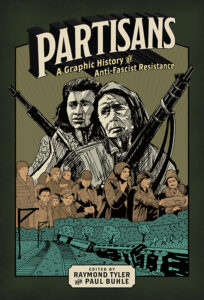
Partisans reclaims the complicated history of the armed anti-fascist resistance in occupied Europe during World War II, which editors Raymond Tyler and Paul Buhle argue, in their Introduction, “must not, cannot, be forgotten in our own time.” What they mean, of course, is that fascism isn’t dead; today’s far right is vicious, vengeful, violent, and eager to rehabilitate and celebrate the fascist leaders of Germany, Italy, Spain, and the subservient regimes in Hungary, Greece, Croatia, Slovakia, and elsewhere that the partisans fought against. “We must find our own creative ways, individually and collectively, to rise to the challenge.”
Tyler and Buhle don’t suggest what those ways might be, but the 15 artists and writers who contributed to their book collectively tell a story marked by sabotage, assassination and summary executions, arson, bombings, and reprisals against collaborators. Partisan warfare was heroic and selfless, sometimes visionary, but also ruthless, bloody, and unforgiving, often mirroring the brutality of the forces the insurgents were fighting against. Since the opposing sides were not separated by trenches or battle lines, an ability to not see the other side as human was nearly as prevalent among the partisans as it was among their foes.
The question lurking behind this history: What degree of courage, commitment, and sacrifice will it take to defeat the neo-fascists today?
The editors start by defining their terms. “The Resistance” is the larger anti-fascist movement, taking in anyone who opposed the wartime German occupation in one way or another, whatever their ideology, such as by providing intelligence or aid to those fleeing the occupied zones. “Partisans” were the armed resistance, usually drawn from left-wing movements, including “those allied in some ways with communist parties aimed ultimately at social transformation.” They were not regular soldiers, but ordinary civilians from all walks of life, although in some countries, they included veterans of the Spanish Civil War and people who had been engaged in political opposition to fascism before the occupation.
This is accurate so far as it goes, but it’s worth adding that the armed resistance also included groups that were not leftists, such as, in France, groups tied to Charles de Gaulle’s Free French, and in Greece, the National Groups of Greek Guerrillas (EOEA). The more important point is that while partisans came from a variety of political backgrounds—or none at all—during the fighting, they often developed their own political consciousness and a desire for their struggle to generate a new society rather than a return to the old, prewar order. The degree of cooperation between partisan groups within each occupied country ran from high to low to nonexistent.
Nor does a single model describe how they fought.
In tightly controlled countries like France, the Netherlands, and Northern Italy—after Mussolini was overthrown and the German army moved in to occupy it—partisan activity consisted of sabotage, raids, targeted killings, and hit-and-run combat. In Yugoslavia and Greece, it was closer to all-out warfare, sometimes approaching the level of pitched battles. Denmark, which is not represented in Partisans, offered very little armed resistance to the Germans, but the Danish underground engaged in nonviolent resistance and sabotage and rescued almost the entire Jewish population of the country, while in neighboring Norway, with its tough, mountainous geography, the resistance included commando raids and assassinations. A lot depended on the terrain, the population, and the strength of the German grip.
Partisans begins with a short prologue about the Spanish Civil War, followed by 10 chapters covering the armed anti-fascist insurgencies in France, Hungary, Greece, Yugoslavia, Italy, the Soviet Union, the Netherlands, and Jewish Eastern Europe. The stories it tells vary, too.
Sharon Rudahl’s piece covers the role that the American singer and dancer Josephine Baker played in the French Resistance. Tina Robbins and Anne Timmons relate how three Dutch girls were recruited into the struggle and their part in a campaign of assassinations of collaborators and SS officers. Franca and Isabella Bannerman illustrate Franca’s experience as a staffetta, or courier, transporting supplies, weapons, and intelligence for the Italian anti-fascist partisans. David Lasky tells the story of a Jewish partisan in Eastern Europe, not skipping the violence such people often experienced at the hands of Russian partisans. Sander Feinberg and Summer McClinton cover the Hungarian resistance, including the wartime efforts to rescue Hungarian Jews. Seth Tobocman’s chapter focuses on the astonishingly successful Yugoslav resistance. Daniel Selig’s chapter on the French resistance takes time to sort out the ideological splits among the Maquis or rural guerrilla bands (nicknamed for the scrublands within which many of them operated).
The artists and writers respond to the variety of stories they tell in Partisans with a variety of styles of illustration. Tobocman applies his trademark angular images to the story of the Yugoslav fighters. McClinton uses a more realistic style to illustrate Feinberg’s account of the Hungarian struggle. Timmons uses a classic postwar comic book style to tell the story of the three heroic Dutch women. A standout, for me, is David Lester’s chapter on the ferocious Greek resistance, which embraced armed insurgency, strikes and mass demonstrations, and the establishment of autonomous, directly democratic liberated zones of some 750,000 people. Lester’s black-and-white drawings are dramatic, movingly human, and splashed with a blood-red wash that evokes the savage nature of the fighting.
While every country’s brand of resistance to the occupation took a different shape, there were similarities. Women, who were excluded from the armed forces in nearly all countries before the war, took an active role in the partisan struggle in many of them: as fighters, as intelligence gatherers, and in leadership roles. And while the political consciousness that developed in the Resistance was often nebulous, it often included direct democracy or more democracy, reflecting both the experience of self-organizing during the war and disgust with the corrupt and reactionary politics of the decades that preceded it.
Both of these threads are visible in Partisans, and this raises the question of how they played out after the fighting was over. In France, Italy, and Yugoslavia, women got the vote almost as soon as the war ended, but still faced an uphill battle for their full rights as autonomous individuals; in Greece, too, they gained full suffrage, but had to wait a bit longer, until 1952. In much of Western Europe, a capitalist-friendly form of democratic socialism prevailed that raised living standards and eased economic and social inequality.
In other respects, the aftermath of the anti-fascist insurgencies was more complicated, and Tyler and Buhle seem to have made an editorial decision not to delve too deeply into this part of the story.
In almost all countries—except the ones that joined the Communist bloc—the victorious Allies were anxious for politics to return to something like the prewar status quo, and in many places it did, despite some reforms and the abolition of monarchy in Italy and the Balkan states, for example. In his chapter on the French Resistance, Selig notes that the Communist FTP (Francs-tireurs et partisans), who played a prominent part in the struggle, were nudged aside by the provisional government headed by de Gaulle, and were imprisoned by the thousands for crimes like looting and murder. The French partisans never formed a political party of their own.
“After the war, many resisters were disappointed that the reestablished Forth Republic did not coincide with the ideal of profound change that had motivated them,” Selig writes. An even worse fate struck the Greek guerrillas who had effectively liberated their country but who, by then, were already tearing themselves apart in a bitter fight between Communist and non-Communist formations: an aspect of the story that Lester doesn’t cover in his chapter. After the German surrender, Stalin refused to wholeheartedly support the Communist EAM-ELAS, and sat back while the conservative royalist government, supported by the US and the UK, crushed it. There as elsewhere, the people who had risked the most were ground down between the two sides in the Cold War struggle for power in postwar Europe.
Notably, the one European country where the partisans did create the postwar order was Yugoslavia, where Tito’s authoritarian government restored a multiethnic state and steered it adroitly between the Soviet and Western blocs until his death in 1980. (Tito had argue with Stalin for continuing to support the Greek Communist partisans.) Pyle and Tobocman engage with this part of the story and the murderous ethnic warfare that followed, Tobocman suggesting that dictatorship provided a “poor education” for creating a lasting multicultural society. But here again, post-Soviet Russia and NATO played a role in encouraging Serb, Slovene, and Croat nationalisms to reassert themselves after Tito’s death, brutally redrawing Cold War battle lines across the former Yugoslavia almost as soon as the Cold War was over.
This is the tragic aspect of the partisans’ story, and it extends to the countries that aren’t covered in this book, including Poland, Czechoslovakia, and Germany itself, where only one underground faction—the Communists—reaped the rewards of victory, backed by Stalin. Yugoslavia was not the only anti-Axis insurgency that asserted control of the state after the war ended: but the others were in non-European countries that Partisans leaves out.
Anti-Japanese guerrillas in the Philippines were astonishingly effective during the occupation; by the end of the war, they controlled all but 12 of the country’s 48 provinces. Independence followed, although the US continued to exercise a degree of economic and military control over the new country. In Vietnam, the Viet Minh (League for Independence of Vietnam) successfully fought both the Vichy French colonial government and the Japanese occupiers and declared independence after the war: only for de Gaulle’s government, and then the US, to engage them in a 30-year neo-colonial war.
In Indonesia, the situation was more complicated, and politically murky. Opponents of the Dutch colonial government collaborated with the Japanese occupiers, who late in the war encouraged them to prepare for independence—and the war of liberation against the returning Dutch authorities that would follow.
Arguably, the nature of the struggles in East Asia was very different from those in Europe, but these were the countries where the resistance resulted in the most profound change. Outside Europe, World War II and the Japanese invasions weakened the colonial grip, and the insurgencies that began or gained strength during the occupation were ready and able to assert independence afterward. Not so in Europe itself, where the British, American, and Soviet forces, not to mention the Free French, were determined not just to defeat the Nazis but to remake the postwar order in their favor. A book that covered the wartime partisan movements across both regions could have established a richer context for the political transformations that followed.
That’s not to say that the artists and writers who collectively created Partisans should have produced a different book.
The price the insurgents paid was frightful; some 20,000 died in struggle in Greece—slightly less than the toll they extracted from the occupiers—and Yugoslavia claimed as many as 245,000 partisans died. Civilian losses, of course, were far higher. Few practiced non-violent civil disobedience, since this would have been a near-invitation to murder. Insurgency was a personal as well as a collective matter, carried out either violently or in support of violence, often at close quarters, and the Partisans depicts this as explicitly as a comix-format book could be expected to. The book reveals the insurgents and others who participated in the resistance as almost insanely brave. It also suggests the toll their struggle took, including psychologically.
The trauma remains.
For decades, the French have fought over who can rightfully claim membership in the Resistance as well as the conduct of the Vichy collaborationist government. One way to view the Bosnian and Kosovar wars is as a reversion to the ethnic bloodletting of World War II. The Russian government eagerly and inaccurately tars its Ukrainian victims as “fascists” and “Nazis.” Italian Prime Minister Giorgia Meloni, whose Brothers of Italy party is a successor to Mussolini’s Fascists, recently commemorated an episode at the end of the war in which thousands of Italian troops were thrown into sinkholes by Tito’s Yugoslav forces, and which she alleged was followed by decades of “unforgivable” silence. The Italian left, whose legacy is the struggle against fascism, tend not to feel the same.
While little of this part of the story is covered in Partisans, it lies very close to the surface.
Tyler and Buhle don’t spell out what they take to be the “challenge” the insurgents’ achievements pose; the world is different today, and neo-fascism arises from this different set of circumstances. But they ask us to think about how we should respond in light of how the partisans did and what they achieved. In their Introduction, Tyler and Buhle say, “History does not repeat itself. But the example offered by the Partisans’ courage must not, cannot be forgotten in our own time. We must find or own creative ways, individually and collectively, to rise to the challenge.”
The underlying issue is how our context differs and what means are appropriate to address it. Today, we use the word fascism to describe the far-right resurgence. But is the fascism of Trump the same as that of Hitler, Mussolini, and the Japanese militarists? Will the same methods be required to dislodge and defeat it? If we don’t think so, then are we right to call it fascism? If we do, then are we wrong to think—as we apparently do—that elections, protest, and non-violent civil disobedience are the appropriate response? Or are we fooling ourselves, as so many were in the years leading up to Hitler’s invasion of Poland?
The answer is not simple, because circumstances differ from country to country, as they did during the war. But it’s worth noting that today’s neo-fascists, from Trump and the MAGA movement to Orbán in Hungary to Putin in Russia to the AfD in Germany to the Rassemblement national (National Rally) in France, are determined to get and hold power, and never again give it up. They might present a smooth, sophisticated contemporary politicians, but like their predecessors, they aim to cleanse society, once and for all and by force, of the people and the movements that they believe have infected it and destroyed its (imagined) past glory. It’s unlikely that defeating them will be a peaceful matter.
Author

Latest Issue
2025: Vol. 24, No. 1-2
Latest Issue
2025: Vol. 24, No. 1-2

Essays
Essays
By Robert J. Antonio: Implementing Project 2025: Day One and After
Essays
Essays
By Dilip Simeon: Domination and Chaos: India’s Radical Conservatism
Essays
Essays
Essays
Essays
Essays
Fanon at 100
By Paget Henry: Frantz Fanon and the Crisis of Our Current Transitional Period
Essays
Fanon at 100
Essays
Masculinity in Crisis
Essays
Masculinity in Crisis
By George Lundskow: Making Racism and Misogyny Great Again: The Emptiness and Misplaced Meaning of Angry Young White Men
Review Essay
Book Reviews
By Douglas Kellner: Domenico Losurdo’s Western Marxism: How it was Born, How it Died, How it Can Be Reborn
Book Reviews
By Michael J. Thompson: Meera Nanda’s Postcolonial Theory and the Making of Hindu Nationalism
Book Reviews
By Keanu Heydari: Timothy Scott Johnson’s Repeating Revolutions: The French Revolution and the Algerian War
Book Reviews
By Miron Clay-Gilmore: William M. Paris’ Race, Time, and Utopia: Critical Theory and the Process of Emancipation
Book Reviews
Book Reviews
By Paul Buhle: Noah Isenberg’s Edger G. Ulmer: A Filmmaker at the Margins
