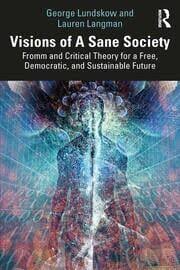
George Lundskow and Lauren Langman’s Visions of a Sane Society
Lauren Langman and George Lundskow’s new book, Visions of a Sane Society: Fromm and Critical Theory for a Free, Democratic, and Sustainable Future, is a bold effort to update Fromm’s ideas and make them relevant to the present conjuncture. The authors put forth many interesting and unique insights that build on Fromm’s thought while in important ways moving beyond it. Notably, by situating Fromm’s insights not only in relation to existing conceptions of authoritarianism but also in relation to urgent questions related to social justice, the authors convincingly demonstrate the continuing relevance of his thought. Yet this does not prevent them from offering an honest evaluation of the blind spots and lacunae in his conceptual universe. The following observation is a case in point: “As a simple example, Fromm generally assumed binary, heterosexual intimate relationships, and although he never denied that other possibilities could be healthy and fulfilling, neither did he consider things like non-binary, asexual, trans, and other alternative identities. He was also wrong about the essence of sadism as the desire for control” (213). In other words, while this important new study is influenced by and engages Fromm’s though, it is no hagiography.
The authors display a thorough knowledge and understanding of a range of disciplines, including history, political theory, philosophy, sociology, political theology, and anthropology and skillfully combine insights from these various fields into a robust framework for thinking through thorny social psychological problems while gesturing toward liberation and healthier social and political arrangements. I genuinely appreciated the authors’ willingness to draw on their own lives and experiences as they presented their arguments in various parts of the text (e.g., 164). It constitutes a refreshing break with the stodgy and questionable convention of keeping personal life and experience out of one’s academic writing. Another one of the book’s major accomplishments is to have convincingly demonstrated that contemporary fascism in the U.S. is rooted, at least in part, in a history of racism of various kinds as well as other oppressive hierarchies, including gender-based ones. The authors show that even though the Confederate army was defeated in the U.S. civil war, the racist assumptions and ideology that animated it continued to resurface in different guises long after the war, with Trump and MAGA being a case in point (79-83). They note: “Although it started before Donald Trump, his campaign slogan to make America Great Again is the current manifestation of white heteronormative ethnonationalism, the essence of American fascism” (124). Importantly, the authors also show that historically the labour movement—and unions in particular—in the U.S. was not immune to racism, and that this partially accounts for its eventual marginalization and decline (83-86).
Very interesting as well is the discussion of charisma in relation to the prophetic tradition and Trump, teasing out the traits that make charismatics stand out, propel them into positions of power, and help them generate a following (159-169). Having said that, the authors could have perhaps said a little more about the differences between authoritarian and non-authoritarian forms of charisma, because the two are certainly not identical. In any case, it should be noted as well that the authors offer a nuanced and interesting discussion of positive and progressive, as opposed to retrograde, iterations of the messianic or the prophetic tradition, which is valuable not least because, as they themselves point out, Fromm himself often conceptualized hope, spiritual renewal, and progressive social change through a prophetic lens. They note the following with respect to Fromm’s conception of the prophetic: “Consequently, the prophets did not seek to replace one dogma with another, but rather to subvert all dogmas with a critical orientation so that questions rather than answers become the essence of the new faith” (208). This discussion is illuminating because it shows that the Left ought not to cede religion to the Right and reactionary forces. The authors make it abundantly clear, however, that the possibilities for meaningful social change through institutionalized religion are limited and that it is unlikely to be the locus of genuine experiments in liberation (243).
Especially interesting, salient, and illuminating is the final chapter, which offers a highly original, engaging, and compelling discussion of the desirability of incorporating insights from Indigenous societies and cultures into a vision for a better future. Their discussion here touches on, among other things, the ways these societies and cultures enable us to envision an economic “commons”, full gender equality, and the possibility of embracing more constructive, logical, and fluid types of authority, i.e., ones rooted in moral authority and experience as well as a sense of social responsibility. The authors plausibly maintain that these societies offer healthier, more mature, and more sustainable ways of relating to the natural environment, ones that dispense with domination and the hallmarks of which are responsibility, care, and harmonious co-existence. Perhaps the insights embedded in related worldviews and traditions can also be one of the sources of a progressive and forward-looking faith and spirituality (269-279).
This text should certainly be commended for articulating a robust humanistic vision in the spirit of Fromm’s writings while in important ways constituting an advance over them. At times, however, it also reproduces Fromm’s moralizing impulse which, to the extent that it is meant to serve as a substitute for serious political strategy, should be criticized from the Left. Indeed, the moralizing impulse that goes along with the otherwise inspiring and original humanistic and radical vision put forth in this book is likely what blinds the authors to the need for serious strategic thinking in terms of advancing the causes championed by progressive movements more effectively. The following set of questions and framing is a case in point: “Starting in Chapter 5, we will offer our own vision of a better future, but we also ask everyone a few broader questions: Who are you? How do you want to spend your life? What is your basis of right and wrong? Maybe most importantly, what happens when you die? These are reasons for living, and, if necessary, challenging power. If we can answer these questions meaningfully, a progressive future becomes possible.” (104). These questions are not entirely amiss or irrelevant, of course, but in addition to advancing a kind of moralizing spirituality, they exhibit a preoccupation with the existential dimension of the path to social maturity and flourishing rather than with concrete political strategies whereby oppressive hierarchies might be challenged and weakened over the long term. The question of strategy certainly cannot and should not be sidelined in favor of concerns related to spirituality and “transcendent beliefs” (i.e., moral systems and religious commitments that wed the individual to the community), even if it is true that both of these things are important elements in articulating and working towards a better future (101). Perhaps this issue haunts Fromm scholarship as a whole in light of the fact that Fromm’s own writings for the most part do not offer direct reflections on Left strategy, which is not to say, of course, that his ideas aren’t useful for strategizing on the Left. The authors indeed make a point of highlighting this lacuna in Fromm’s oeuvre: “Fromm said very little about how to achieve a post-capitalist, humanistic socialism. Matheus Romanetto (2025) thoroughly evaluated all of Fromm’s publications, talks, unpublished manuscripts, and letters. He found almost nothing on how to transform theory into practice” (41). Yet given their focus on existential and spiritual concerns in much of this text, perhaps they themselves do not fully address or overcome it despite their best efforts.
It is also difficult not to notice that work of the preeminent expert on Fromm and anti-fascism, Joan Braune, is not cited in this book. This is a weakness, in my opinion, not least because Braune offers important insights, grounded in her anti-fascist scholarship and activism, on how to combat and organize against fascism from the Left (2024). Indeed, the section dealing with the possibility of defeating fascism, entitled “Countering Fascism,” is much too short and cursory (260-263) considering how much of this book is devoted to reflecting on the rise of fascism in the U.S. and elsewhere. In fact, the authors could have done a better job of engaging existing Fromm scholarship in general. For example, the book offers very interesting and illuminating reflections on the prophetic tradition in terms of both promise and abuses, as mentioned earlier, but for some reason does not engage Braune’s important recent book-length study on the prophetic in Fromm (2014) or Dustin Byrd’s illuminating essay on Fromm’s conceptualization of the traits that distinguish “prophets” from “priests” (2014). Surely these two seminal studies are not irrelevant to the arguments considered and presented here.
Lastly, the authors should have examined more attentively the question of how recalcitrantly narcissistic and anti-social traits can be combatted on the road to the normalization of the productive character structure and “prosocial” behaviour. The authors seem to assume that characterological pathologies will simply wither away once the productive character type become ascendant, and at times imply that narcissism can be willed away as though it were essentially a matter of choice, but the truth is that that these regressive and destructive character types have to be actively rooted out from society if there is hope of psychological productiveness becoming the norm (50-54). The issue of malignant narcissism should have been discussed in more detail and at greater length, specifically with reference to Fromm’s important and enduring insights from The Anatomy of Human Destructiveness. In this context, too, a moralistic impulse overshadows the need for a serious analysis of meaningful and effective ways for dealing with serious characterological pathologies, which threaten both the well-being of individuals and social cohesion. It is probably the case that celebrating and valorizing productiveness will simply not do as a strategy of addressing serious and dangerous anti-social characterological pathologies and trait.
Among this fine book’s many accomplishments are an interesting discussion and critique of capitalism from a Marxian and socialist lens, an innovate approach to the limitations and promise of contemporary technologies and social media, and a bold, unapologetic, and thought-provoking engagement with dilemmas concerning religiosity and spirituality in relation to progressive social movements that confronts the Left with difficult and urgent questions with regards to the need for transcendent beliefs, values, and practices (44-45). Inasmuch as it pushes us to reorient our thinking about the relationship between individual flourishing and collective life, it necessitates a re-revaluation of the sustainability and desirability of the common sense of “radical individualism” embedded in neoliberal policies and attitudes. I would like to reiterate that this is a thought-provoking and pathbreaking book, one that calls for attentive and close engagement by scholars of Fromm, Critical Theorists, scholars of fascism, and the broader public.
Bibliography
Braune, Joan. Erich Fromm’s Revolutionary Hope: Prophetic Messianism as a Critical Theory of the Future. SensePublishers, 2014.
Braune, Joan. Understanding and Countering Fascist Movements: From Void to Hope. Routledge, 2024.
Byrd, Dustin. “Fromm’s Notion of the Prophet and Priest.” In Reclaiming the Sane Society, edited by Seyed Javad Miri, Robert Lake, and Tricia M. Kress. SensePublishers, 2014.
Fromm, Erich. The Anatomy of Human Destructiveness. Holt Paperbacks, 1992.
Lundskow, George, and Lauren Langman. Visions of a Sane Society: Fromm and Critical Theory for a Free, Democratic, and Sustainable Future. Routledge, 2026.
Author

Latest Issue
2026: Vol. 25, No. 2
Latest Issue
2026: Vol. 25, No. 2

Essays
Essays
By Thomas Kleven: White Supremacy, White Insecurity, and the Struggle for a More Egalitarian Social Order
Essays
Essays
Essays
Essays
Essays
Essays
Essays
The Legacy of Jürgen Habermas
By Gordon Finlayson: Habermas’s Legacy: The Philosophy of the Public Sphere
Essays
The Legacy of Jürgen Habermas
By Kenneth Baynes: Habermas’s Case for Democracy: the Public Sphere, Communicative Reason and the ‘Co-originality’ of Public and Private Autonomy
Essays
The Legacy of Jürgen Habermas
By John Abromeit: Jürgen Habermas’s Image of the United States as a Model of “Modernity”: From Attachment to Melancholy
Poetry
Allen Ginsberg's Centennial
Poetry
Allen Ginsberg's Centennial
Poetry
Allen Ginsberg's Centennial
Poetry
Allen Ginsberg's Centennial
By Eileen Myles: Jan. 25
Poetry
Allen Ginsberg's Centennial
By Jim Cohn: For Allen Ginsberg, on His 100th Birthday (3 June 1926 – 3 June 2026)
Poetry
Allen Ginsberg's Centennial
By Eliot Katz: Letter to Allen on the State of the State, March 2026
Book Reviews
By George Lundskow: Cynthia Miller-Idriss’ Man-Up: The New Misogyny and the Rise of Violent Extremism
Book Reviews
Book Reviews
By Benjamin Heim Shepard: Jeremy Varon’s Our Grief is Not a Cry for War
