Jürgen Habermas’s Image of the United States as a Model of “Modernity”: From Attachment to Melancholy
“it is evident that melancholia too may be the reaction to the loss of a loved object. […] one can recognize that there is a loss of a more ideal kind. The object has not perhaps actually died, but has been lost as an object of love.”
– Sigmund Freud, “Mourning and Melancholy”
Early Frankfurt School Critical Theory and Marx’s critical theory of modern capitalist society are two different, but closely related forms of critical historicism.[1] According to both, “ideas” (including sophisticated social theories) cannot be separated from the historical and social contexts in which they emerge. According to Horkheimer’s seminal definition, “critical theory” is distinguished from “traditional theory”[2] precisely through its self-reflexive awareness of its location within such larger social totalities and of the active role it plays in helping to reproduce – and, potentially, to transform – historically inherited social relations. With his Kantian emphasis on the ultimate “primacy of practical reason,” Habermas also emphasized the active and potentially emancipatory role of theory; but his thought remained too closely bound to the social and historical forces that shaped it in Cold War West Germany, which created significant blind spots in his theory that became increasingly apparent in the last decades of his life.
Habermas’s thought was decisively shaped by the social and historical conditions of West Germany – and the Cold War in Europe more broadly – in the decades following World War 2, when he matured intellectually.[3] During this time West Germany had set itself the task of establishing a stable liberal democracy under the watchful eye of the United States. It took Habermas some time to arrive at the “mature” formulation of his theory, which can be found in his two major works, The Theory of Communicative Action and Between Facts and Norms. After writing a dissertation on Schelling, which was still under the spell of Heidegger’s philosophy, Habermas adopted a critical Marxist position, which soon brought him into conflict with Max Horkheimer, who had become much more conservative since returning to West Germany from the U.S. in 1949-1950. Horkheimer insisted that Habermas leave the Institute for Social Research, where he was serving as an assistant in 1956 and 1957.[4] Habermas completed his Habilitationsschrift at the University of Marburg under the direction of the critical Marxist professor, Wolfgang Abendroth. Habermas’s study, The Structural Transformation of the Public Sphere: An Inquiry into a Category of Bourgeois Society (STPS), would remain for the rest of his life his most popular and influential book, and it bore the imprint of his early studies with Horkheimer, Adorno, and Abendroth.[5]
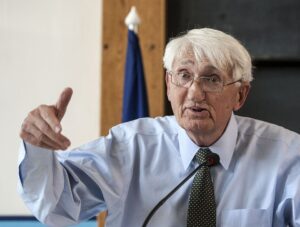
In the following years, however, after becoming a professor of philosophy and sociology first at the University of Heidelberg and then at the J.W. Goethe University in Frankfurt, Habermas started down a different theoretical path that would eventually find full expression in his mature works. Simplyfying, one can say that in the 1960s and 1970s, Habermas made a “linguistic-normative turn” and also embraced a new evolutionary theory of “modernity” as the differentiation of value spheres, which took the place of his earlier emphasis on the regressive transformation of “bourgeois society.”[6] During this time, Habermas’s appetite for liberal-democratic social and political theorists, but also linguistic, normative and even analytical philosophers from the U.S. was practically insatiable. Talcott Parsons, George Herbert Mead, John Rawls, John Searle, Saul Kripke[7] were all incorporated in different ways – if always more or less critically – into the massive theoretical edifice Habermas was constructing during this time. Of course, Habermas also incorporated many other theorists into this edifice, but his very active engagement with U.S. thinkers – which would continue into the late 1980s, as he was writing Between Facts and Norms[8] – no doubt reflected “Habermas’s respect for America as the beacon of deliberative democracy and upholder of human rights,” as Martin Jay has recently written.[9] But Habermas’s idealized, “normative” image of the U.S. – shaped much more by professors writing at leading universities than any serious engagement with the actual history of the U.S. – also blinded him to the dark sides of U.S. society, which Horkheimer, Adorno, Lowenthal and Marcuse had all recognized much more clearly.[10]
Before returning to the blind spots of Habermas’s interpretation of the U.S. as a model of liberal democracy, I would like to mention a recent study of the international reception of the Frankfurt School, which sheds important light on the differences between early Frankfurt School Critical Theory and Habermas’s “reconstruction” of it in the 1960s, 1970s, and 1980s.[11] Outside of Germany and the U.S., Habermas’s theory was often embraced in countries that were transitioning from authoritarianism – whether of the military dictatorship or the Soviet communist type – to liberal democracy in the 1970s and 1980s, such as South Korea and Brazil.[12] Even in countries, such as Yugoslavia, which had had a deep reception of the “first generation” Critical Theorists in the 1960s, it seemed to some well-informed commentators in the 1970s and 1980s, such as Nadežda Čačinovič, that early “Critical Theory had no language or concepts for what was happening in Eastern Europe in the 1980s.”[13] During this time, when “real-existing socialism” was imploding, liberal-democratic concepts, such as “civil society,”[14] seemed more promising to “dissident” intellectuals. Habermas’s Between Facts and Norms was also conceived and written during this time and it provided a useful model, not only for Eastern European critics of Soviet communism, but also for Social Democratic Parties in Western Europe which were distancing themselves from socialism and Marxism in the 1980s.[15] In short, Habermas’s theory resonated felicitously with the transition away from authoritarianism that was happening in many different countries around the world in the 1970s and 1980s, at a time when it seemed increasingly like there was “no alternative” to liberal democracy and free market capitalism.
With some notable exceptions,[16] early Frankfurt School Critical Theory had first reached a broad audience during the international protest movements of the late 1960s – above all, through interest in Herbert Marcuse’s writings, which was reinforced by his active involvement in these movements. When it became apparent in the early 1970s that the more radical demands of the protest movements would not be realized, an “academicization” of the reception of Critical Theory began in the mid-1970s, which also set the stage for the aforementioned broader reception of Habermas’s still developing work in the 1980s and 1990s. But with the multiple global financial crises and the rise of the alter-globalization movement in the 1990s, a renewed reception of the more explicitly anti-capitalist writings of the early Critical Theorists began. This reception picked up momentum after the Great Recession of 2008, which exposed clearly the chasm that neoliberal globalization had created between “Wall Street” and “Main Street.” The Great Recession also poured fuel on the fire right-wing populist backlash against neoliberal globalization, which had been underway already for some time in Europe and which exploded onto the scene in the U.S. with the sweeping success of the “Tea Party” movement in the 2010 midterm elections.[17] These historical developments, along with the election in 2016 and reelection in 2024 of Donald Trump, have sparked a renewed interest in the early Critical Theorists analyses of the links between capitalism and authoritarianism.[18] During this same time – as another recent collection of essays has demonstrated – Habermas’s “normative reconstruction” of Critical Theory, with its emphasis on the positive achievements of “modernity,” has come to seem less relevant in face of such blatantly regressive historical tendencies.[19]
To be sure, Habermas continued to update his theory in light of more recent historical developments, including his earlier analysis of the regressive transformation of the bourgeois public sphere from a space of critical debate into a platform for the passive consumption of commodified information and entertainment. A few years ago, Habermas argued that the democratic potential of social media has been undermined by its thoroughgoing commodification, which has eliminated quality control and created a fragmented public sphere no longer adequate to the crucial task of promoting rational debate and democratic will formation.[20]Although he claims that “the theory of democracy and the critique of capitalism belong together,”[21] his analysis continues to rely on an anachronistic model of welfare state capitalism that existed in the post-World War 2 decades, in which a Marxist critique of political economy was replaced by the political regulation of a market economy, which is viewed as essentially natural and non-contradictory.[22] In this model, the state is responsible not only for reducing inequality and ensuring that everyone can meet their basic needs, but also maintaining “sufficiently favorable conditions for the valorization of capital.”[23] This model is based – so Habermas – on the “political exploitation of a highly productive economic system.”[24] The precipitous rise of inequality, precarity and oligarchy in recent decades is, in other words, not so much the fault of the inherent tendencies of global capitalism itself, as of the weakening of the welfare state, and the need to create new political institutions that could provide trans-national regulation.[25]But not everyone was convinced by Habermas’s argument that – as Nancy Fraser recently put it – “a political crisis of legitimation had displaced an economic crisis of accumulation.”[26] As the ravages of neoliberalism became increasingly clear in the 1980s and 1990s, Fraser increasingly distanced herself from Habermas in order “to re-open the space foreclosed by him for a democratic-socialist alternative to ‘late capitalism’.”[27]
To return now to Habermas’s idealized image of the U.S. as the beacon of liberal democracy, it is perhaps not surprising that Donald Trump’s election in 2016 and re-election in 2024 seemed to put Habermas in a deeply pessimistic mood.[28] Habermas was certainly not alone in that sentiment, but his consternation must have been compounded by the fact that Donald Trump’s authoritarian political movement is so egregiously at odds with his own “normative” image of U.S. liberal democracy. Here, the contrast with the early Critical Theorists, who lived in the United States for over a decade, and carried out extensive empirical studies of authoritarianism here, was quite clear. The empirical studies conducted by the Institute in the 1940s led them to the conclusion that the U.S. was by no means immune to the powerful subjective and objective tendencies towards authoritarianism and fascism, which existed in all modern capitalist societies. In fact, Adorno came to view the U.S. as a “radical bourgeois society,”[29] which provide perhaps the best possible laboratory for the study of such tendencies.[30] Adorno and – to an even greater degree – Horkheimer developed a greater appreciation of U.S. democracy thanks to their “American experience,”[31] but it did not lead them to forget the dangerous tendencies towards authoritarianism that continued to exist in modern capitalist societies, even after the military defeat of fascism.
A look back at the so-called Historikerstreit (historians’ debate) in Germany in the 1980s can also help explain why a progressive West German intellectual, like Habermas, would idealize U.S. democracy. Conservative historians, such as Ernst Nolte, Michael Stürmer, and Andreas Hillgruber, sought to relativize the Nazi past in order to make it possible for Germans to identify once again with nationalist traditions, or even to identify with Germans fighting on the Eastern Front against the advancing Red Army as anticipating the later Cold War conflict.[32] Against such reactionary arguments Habermas encouraged West Germans to identify with the victorious democratic allies by adopting an anti-nationalist, “post-conventional identity” and by embracing a democratic “constitutional patriotism.” This aspect of Habermas’s argument is well known and commendable, but less attention has been paid to the historical interpretation of fascism, upon which the arguments not only of Habermas, but also his ally in this debate, the historian Jürgen Kocka, were based. In the debate, both Habermas and Kocka relied on the so-called Sonderweg (different path) thesis, which had been developed mainly by Hans-Ulrich Wehler,[33] a colleague of Kocka’s at the University of Bielefeld, and also a long-time friend of Habermas’s. According to this thesis, the primary cause of fascism in Germany was the persistence of pre-modern, “feudal” structures, particularly in areas such as Prussia whose resistance to “modernization” had set Germany upon a different historical path than other Western countries, where the development of capitalism and liberal democracy had gone hand in hand.[34] According to this interpretation of fascism, West Germans needed above all to embrace “modernization” along Western lines – with the U.S. as the most advanced model to be emulated – in order to ensure that fascism could never reoccur in Germany.[35] During the Historikerstreit, Habermas stated unequivocally that “the unconditional opening of the Federal Republic to the political culture of the West is the greatest intellectual achievement of our postwar generation; my generation should be especially proud of this.”[36] One sees clearly here that Habermas views his own work as a philosophische Westanbindung – that is, a philosophical attachment to the West — that was part of the larger attachment to the West carried out by West Germany during the Cold War period.
Against this backdrop, Habermas’s move away from the essentially Marxist theory of modern European history, which stressed the regressive tendencies of bourgeois society in the late 19th and early 20th centuries, towards a new theory of “modernization,” as the evolutionary differentiation of a value spheres, makes a lot of sense.[37] So does the vehemence with which Habermas attacked “anti-modern” tendencies in French poststructuralism in the 1980s, whose philosophical origins he traced back to the “anti-modernism” and “anti-rationalism” of Heidegger and Nietzsche.[38] Not surprisingly perhaps, Habermas also subjected Horkheimer and Adorno’s Dialectic of Enlightenment to a rather sharp critique for its failure to adequately appreciate the positive aspects of “modernity.” Although I sympathize to a certain extent with Habermas’s critique of Dialectic of Enlightenment, I think he overlooked the more compelling theory of a “dialectic of bourgeois society”[39] that one finds in Horkheimer’s writings in the late 1920s and 1930s. Furthermore, the resurgence of neoliberalism and authoritarian populism in Europe and the United States since the 1980s has made Habermas’s embrace of the Sonderweg thesis and an idealized image of U.S. liberal democracy seem much less convincing than the early Critical Theorists’ very different interpretation of capitalist “modernization” as having powerful subjective and objective tendencies towards authoritarianism and even neo-fascism. The melancholy pessimism that seems to have seized Habermas near the end of his remarkable life, could be interpreted as an expression of his shock at the re-election of Donald Trump in 2024 and the difficulty he had in mourning the loss of his idealized image of the U.S. – but perhaps also as an indication of the inadequacy of his theory to explain why real social and historical developments were diverging so drastically from the “norm.”
In response to the rise of fascism in Europe in the 1920s and 1930s, Walter Benjamin wrote: “The current amazement that the things we are experiencing are ‘still’ possible in the twentieth century is not philosophical. This amazement is not the beginning of knowledge – unless it is the knowledge that the view of history which gives rise to it is untenable.”[40] The onslaught of authoritarian and openly white supremacist policies initiated during Trump’s second term – not to mention J.D. Vance and Elon Musk’s open support for the neo-Nazi “Alternative for Germany Party” in the run-up to German federal elections in February, 2025[41] – made it difficult indeed to maintain the idealized view of U.S. history as a model of liberal democracy, which had long inspired progressive West German intellectuals like Habermas. Another view of history, which had largely been overlooked by Habermas, namely the view of the U.S. as a model for settler colonialism and institutionalized racial discrimination, which had inspired Hitler and the Nazi Party in the 1920s and 1930s, suddenly seemed more relevant.[42] As the Institute’s empirical studies of authoritarianism in the U.S. in the 1940s had made clear, neither its thoroughgoing “modernization,” nor its allegedly exceptional liberal-democratic political traditions and institutions, could guarantee against a resurgence of “pseudo-conservative” authoritarianism in the U.S.[43] Unfortunately, the early Critical Theorists’ interpretation of the U.S., as a “radical bourgeois society” located within the larger history of modern capitalism as a whole, has proven more prescient than Habermas’s interpretation of the U.S. as a normative model of liberal democracy and “modernity.”
Notes
[1] For an interpretation of the “early model of Critical Theory,” developed by Horkheimer – with the help of Erich Fromm, Herbert Marcuse, and Leo Lowenthal – in the late 1920s and 1930s, as a form of “critical historicism,” which differs from both Dialectic of Enlightenment and Habermas’s later theory, see John Abromeit, “The Critical Historicism of the Early Frankfurt School.” Journal of the History of Ideas (March, 2024) https://www.jhiblog.org/2024/03/06/the-critical-historicism-of-the-early-frankfurt-school/. The outlines of Horkheimer’s unfinished critical historicist project appear most clearly in his efforts in the mid-1930s to develop an “anthropology of the bourgeois epoch,” and a reformulation of the social philosophical foundations of Hegel and Marx’s “dialectical logic.” See, “The Anthropology of the Bourgeois Epoch,” and “Reflections on Dialectical Logic in the Mid-1930s,” in: John Abromeit, Max Horkheimer and the Foundations of the Frankfurt School (Cambridge University Press, 2011), pp. 248-335. For an interpretation of Marx’s theory of modern capitalism as a form of “critical historicism” – that is, an interpretation that rejects the transhistorical categories of “traditional Marxism” – see Moishe Postone, Time, Labor, and Social Domination: A Reinterpretation of Marx’s Critical Theory (Cambridge University Press, 1993).
[2] This would also include the traditional historicism of someone like Leopold von Ranke or Wilhelm Dilthey, which was so sharply – a rightfully – criticized by Nietzsche and Walter Benjamin.
[3] Matthew G. Specter, Habermas: An Intellectual Biography (Cambridge University Press, 2010). Specter concludes his study with the following sentence: “Not only his explicit political and legal thought but also his social theory bear the unmistakable imprint of its genesis over four decades in the Bonn Republic.” Habermas: An Intellectual Biography (Cambridge, UK: Cambridge University Press, 2010), 212.
[4] On Habermas’s relationship to Horkheimer during this time, and later, see John Abromeit, “The Personal and Theoretical Relationship Between Jürgen Habermas and Max Horkheimer,” The Cambridge Habermas Lexicon, eds. Eduardo Mendieta and Amy Allen (Cambridge University Press, 2019), 573-75.
[5] Habermas himself recently acknowledged that, of all his books, STPS “has remained my most successful to date,” but also that it “provided new stimuli for more wide-ranging historical research.” After his “linguistic-normative” turn in the 1960s and 1970s, Habermas’s writings fell out of interest among historians (with the exception of a few intellectual historians). Jürgen Habermas, A New Structural Transformation of the Public Sphere and Deliberative Politics, trans. Ciarin Cronin (Polity, 2023), 1. For a sampling of the historical research and debates that STPS stimulated, see: Habermas and the Public Sphere, ed. Craig Calhoun (MIT Press, 1992).
[6] For a perceptive examination in the shift in the 1960s and 1970s of Habermas’s theory of history away from a Hegelian-Marxist critique of the transformation of bourgeois society within the modern period, to a sweeping defense of the achievements of “modern” societies against preceding (and contemporary) “pre-modern” societies, see John P. McCormick, Weber, Habermas, and the Transformations of the European State: Constitutional, Social and Supranational Democracy (Cambridge, UK: Cambridge University Press, 2007), 43-49.
[7] When I arrived in Frankfurt in 1993, eager to study Frankfurt School Critical Theory, I found out that Habermas was teaching a seminar on Kripke’s “theories of reference.” Having just fled from a very analytically oriented philosophy department in the U.S., I was disappointed by Habermas’s course offering. Fortunately, Alfred Schmidt was offering seminars on the Enlightenment, Hegel, Marx and Critical Theory, which I attended with great pleasure and benefit. I learned later that I was by no means the first foreign student to have this experience. A generation earlier, Andrew Arato had also come to Frankfurt to study Critical Theory, only to find out that Habermas was teaching seminars on Talcott Parsons. For his recollections, see “Andrew Arato” in: North American Critical Theory after Postmodernism: Contemporary Dialogues, ed. Patricia Mooney Nickel (Palgrave Macmillan, 2012), 107-27.
[8] In the preface to Between Facts and Norms, Habermas states explicitly that he will “refer to current discussions in the Federal Republic and the United States, the two countries whose legal traditions are familiar to me.” Jürgen Habermas, Between Facts and Norms: Contributions to a Discourse Theory of Democracy, trans. W. Rehg (Polity, 1997), xl.
[9] Martin Jay, “Martin Jay’s Habermas,” The Ideas Letter (April 2, 2026), https://www.theideasletter.org/essay/martin-jays-habermas/
[10] John Abromeit, “Frankfurt School Critical Theory and the Persistence of Authoritarian Populism in the United States,” in Critical Theory and Authoritarian Populism, eds. J. Morelock (University of Westminster Press, 2018).
[11] The Internationalization of Critical Theory: Frankfurt School Receptions in Europe, the Americas and East Asia, eds. J. Abromeit, R. Melo, and L. Repa (Bloomsbury, 2026).
[12] Jaeho Kang, “The Politics of Critical Theory: The Translation of the Frankfurt School in South Korea,” and Rúrion Melo and Luis Repa, “The Reception of Critical Theory in Brazil: From Dictatorship to Redemocratization,” both in: The Internationalization of Critical Theory.
[13] Cited by Nenad Stefanov in: “Found in Translation: On the Infrastructure of the Transfer of Ideas Between Critical Theory in Yugoslavia and West-Germany,” The Internationalization of Critical Theory, p. 244.
[14] For an analysis of Habermas’s transformation of the concept of civil society – from the historicist, dynamic Hegelian-Marxist buergerliche Gesellschaft into a somewhat static and de-historicized liberal-democratic Zivilgesellschaft – see: John Abromeit, “Historicizing Habermas’s Between Facts and Norms: A Critique from the Perspective of Early Frankfurt School Critical Theory,” in: Critical Encounters with Habermas’s Political and Legal Theory, eds. J. Abromeit, M. Dimick, and P. Linden-Retek (Brill 2026), 21-44.
[15] See, for example, José Manuel Romero, “Critical Theory in Spain: A Reception in the Shadow of Habermas,” The Internationalization of Critical Theory, pp. 133-46.
[16] Recent research on the international reception of Critical Theory has revealed that Erich Fromm’s writings were read extensively in many countries around the world already in the 1950s. See for example, the essays on South Korea and Japan in The Internationalization of Critical Theory.
[17] For a good discussion of the Great Recession as the end of the “neoliberal order,” and the rise of a new historical period characterized mainly by right-wing – and also some left-wing – populist revolts against neoliberalism, see Gary Gerstle, The Rise and Fall of the Neoliberal Order: America and the World in the Free Market Era (Oxford University Press, 2022).
[18] See, for example, Critical Theory and Authoritarian Populism, ed. Jeremiah Morelock (University of Westminster Press, 2018); Wendy Brown, Peter E. Gordon, and Max Pensky, Authoritarianism: Three Inquiries in Critical Theory (University of Chicago Press, 2018); and Die Wiederkehr des autoritären Charakters: Transatlantische Perspektiven, eds. M. Clemens, T. Päthe, and M. Petersdorff (Springer, 2022). See also Claudia Leeb’s excellent new study, Contesting the Far Right: A Psychoanalytic and Feminist Critical Theory Approach (Columbia University Press, 2024), and my review of it in: The Review of Politics. 2025;87(4):601-604.
[19] See the essays by Brian Caterino and Phillip Hansen, Willian Scheuerman, John Abromeit, and Michael J. Thompson in: Critical Encounters with Habermas’s Political and Legal Theory, eds. J. Abromeit, M. Dimick, and P. Linden-Retek (Brill, 2026). Each of these essays explores this critical historicization of Habermas’s theory in different ways.
[20] Habermas, A New Structural Transformation of the Public Sphere, 30-59.
[21] Ibid., p. 80.
[22] For example, Habermas explicitly denies that modern capitalism is inherently antagonistic, when he argues that, “crises can at most be explained historically. They are not built into the structures of functionally differentiated societies in such a way that they would intrinsically compromise the project of self-empowerment undertaken by a society of free and equal subjects who bind themselves to law.” Habermas, Between Facts and Norms, 386.
[23] Habermas, A New Structural Transformation of the Public Sphere, p. 27.
[24] Ibid., p. 79.
[25] On Habermas’s efforts to theorize a supranational constitutional and welfare state, see John McCormick, Weber, Habermas, and Transformations of the European State: Constitutional, Social and Supranational Democracy (Cambridge University Press, 2007), 176-286.
[26] Nancy Fraser, “After Habermas,” London Review of Books blog (March 25, 2026).
[27] Ibid.
[28] In 2024, Habermas wrote to Martin Jay, “I am more pessimistic than any time so far” in regard to the “depressive [sic] state of our countries.” Martin Jay, “Martin Jay’s Habermas,” The Ideas Letter (April 2, 2026), https://www.theideasletter.org/essay/martin-jays-habermas/
[29] Theodor Adorno, “Über Tradition,” in Theodor Adorno, Gesammelte Schriften in 20 Bändern, ed. Rolf Tiedemann, vol. 10.1, Ohne Leitbild: Parva Aesthetica (Frankfurt: Suhrkamp, 1986), 310.
[30] John Abromeit, ““The Concept of Pseudo-Conservatism as a Link Between The Authoritarian Personality and Early Critical Theory,” Polity: The Journal of the Northeastern Political Science Association, vol. 54, no. 1 (January, 2022), 29-58.
[31] Detlev Claussen, “Die amerikanische Erfahrung der Kritischen Theoretiker,” Keine Kritische Theorie ohne Amerika (Neue Kritik, 1999), 27-45.
[32] For a documentation and English translation of the various contributions to the debate, see: Forever in the Shadow of Hitler? Original Documents of The Historikerstreit, the Controversy Concerning the Singularity of the Holocaust, trans. by James Knowlton and Truett Cates (Humanities Press. 1993).
[33] Hans-Ulrich Wehler, The German Empire, 1871-1918, trans. Kim Traynor (Berg Publishers, 1985.
[34] For example, Habermas criticizes Hillgruber – who took umbrage at the Allies complete dismantling of Prussia after World War 2 – for not realizing that “the structure of power in the [Third] Reich could actually have something to do, as the Allies assumed, with the social structure especially well preserved in Prussia.” Jürgen Habermas, “A Kind of Settlement of Damages,” New German Critique 44 (Spring – Summer, 1988), 36.
[35] For an early, trenchant critique of the Sonderweg thesis and its implications for the interpretation of the historical causes of fascism in Germany, see Geoff Eley, “In Search of the Bourgeois Revolution: The Particularities of German History,” in: Political Power and Social Theory, vol. 7 (1988), pp. 105-133. In the article Eley criticizes “the simple continuity thesis that locates Germany’s vulnerability to fascism in ‘pre-industrial’ blockages of ‘modernization’,” and he argues that “Germany’s failure to develop a native liberalism of more vitality may have lain with the conditions of capitalist reproduction themselves, and not with the continuing domination of a ‘pre-industrial power elite.’” (125)
[36] Ibid., 43.
[37] On this “transition in Habermas’s thought from an interepochal analysis of transformation to a more intraepochal one of crisis,” (57) in which “Habermas no longer relies on contradictions immanent to different stages of and exclusive to modernity to identify objective possibilities for and constraints on emancipation” (58), see John McCormick, “The Transformation of Habermas’s Theory of History,” in his Weber, Habermas, and Transformations of the European State: Constitutional, Social and Supranational Democracy (Cambridge University Press, 2007), pp. 49-59.
[38] Jürgen Habermas, The Philosophical Discourse of Modernity, trans. Frederick Lawrence (MIT Press, 1987).
[39] On the concept of a “dialectic of bourgeois society” as central to Horkheimer and the Institute’s Critical Theory in the 1930s, see John Abromeit, “Genealogy and Critical Historicism: Two Concepts of Enlightenment in the Writings of Max Horkheimer and Theodor Adorno,” Critical Historical Studies, vol. 3, no. 2 (Fall, 2016), 283-308.
[40] Walter Benjamin, “Theses on the Philosophy of History,” in: Illuminations, ed. Hannah Arendt, trans. Harry Zohn, 257.
[41] While at the Munich Security Conference, on February 14-16, Vance refused to meet with the sitting, Social Democratic Chancellor of Germany, Olaf Schulz, but he did meet (outside of the conference) with Alice Weidel, the leader of the A.F.D. Musk also held a 74-minute virtual conversation with Weidel on January 9, 2025.
[42] James Q. Whitman, Hitler’s American Model: The United States and the Making of Nazi Race Law (Princeton University Press, 2017). Carroll P. Kakel, The American West and the Nazi East: A Comparative and Interpretive Perspective (Palgrave Macmillan, 2011). I don’t have the space here that would be to analyze in an adequately nuanced manner Habermas’s controversial intervention in defense of Israel after the Hamas attacks on October 7, 2023. However, the problematic assumptions that underlay it, were revealed more clearly when Habermas refused to defend fellow Critical Theorist – and Jew – Nancy Fraser, whose appointment to an academic position in Germany at the University of Cologne was rescinded because she had signed an open letter criticizing Netanyahu’s scorched earth policies in Gaza, and ethnic cleansing in the West Bank. Here, too, it seems that Habermas refused to acknowledge the negative – that is, racist and settler colonial – aspects of Israeli history and society, a country which has also used its status as a formal democracy – the “only democracy in the Middle East” – to deflect criticisms of its brutal policies against Palestinians. On Fraser’s disinvitation by the University of Cologne, its link to a new “philosemitic McCarthyism” (Susan Nieman) in Germany, and Habermas’s dubious reticence in this case, see:Nancy Fraser, “Gaza as World Event,” New Left Review 158 (March-April, 2026), 49-64.
[43] John Abromeit, “The Concept of Pseudo-Conservatism as a Link Between The Authoritarian Personality and Early Critical Theory.”
Author

Latest Issue
2026: Vol. 25, No. 2
Latest Issue
2026: Vol. 25, No. 2

Essays
Essays
By Thomas Kleven: White Supremacy, White Insecurity, and the Struggle for a More Egalitarian Social Order
Essays
Essays
Essays
Essays
Essays
Essays
Essays
The Legacy of Jürgen Habermas
By Gordon Finlayson: Habermas’s Legacy: The Philosophy of the Public Sphere
Essays
The Legacy of Jürgen Habermas
By Kenneth Baynes: Habermas’s Case for Democracy: the Public Sphere, Communicative Reason and the ‘Co-originality’ of Public and Private Autonomy
Essays
The Legacy of Jürgen Habermas
By John Abromeit: Jürgen Habermas’s Image of the United States as a Model of “Modernity”: From Attachment to Melancholy
Poetry
Allen Ginsberg's Centennial
Poetry
Allen Ginsberg's Centennial
Poetry
Allen Ginsberg's Centennial
Poetry
Allen Ginsberg's Centennial
By Eileen Myles: Jan. 25
Poetry
Allen Ginsberg's Centennial
By Jim Cohn: For Allen Ginsberg, on His 100th Birthday (3 June 1926 – 3 June 2026)
Poetry
Allen Ginsberg's Centennial
By Eliot Katz: Letter to Allen on the State of the State, March 2026
Book Reviews
By George Lundskow: Cynthia Miller-Idriss’ Man-Up: The New Misogyny and the Rise of Violent Extremism
Book Reviews
Book Reviews
By Benjamin Heim Shepard: Jeremy Varon’s Our Grief is Not a Cry for War
