Joseph Strausbaugh’s Duchamp Takes New York
It is difficult, even now, to grasp how many revolutions—artistic, political or economic—exploded during the 1910s and how thoroughly they have been digested and turned against their best purposes. Or perhaps this is too easy and gloomy of an interpretation. A century is a blink in human history, and the effects have not been erased, or we would be living in a world of untroubled global capitalism, liberal in doctrine, predatory in practice. Instead, we have…troubles, good and bad alike.
Blame Marcel Duchamp! He epitomizes the break in thinking about art, the social and political ways of thinking with the art creation and beyond it. He is the soul, so to speak, of the Armory Show of 1913, introducing the “moderns” to a confused but still mostly old fashioned American culture. And then, even more so, he epitomized Dada, which did not get far in the US as a European-based, antiwar movement but left other tracings far beyond MOMA—which seemed to many to have been a realization that finished off earlier proto-revolutionary content.
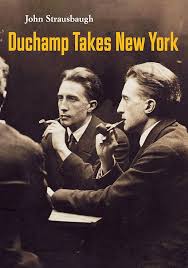
We are talking about his grand entrance with a singular art piece, Nude Descending a Staircase. Introduced to us as a “longtime chronicler” of Manhattan, John Stausbraugh. There it was amidst paintings of artists already famous, offering the thousands of viewers sources of amazement and….satire. The Armory Show’s publicist happened to be a daily cartoonist for a Brooklyn newspaper, and the Nude soon proved to be the subject of more satirical drawings, cartoons to strips, than any other item, stretching out into the 1920s if not beyond.
Stausbraugh cogently explains a primary reason. Americans, those who counted and perhaps the educated classes at large, looked to art for practical, functional uses. Popular arts seemed closer to the circus, to the older moon-spoon-June (and Mother) sheet music and the emerging jazz, including the notorious youthful “jazz dancing” of the big cities, associated with park benches, modern “spooning” and related sexual activities.
This generalization does not hold for the 1910s, for one good reason: Ashcan Art and the politically radical, free love spirit of Greenwich Village at its apex. A circle of artists “discovered” the working class and the slums as subjects for their work, and they did it publicly, spectacularly in an ardently socialist magazine, The Masses, suppressed in 1917 for antiwar views. Ashcan has remained the favorite for the Left ever since, an anticipation of the better WPA murals of the 1930s-40s, the urban murals of the 1970s, avowedly race-conscious art and perhaps even agitational, leftwing realist art of recent decades (think Elizabeth Catlett). Is this leftish, more political realism another and competing form of modernism? The question hangs fire.
The puzzle at hand in Duchamp Takes New York is smaller but fascinating: why Duchamp’s own revolution seemed to have been swallowed up so successfully by the mainstream. Perhaps we can unravel this by starting with Duchamp himself. Born in 1887 in a bourgeois Normandy environment, he began painting early, trying out different emerging styles. His pals, Francis Picabia and Guialllme Apollinaire, would be giants, more aggressive and even violent in their work. Young Duchamp discovered himself, so to speak, in 1912 with the famed painting evidently inspired by Muybridge’s photographic studies. The Parisian art establishment, revolutionary enough to accept Cubism, viewed it initially as a satire on Cubism, which is very funny if you think about it. Where would Cubism be without Duchamp’s Nude?
He did two other things that were, arguably, only one other thing. Creating a sort of accidental art, he claimed he had “unlearned to draw.” In the same years, he discovered “Readymades” for himself, taking things off the street and with little effort, signing them as his own. Compared to this stuff, the large glass construction comically titled The Bride Stripped Bare By Her Bachelors, Even (in the English language translation) would more likely be seen as provocation than creation. Like the famous and these-days much discussed, satiric photo of himself as female, “Rrose Sálivi,” it is life!
Never mind. Back in France, Duchamp was called up to service in the fast-breaking war, escaping by a return to New York, where he received an absurd degree of press attention. Perhaps American journalists and their editors (and their owners) were seeking something unrelated to war, as it became clear that the antiwar public mood (“He kept us out of war,” Woodrow Wilson’s winning campaign slogan of 1916) could be shifted to safer ground. Here, proclaiming the land of the new to be superior to the old (aka troubled Europe, mired in age-old quarrels, and never mind that the modern pursuit of empire was at the root), Duchamp and others launched an artistic revolution, without seeming to connect with those other artistic-political revolutionaries in New York. Or are we missing something?
Duchamp claimed to be a loner, but he had plenty of surrounding pals, admirers and women. He gained life-long friends, especially the Jewish artist from Baltimore who renamed himself Man Ray, and also Florine Stettheimer. They all had rich parents, of course. Man Ray’s photographic studies of nudes, especially one nude, introduced a style of modernist photography. Stettheimer proved more shocking yet with a full-frontal painting of her 45 year old self.
Meanwhile, Dada emerged in Europe as a militantly anarchist, antiwar movements of art and culture. Duchamp backed away from political commitments, as always, even when some of his closest friends moved into what would become, in a few years, the avowedly revolutionary Surrealist movement. Duchamp’s revolution was strictly artistic and simultaneously anti-artistic, the toilet that he signed “R. Mutt” and put up for exhibition. Said urinal, as the author points out, disappeared after being exhibited and was apparently never seen again. The gesture was the point.
By the time Duchamp had abandoned New York for Argentina in 1917, an exhibit of modern art twice the size of the Armory Show had made another, if less dramatic, splash. The splashy art most noted happened to be a creation of his friend Beatrice Wood, the painting titled, in mangled French, Un peu d’eau dans du savon, “a little water in soap,” described by Strausbraugh as “a female nude in a bath tub with a bar of soap covering her public area” (p.69), Duchamp had made the decisive suggestion of adding an actual bar of soap glued to the decisive spot. It was a prank that the crowds loved.
Had his paintings and constructions really changed the course of modern art, as the author and numerous critics have asserted? Not in content, surely, but in form, most definitely. Nothing, certainly no construction, could be forbidden, and by that measure “art” became bigger and more amorphous, perhaps even more democratic, although maybe not. Would the art of the next century be decided by speculations of market value, or, in the other direction, by mostly young graphic novelists going their own way?
Duchamp’s actual role as artist expired just in time for his role as informal promoter, no effort more important the inspiring Manhattan socialite Peggy Guggenheim to take up collecting and making exhibits possible, both in the US and in Europe. Duchamp himself became a part time art dealer. Guggenheim rushed to Paris in 1939, as the Germans moved ever-closer, buying up all the modern art that she could, for safety and transport. A considerable quantity of “degenerate” art thus escaped Nazi devastation. Duchamp, postponing his exit until 1942, landed in New York in time to become a human centerpiece in the shift of the art world’s center from the Old World to the New. No one would have guessed that Time magazine magnate Henry Luce would correctly declare later that money made all the difference.
The Guggenheim Museum, as an upstart rival to MOMA, had a lot to say for itself, including the recognition of John Cage, music’s prime modernist. The first Guggenheim exhibit, opening in 1942, showed modernist paintings and constructions of all kinds, and arguably took Surrealism from a quiet (and notably gay) corner of the American art-and-bohemianism subculture out into the light. Leonora Carrington, Joan Miro, Roberto Matta and others reached wide audiences from here.
So did Jackson Pollock, Mark Rothco and Robert Motherwell among others, a first large look at the Abstract Expressionism that would become dominant in a decade. The Guggenheim exhibit of women artists’ work, including Frieda Kahlo, Dorothea Tanning and Meret Oppenheim, had no such lasting impact, but Peggy Guggeheim, urged on by Breton and Duchamp, had tried.
Duchamp remained a celebrity in wartime New York, despite his best efforts at insularity. The first magazine to offer him a special issue, View, combined fondness for Surrealism with an atmosphere of homosexual eros, renewing as always the studied sexual ambiguity of Duchamp himself ever since the famed 1915 of himself photo in drag. Many had wondered and still do. His marriages were of little importance to him but he had a lot of female lovers and no known men. The fears of the time? Or a game he was playing?
With a big spread in Life magazine, Duchamp had already become as famous as he ever wished to be. Abstract Expressionists themselves did not really like his readymades. But modernists in assorted arts paid homage, including dance modernist Merce Cunningham, who revered and even sought to adapt his work. That he died in the wake of the Parisian student uprising of May, 1968, may be ironic or suitable. Etant Donnes, a quasi-erotic work appearing only after his death, was made of all kinds of objects and featured a peep hole offering a view of a woman’s vagina. Friendly critics considered it a fitting sendoff to a life of provocation.
And it posed the same questions. Is provocation enough for an artist’s life’s work, or do we wish for commitment to make an artistic contribution to the radical dreams of social transformation—by now, reduced to hopes—of our time? Duchamp contributed greatly in form, but it was never clear that he intended to contribute to content. Perhaps it was enough, until the multiple tragedies of the 1940s, to merely play the jokester. Then again, the emergence of a feminist, gay and lesbian art, breaking from the limitations of Abstract Expressionism in multiple ways—women artists physically “embodying” the new art forms with images of themselves during the 1960s-80s, would be proof enough. Artists could freely make use of his contributions and see him as an inspiration. Hail Duchamp! But not without some useful criticism.
Author

Latest Issue
2026: Vol. 25, No. 2
Latest Issue
2026: Vol. 25, No. 2

Essays
Essays
By Thomas Kleven: White Supremacy, White Insecurity, and the Struggle for a More Egalitarian Social Order
Essays
Essays
Essays
Essays
Essays
Essays
Essays
The Legacy of Jürgen Habermas
By Gordon Finlayson: Habermas’s Legacy: The Philosophy of the Public Sphere
Essays
The Legacy of Jürgen Habermas
By Kenneth Baynes: Habermas’s Case for Democracy: the Public Sphere, Communicative Reason and the ‘Co-originality’ of Public and Private Autonomy
Essays
The Legacy of Jürgen Habermas
By John Abromeit: Jürgen Habermas’s Image of the United States as a Model of “Modernity”: From Attachment to Melancholy
Poetry
Allen Ginsberg's Centennial
Poetry
Allen Ginsberg's Centennial
Poetry
Allen Ginsberg's Centennial
Poetry
Allen Ginsberg's Centennial
By Eileen Myles: Jan. 25
Poetry
Allen Ginsberg's Centennial
By Jim Cohn: For Allen Ginsberg, on His 100th Birthday (3 June 1926 – 3 June 2026)
Poetry
Allen Ginsberg's Centennial
By Eliot Katz: Letter to Allen on the State of the State, March 2026
Book Reviews
By George Lundskow: Cynthia Miller-Idriss’ Man-Up: The New Misogyny and the Rise of Violent Extremism
Book Reviews
Book Reviews
By Benjamin Heim Shepard: Jeremy Varon’s Our Grief is Not a Cry for War
