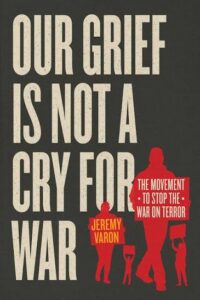
Jeremy Varon’s Our Grief is Not a Cry for War
With the US interventions from Iran to Venezuela, Jeremy Varon’s Our Grief Is Not a Cry for War: The Movement to Stop the War on Terror is a reminder of all that can go wrong. “War is hell,” said General Sherman as Union troops moved to Atlanta in 1864; war is hell, then and now, leaving wounds extending generations, war-torn from the Civil War to Iraq and inevitably Iran. This was Simond Freud’s (1920, 1955) insight working with his patients, back from WWI, with wild dreams, “occurring in traumatic neuroses … bringing the patient back into the situation of his accident, a situation from which he wakes up in another fright”. Freud studied the trauma among veterans, many with bouts of amnesia, followed by violent dreams of the unsayable, manifestations within unconscious activity, opening an investigation into memory and forgetting. People repeat themselves when they are stuck, that is, until they gain insight, hopefully. Some never do. We repeat. These are wounds that we do not talk about, hence the repetitions (Caruth 1955). Unless we learn from them or work them through, we repeat them, as we’ve seen a great of deal recently. Jeremy Varon’s Our Grief Is Not a Cry for War is a testament to this. Full of stories of death, vengeance, and a lurch into war justified by deceit, followed by news of Abu Ghraib prison, near Baghdad, the site of human rights violations when U.S. forces detained thousands of Iraqis between 2003 and 2006. We all saw the photos of systemic physical and sexual abuse, the beatings, electrocution, and forced nudity, followed by the conviction of several U.S. soldiers. Perusing Varon’s 476-page study, many of the same vacillations, the stories of war, of forced interrogation, of detention, the same horrors, the same nightmares, including a few of my own, come to the surface, images of wave after wave of activism, demos, protests in the rain, gestures of futility, sound and fury, arrests, on and on.
After returning from a honeymoon in Istanbul in late August 2001, participating in a spring of protests for AIDS drugs, access to medicines across borders, it felt like the world was opening up. I was on my way to classes uptown at the City University of New York that morning of the 11th of September. Walking to the F train just after 8:45 AM, a man ran up to me to declare someone had flown a plane into the World Trade Center, at 8:46 AM. I thought nothing of it. Crazy people do crazy things every day here. I walked to catch the F train to the city. Riding into Manhattan, a second plane, United Airlines Flight 175, struck the South Tower of the World Trade Center at 9:03 a.m. Walking out of the train at Bleeker Street in Manhattan, my transfer was closed. No trains uptown. A mystery gripped the city, a strange energy emanating. Still, the morning rush hour careened upon us, bodies walking, seemingly unaware, news slowly dawning on them. I got on the bus uptown. Another plane had been hijacked, someone said, entering the bus. It crashed into the Pentagon, said someone else. I was starting to get scared. The next stop, someone came in screaming it must have been Osama Bin Laden. Don’t jump to conclusions, I thought to myself. By the time the bus dropped me off at 77th Street, a full moral panic had grasped the city. We still actually had class. Harold Weissman, an old sixties type from Mobilization for Youth, asked us to think about war and peace, suggesting we were entering a time of war. But no one could concentrate. Smoke filled the sky. I walked back downtown to catch the train home. A few veterans of the Global Justice Movement, including LA Kauffman and I met at Union Square the next morning. There, we talked about the movement we’d been a part of, transforming into a peace and justice movement. Action after action filled the days to come, my friends blocking traffic at rush hour. Another morning, I never made it to class. Security arrested us, dressed as vampire billionaires celebrating war profiteering at the Carlyle Group, where the father of the current president, who was once president himself, was advising people to invest in defense portfolios. “[R]iot police arrested without warning ninety-four protesters peacefully protesting,” writes Varon. “They were there to protest the Carlyle Group, an investment firm with extensive ties to the military sector and ties to the Bush family. New York City paid a massive settlement for the arrests illegal arrests,” notes Varon (p. 206). I never got to take off my top hat, even in jail. We missed work, therapy appointments, litigated, forced our doctors to testify about stress and won a huge settlement. It’s strange to read Varon’s story of how we responded, the things activists said and did.
On Feb 15th, 2003 in the largest demonstration in world history. As I wrote on February 18th, 2003:
“Despite the state imposed barriers, activists from all walks of life descended on the city. The day of the march, the police sent horses to break up the marches… My father, a 66-year-old retired pastor, who was in town over the weekend observed, “We started out at 51st St, then 57th, then 62nd, and then 68th up 2nd Avenue. At 68th Street, we realized we were being pushed out of town. Every time we’d try to turn down to go to the rally, the police would push us up away from the rally. It was perfectly clear that was what they were trying to do. It was crowded like a VE day. They brought out batons to push us and we chanted, ‘Let us through!!! Let us through!!!’ Every time it would calm down, the police would try to stop us, yet most of us broke through anyway. I was just a citizen trying to gather with other citizens to have a conversation with the President,” (Shepard, 2003).
Over half a million marched through the streets of New York, in coordination with protests held around the world; 700,000 mobilized in London, one million in Rome. All weekend long, the protests were the top news story. Many described the day as the largest day of simultaneous peaceful protest in world history. Two days later, the New York Timescompared the weekend’s mobilization with the Velvet Revolution of 1989 and the Revolutions of 1848. The discussions of Feb 15th are a centerpiece of Jeremy Varon’s Our Grief is Not a Cry for War, a gripping account, told with a historian’s eye and an activists sensibility. The stories Varon traces work much the same way as Freud’s trauma narratives, “bringing the patient back into the situation of his accident, a situation from which he wakes up in another fright”. At least this was the case for me, reading along, tracing my reactions to Varon’s vivid accounts of this nightmare of history, back to the scene of the crime, to the war, the time when it felt like it all fell apart.
October 6th, 2025, I rode up to join Jeremy Varon for the launch of his book at Rizzoli Books. Walking into the event, I ran into Andrew Boyd, a veteran of those anti-war demos from a quarter century prior, who walked in with me. There was Leslie Cagan, who organized the demos, our heartbreak lingering. The reading has already started, Jeremy unpacking the pieces, unravelling the layers of our distant past, a peace movement that tried to stop a war. “Any time there is a great injustice, we need to document who spoke out, about this preventable on a large scale….” says Varon, tracing the toll of casualties from the US War on Terror, some 38 million displacements, 4.5 to 4.7 million deaths, in Afghanistan, Iraq, Syria, and Yemen, a massive human cost, impacting millions more. “Millions of people around the world, with a Cassandra- like accuracy, laid out what would happen. Again and again, the anti-war movement was right,” says Varon. “I wanted to save the movement from forgetting, from oblivion. Some turned their lives upside down to participate.” Listening, my mind trailed back to jails in Lower Manhattan, bust after bust during those years, lost time, classes, police, traffic, cascades of bodies, police in riot gear for years. “I wanted to put them on record with the abolitionists…. 2001 was the high water mark of the global justice movement… to address global inequality, dire poverty… the prosperity of the few depends on the misery of the others… 9/30, the convergence around the IMF meetings in Washington was planned with the IMF / World Bank and fire-breathing anarchists. Some 10,000 had committed to engage in forms of non-violence civil disobedience. After 9/11, these demonstrations were canceled. The movement never got its feet back, 911 decimated it,” says Jeremy, recalling the 30 million who took to the streets around the world to oppose the invasion of Iraq. “The anti-war movement changed in composition and size. Bush said you are either with us or against us. 9/11 opened the gates of hell. This war is never going to end.” Family members who lost someone worried their loss was going to be repeated, or exploited exponentially. Our grief is not a cry for war, they repeated. “After 9/11 the US had the sympathy of the world. This soon dissipated. The sense of the old ugly American neoliberal agenda reappeared soon enough, the image the world saw with Vietnam. The invasion of Afghanistan was one thing. But Iraq did not bomb us.
While no one wanted Saddam Hussein, few wanted us to invade Iraq. Feb 15, 2003, the World Says No to War was the biggest single day of protest in world history,” says Jeremy, who I saw in the streets frequently during those days, still do. It was one of the craziest days of my life. We all participated in demonstrations. Dad worked with others to break the police barricades, police clashing with protesters all day long. That day of protest Some 15-30 million people protested around the world, millions in world cities. “That wasn’t enough to stop it,” says Jeremy. The media followed, parroting the jingoism. “The coverage of war as it happened had nothing to do with how it happened. Today feels a little like 2004, says Jeremy, into this post truth delusional world. We knew there were no weapons of mass destruction, but still the US went forward and re elected Bush, even with the image of Abu Ghraib prison, torture and prisoner abuse. He even won the popular vote this time. You can’t let that sense of defeat throw you off. You just can’t. The movement moved beyond the drab rituals of dissent into profound rituals, Camp Casey anti war protest in Crawford Texas. The movement delegitimized the Iraq War. There’s no glory in being proven right. The antiwar movement played a role in turning the opinion against the war. But so did the failure around the response to Hurricane Katrina. ‘Heck of a job Brownie,’ said Bush to his friend, responsible for the Katrina air. If he was this delusional around Katrina, what could he be thinking around Iraq, many thought. Who knows if reality will prevail, wonders Varon, turning to the present moment. A woman in the audience laughs out loud. There’s so much damage that has been done. A failed coup against our democracy and constitution. And the people rewarded this with a second term. As a historian, who we are is so wrapped up in what we do to understand our past to have been,” Jeremy concluded. Tears in my eyes, thinking about Dad now gone, the cycles of history, Andrew’s French Bread for Peace block from those peace marches, I rode home, recalling our losses and striving. There would be a lot of tears thinking about what we lost, the shattered assumptions and beliefs, the losses rendered invisible, the unsayable manifest in vivid dreams.
Varon reminds us that this struggle between memory and forgetting, between amnesia and ignorance, we’ve been at it for a long time. 2025 feels a little like 2004, when Bush was re-elected, says Varon, taking us back to the days we wanted a peace movement in New York. “The only way to prevent it from happening HERE again is to prevent in from going on ANYWHERE ELSE,” wrote Slavoj Žižek on October 29, 2001 (p. 15). If only. Varon elaborates, reviewing the initial responses to 9/11 and the waves of activism which followed:
“With Will, Žižek and other critics share the premise that 9/11 ended America’s deceptive separation from the world. But there the similarities end. To the critics, the myth of exceptional virtue collapsed with the towers, revealing the likeness between America’s violence and that of its enemies. However stinging, their point was not to proclaim the moral equivalence of tit-for-tat violence. Instead, it was to present existing global conflicts as the essential context for 9/11 and to recommend humility—not martial pride—as the response.”
A quarter of a century later, it’s hard to see much of that humility. Quite the contrary.
Chapter by chapter, Varon uses his historian’s craft to navigate the machinations of meaning-making, the soul searching, absurdist, sometimes dreary, often compelling antiwar demos, opposing the bloodthirsty manipulation by those with little interest in the lessons of our history. Navigating the stories of the activists, who took risks, who blocked traffic, who disrupted business as usual, old interviews, and new, Varon crafts a narrative, making sense of what happened. He asks what it meant after the bombings, as recrimination followed, the US playing footsie with torture, using Orwellian language and legal maneuvers to erode habeas corpus.
A day before the bombings, Bill Ayers’ memoir of his days with the Weather Underground, Fugitive Days, was first published in 2001. The work assessed the lessons of the movement to oppose the Vietnam War in the US. Two years later, Jeremy Varon expanded on this investigation with his 2004 work, Bringing the War Home: The Weather Underground, The Red Army Faction, and Revolutionary Violence in the Sixties and Seventies. In it, Varon explores Max Weber’s conception of the state’s unique power as a “monopoly of the legitimate use of physical force”. He compares the left-wing violence in the United States and West Germany, contrasting the motivations and ideologies of two distinct groups that rejected pacifism. Like Howard Zinn, Varon synthesizes questions about activism with scholarship, reminding us that inquiry matters; history matters. You can’t be neutral on a moving train.
A longstanding veteran of social justice struggles, Varon (ND) has participated in movements “for divestment from apartheid South Africa; opposition to CIA campus recruitment; HIV/AIDs activism; the movement for global economic justice; and opposition to the 1991 and 2003 Iraq wars.” Since 2005, he has been a leading member of Witness Against Torture …His work with the group is a subject of an oral history conducted by Columbia University for its “Guantanamo Bay Oral History Project.” Varon brings all these experiences into this study.
With the US in another war for oil, the history of our current moment extends in countless directions. These are tributaries that Varon navigates. “Once in every generation, without fail, there is an episode of hysteria about the barbarians,” writes Coetzee in Waiting on the Barbarians, his 1980 novel of memory and empire, seeming to paraphrase Faulkner, who set his own imprint on the conversation with the understanding, “The past is never dead. It’s not even past” (1951, p.73).
Varon reminds us of the activists compelling us to face the costs, the Veterans for Peace, LA Kauffman and Leslie Cagan, who organized mass rallies with United for Peace and Justice, Cindy Sheehan, whose son died in the war, and her Camp Casey, named after the U.S. Army Specialist Casey Sheehan, who perished in Iraq in 2004. When President Bush declared Americans killed in the war had died for a “noble cause” in 2005, Sheehan set up camp near Bush’s vacation home in Crawford, Texas to ask what exactly that noble cause was? The Downing Street memo of May 2005 had eroded trust in the explanation for the Iraq War; a “smoking gun.” It cast significant doubt on the official justifications for the Iraq War, documenting that as early as July 2002—eight months before the invasion—British officials believed military action was “inevitable” and that in Washington, the “intelligence and facts were being fixed around the policy” of removing Saddam Hussein. Bush spent August 2005, some five weeks in Crawford, Texas, his 49th trip there, dodging questions from Sheehan and those camped in Crawford, asking what exactly was the point of the Iraq war, that had left their family members dead?
With both firsthand observation of the anti-war movement, its ideas, and arguments, Varon reminds us where we’ve been. Our Grief is Not a Cry for War is a story of a collective nightmare as well as a lost opportunity for humility, instead of vengeance. This is a history of permawar with scars stretching from WWI through WWII, Eisenhauer’s warnings about the dangers of the “military industrial complex,” through the emergence of the PTSD diagnosis after the Viet Nam War, the War on Terror, and our current Orwellian battles against memory.
“It’s very dangerous to forget,” said Iraq’s Omar Mohammed… “because memory is all that is left for us… everything I have has been destroyed.” Memory is “the great enemy of forgetting,” says Varon (p. 369). “This book hopes to play a small role in the battle against” amnesia, he goes on, “exploring the efforts of Americans to oppose the War on Terror. Millions of people engaged in countless actions of protest…” Varon concludes. He summarizes the reasoning for this research with three core points. First, “The perpetration of grave injustices such as those of the War on Terror entailed raised the question of who spoke up and why,” (p. 370). Second, “I seek to guard against any revisionism, insisting that the great hazards of what became failed US wars in Afghanistan and Iraq were both unforeseen and unforeseeable. With remarkable clarity, anti-war voices predicted the geopolitical and moral disaster of much of the war on terror before it took place, (p. 370). And three, “Knowing this past may help us prevent the next reckless war.”
This last line seems to be the line of the book, with all its emotional urgency. But can we “prevent the next reckless war” ? With interventions in Venezuela and Iran since the book came out, it’s not clear. Asking the US to reflect on history is a tall order. Yet, Varon is right to do so.
Our Grief is a Cry for War is a living history. Between the recent present, past, bad dreams, and policy mistakes, Varon has scoured the records to turn lived memory into history. With his excavation of primary sources, interviews, and personal observation, as well as a historian’s eye, Varon’s study is persuasive and essential reading. Varon does a spectacular job of tracing this most unpleasant of stories of terror, nightmares and torture chambers, to offer a plea for humility, for clarity, for history. Can we learn from its lessons? I hope so. But it still feels like we are stuck.
Notes:
Caruth, C. 1995. Trauma: Explorations in Memory. The Jones Hopkins University Press: Baltimore, Md.
Coetzee, J. M. (1980). Waiting for the barbarians. Penguin Books.
Faulkner, W. (1951). Requiem for a nun. Random House
Freud, S. (1955). Beyond the pleasure principle (J. Strachey, Trans.). Standard Edition of the Complete Psychological Works of Sigmund Freud (Vol. 18). Hogarth Press. (Original work published 1920).
Shepard, B. 2003. Breaking Through the Panic. 18 February. https://www.counterpunch.org/2003/02/18/breaking-through-the-pan
Varon, J. nd. https://www.newschool.edu/nssr/faculty/jeremy-varon/
Author

Latest Issue
2026: Vol. 25, No. 2
Latest Issue
2026: Vol. 25, No. 2

Essays
Essays
By Thomas Kleven: White Supremacy, White Insecurity, and the Struggle for a More Egalitarian Social Order
Essays
Essays
Essays
Essays
Essays
Essays
Essays
The Legacy of Jürgen Habermas
By Gordon Finlayson: Habermas’s Legacy: The Philosophy of the Public Sphere
Essays
The Legacy of Jürgen Habermas
By Kenneth Baynes: Habermas’s Case for Democracy: the Public Sphere, Communicative Reason and the ‘Co-originality’ of Public and Private Autonomy
Essays
The Legacy of Jürgen Habermas
By John Abromeit: Jürgen Habermas’s Image of the United States as a Model of “Modernity”: From Attachment to Melancholy
Poetry
Allen Ginsberg's Centennial
Poetry
Allen Ginsberg's Centennial
Poetry
Allen Ginsberg's Centennial
Poetry
Allen Ginsberg's Centennial
By Eileen Myles: Jan. 25
Poetry
Allen Ginsberg's Centennial
By Jim Cohn: For Allen Ginsberg, on His 100th Birthday (3 June 1926 – 3 June 2026)
Poetry
Allen Ginsberg's Centennial
By Eliot Katz: Letter to Allen on the State of the State, March 2026
Book Reviews
By George Lundskow: Cynthia Miller-Idriss’ Man-Up: The New Misogyny and the Rise of Violent Extremism
Book Reviews
Book Reviews
By Benjamin Heim Shepard: Jeremy Varon’s Our Grief is Not a Cry for War
